
If you or a loved one was hurt by a driver with no insurance or too little insurance, a Brunswick Ocean Highway US 17 underinsured motorist lawyer can be the difference between a stack of unpaid hospital bills and a full recovery. A high-speed crash on the four-lane US 17 (Ocean Highway / GA 25) corridor can leave you with injuries that far exceed the at-fault driver's coverage — and in Glynn County, that gap is common. This guide explains how uninsured and underinsured motorist (UM/UIM) coverage works under Georgia law, why your own policy often becomes the source of your recovery, and the deadlines and traps that can quietly cost you the claim.
Key Takeaways
- In Georgia you have 2 years from the date of injury to file a personal injury lawsuit (O.C.G.A. § 9-3-33) — but your UM/UIM policy's notice deadline can be much shorter, so act early.
- Georgia's minimum liability limits are only $25,000 per person / $50,000 per accident — often exhausted by a single ER admission after a US 17 crash, which is what makes UIM coverage decisive here.
- Under O.C.G.A. § 33-7-11, Georgia insurers must offer UM/UIM coverage; you elect either "add-on" (stacks on top of the at-fault driver's limits) or "reduced-by" coverage (offset by them).
- Hit-and-run and phantom-vehicle crashes are handled as uninsured motorist claims under O.C.G.A. § 33-7-11 — but corroboration is required when there was no physical contact.
- You must serve the UM insurer with the lawsuit to preserve the claim — suing only the at-fault driver is a trap that can forfeit your UM recovery.
- Glynn County injury suits are filed in the State Court or Superior Court of Glynn County in Brunswick; recovery is barred if you are 50% or more at fault (O.C.G.A. § 51-12-33).
- Roden Law works on contingency — no fees unless we win — and offers a free case review at 1-844-RESULTS.
Why UM/UIM Coverage Decides So Many Brunswick US 17 Crashes
Your own policy is often the only real source of money after a serious US 17 crash because Georgia's minimum liability limits are far too low to cover a hospitalization. A driver carrying the state minimum of $25,000 per person can total your car, break bones, and send you to the ER — and their entire policy can be gone before you leave the hospital. That is the gap uninsured and underinsured motorist coverage was built to fill.
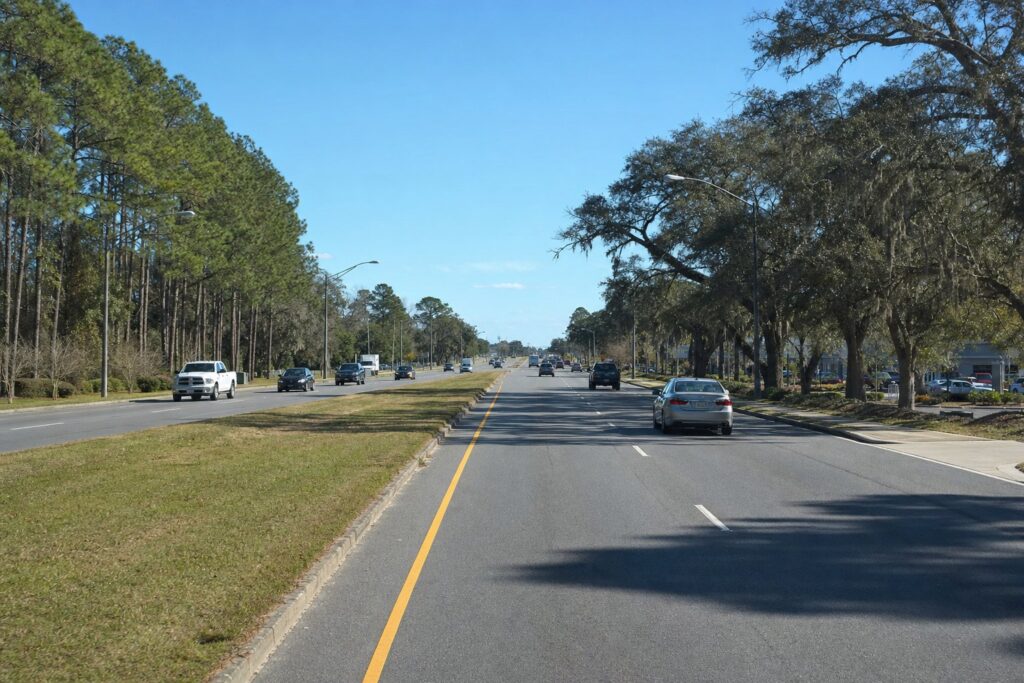
The Ocean Highway (US 17 / GA 25) corridor makes this worse. US 17 runs through north Brunswick as a four-lane primary arterial carrying coastal through-traffic between Brunswick and Darien alongside dense local retail traffic near the Glynn Place Mall corridor and the Altama Park neighborhood. Through-traffic moving at highway speeds meets vehicles turning into retail driveways and side streets — a speed differential that produces high-energy T-bone and rear-end collisions. When the at-fault driver in one of those crashes has no coverage or only the $25,000 minimum, your UM/UIM coverage becomes the claim that actually pays your bills.
According to the Insurance Research Council, roughly one in eight U.S. drivers is uninsured, and Georgia has historically ranked above the national average. According to the Georgia Office of Insurance and Safety Fire Commissioner, uninsured and underinsured motorist coverage must be offered on every Georgia auto policy precisely because so many at-fault drivers cannot pay. On a corridor like US 17, where a single collision can exhaust a minimum policy in one ambulance ride, that coverage is not a technicality — it is the case.
Uninsured vs. Underinsured: What the Difference Means for Your Claim
An uninsured motorist (UM) claim applies when the at-fault driver had no liability insurance at all — or fled the scene and was never identified — while an underinsured motorist (UIM) claim applies when the at-fault driver had some coverage, but not enough to cover your injuries. Georgia folds both into the same coverage under O.C.G.A. § 33-7-11, but the numbers work differently.
If a driver on Ocean Highway carries the $25,000 Georgia minimum and your medical bills, lost wages, and pain total $150,000, the at-fault policy covers only the first $25,000. Your UIM coverage is what reaches the remaining $125,000 — but only up to your policy's limits, and only structured the way you elected when you bought the policy. That election, made when you signed up and often forgotten, controls how much you can actually collect.
Add-On vs. Reduced-By Coverage: The Election That Controls Your Recovery
Since 2009, every Georgia policyholder chooses between two forms of UM/UIM coverage under O.C.G.A. § 33-7-11 — "add-on" and "reduced-by" — and the difference can be tens of thousands of dollars. Add-on coverage stacks on top of the at-fault driver's limits. Reduced-by coverage is offset by them. Most people have no idea which they picked.
| Add-On (stacking) UM/UIM | Reduced-By (offset) UM/UIM | |
|---|---|---|
| How it works | Your UM/UIM limit sits on top of the at-fault driver's liability limits | Your UM/UIM limit is reduced by the at-fault driver's liability limits |
| $100k UM + $25k at-fault | Up to $125,000 available | Up to $75,000 available ($100k − $25k) |
| Best when | The at-fault driver has some coverage but not enough | (Lower recovery in nearly every UIM scenario) |
| Statute | O.C.G.A. § 33-7-11 | O.C.G.A. § 33-7-11 |
Eric Roden, Roden Law's founding partner, points out that the add-on versus reduced-by election is one of the most consequential and least understood decisions a Georgia driver ever makes, and that many Brunswick clients discover only after a serious US 17 crash that a small difference in how their policy was written changed the money available to rebuild their lives. Reading that election correctly is one of the first things a Brunswick Ocean Highway US 17 underinsured motorist lawyer does when reviewing your coverage.
Hit-and-Run on US 17? That's a UM Claim in Georgia
A hit-and-run or phantom-vehicle crash is treated as an uninsured motorist claim under O.C.G.A. § 33-7-11 in Georgia, so you can recover from your own UM coverage even though the at-fault driver is never identified. This matters on the Ocean Highway / Darien Highway corridor and in the Glynn Place Mall retail lots, where a driver who sideswipes you or forces you off the road at speed and keeps going is not the end of your case.
There is a catch. When there was no physical contact with the unknown "phantom" vehicle — a driver who ran you off the road without touching your car — Georgia requires corroboration beyond your own testimony. According to the Georgia Department of Transportation, US 17 carries heavy through-traffic volumes as a primary coastal arterial, which means witnesses, nearby business cameras, and 911 records often exist. Preserving that evidence fast is what turns a phantom-vehicle wreck into a paid claim, and it is a core reason to involve a lawyer early. If your crash was a driveway or parking-lot hit-and-run, the same UM rules that govern the corridor also govern hit-and-run accident claims throughout Glynn County.
Your Own Insurer Becomes the Adversary — Be Ready
In a UM/UIM claim, the insurance company you pay premiums to becomes the party fighting your payout, so you should treat its adjuster the way you would treat the at-fault driver's insurer. This surprises people. You did nothing wrong, you paid for the coverage, and yet the same tactics insurers use elsewhere apply to first-party claims too — delayed responses, lowball offers, and recorded statements designed to trap you into admitting fault.
Georgia's modified comparative fault rule, O.C.G.A. § 51-12-33, is exactly what the adjuster is probing. Your damages are reduced by your percentage of fault, and if you are found 50% or more at fault, you recover nothing. A recorded statement about how the US 17 crash happened is where an adjuster tries to push that number up. Before you give one, understand what to say when the insurance company calls after a crash and the tactics insurers use to deny claims — both apply directly when your own carrier is the one on the phone.
Where a Glynn County UM/UIM Case Is Filed — and the Deadlines
Personal injury lawsuits arising from a Brunswick crash are filed in the State Court of Glynn County or the Superior Court of Glynn County (Brunswick Judicial Circuit), both sitting in Brunswick, with smaller claims up to $15,000 handled in the Magistrate Court of Glynn County. But where you file matters less than when — and UM/UIM claims carry two overlapping clocks.
The lawsuit deadline is the two-year Georgia personal injury statute of limitations under O.C.G.A. § 9-3-33. Separately, your UM/UIM policy imposes its own notice and cooperation requirements, and those can be far shorter than two years. Miss the policy's notice window and the insurer can deny the claim even if you are still inside the statute of limitations. There is also a step unrepresented claimants routinely miss: to preserve your UM claim, you must serve the UM insurer with the lawsuit, not just the at-fault driver. Sue only the driver and the UM carrier can walk away.
| Deadline / requirement | Georgia rule |
|---|---|
| Lawsuit deadline (personal injury) | 2 years from date of injury — O.C.G.A. § 9-3-33 |
| Fault bar to recovery | 50% or more at fault = no recovery — O.C.G.A. § 51-12-33 |
| UM/UIM coverage source | Your own policy — O.C.G.A. § 33-7-11 |
| Hit-and-run recovery | Treated as a UM claim — O.C.G.A. § 33-7-11 |
| Serving the UM insurer | Mandatory to preserve the UM claim |
According to the Federal Highway Administration, US 17 is a principal arterial in the National Highway System, and corridors like it concentrate the high-speed, high-severity crashes where these coverage and deadline rules decide whether an injured person is made whole. For the full statewide picture, our guide on how uninsured and underinsured motorist coverage works in Georgia walks through the coverage in detail; this post localizes it to the US 17 corridor.
Why Injured Brunswick Drivers Call Roden Law
Roden Law brings local, corridor-level experience to Glynn County UM/UIM cases, backed by more than $300 million recovered for clients, a 4.9-star average across 500+ reviews, and 62 years of combined experience. Our Darien office at 1108 North Way sits minutes up US 17 from Brunswick and serves both Glynn and McIntosh counties, so we know the Ocean Highway and Darien Highway corridors, the Southeast Georgia Health System — Brunswick Campus intake, and where the region's most serious trauma transfers go.
We handle these cases on contingency — you pay nothing upfront and no legal fees unless we win. If you were hit near the Glynn Place Mall corridor, along Chapel Crossing Road, or anywhere on US 17, our Darien car accident lawyers can review your coverage election and your deadlines today. Related resources include our car accident lawyers practice hub, background on the most dangerous roads between Darien and Brunswick, coverage of US 17 truck accidents in Glynn County, and — because impaired drivers are disproportionately uninsured — our post on drunk driving crashes in McIntosh County. When trauma transfers head north, our Savannah car accident lawyers team supports the region as well.
📞 Call 1-844-RESULTS · Free Case Review — No Fees Unless We Win
About the Author
Eric Roden is the founding partner of Roden Law and is admitted to practice in Georgia and South Carolina. He has spent his career representing injured people across coastal Georgia — including Brunswick and Glynn County crashes on the US 17 corridor — with a focus on uninsured and underinsured motorist claims under O.C.G.A. § 33-7-11. This article is legal information, not legal advice; for guidance on your specific situation, contact Roden Law for a free consultation.
Frequently Asked Questions
About the Author