
Last reviewed: 2026-07-07
If you or a loved one was hurt riding through the I-20 / Bush River Road interchange, an experienced I-20 Bush River Road motorcycle accident lawyer in Columbia, SC can help you recover maximum compensation for your injuries. A motorcycle crash on this stretch of Columbia's west side can change everything in an instant — a broken leg pinned under the bike, mounting bills from Lexington Medical Center, weeks of lost income, and a driver who swears they "never saw" you. You do not have to face the insurance company alone. Roden Law works on a contingency fee basis: you pay nothing upfront, and no legal fees unless we win your case.
Key Takeaways
- In South Carolina, you generally have 3 years from the date of a motorcycle crash to file a personal injury lawsuit (S.C. Code § 15-3-530(5)) — but evidence at the I-20 interchange disappears fast.
- Venue depends on which side of the county line you crashed on: Lexington County (Eleventh Judicial Circuit) or Richland County (Fifth Judicial Circuit).
- The two dominant crash types here are high-speed merge/weave collisions on I-20 ramps and left-turn failure-to-yield crashes on 4-lane, 40-mph Bush River Road.
- South Carolina uses a 51% bar on comparative fault — you can recover as long as you are not more than 50% at fault (Nelson v. Concrete Supply Co.).
- If the at-fault driver flees, a John Doe uninsured motorist claim (S.C. Code § 38-77-170) may let you recover from your own policy — but strict evidence conditions apply.
- Adult riders are not required to wear a helmet in South Carolina (S.C. Code § 56-5-3660), and insurers cannot automatically blame you for not wearing one.
- Roden Law charges no fees unless we win — call our Columbia office for a free case review.
Why the I-20 / Bush River Road Interchange Is So Dangerous for Riders
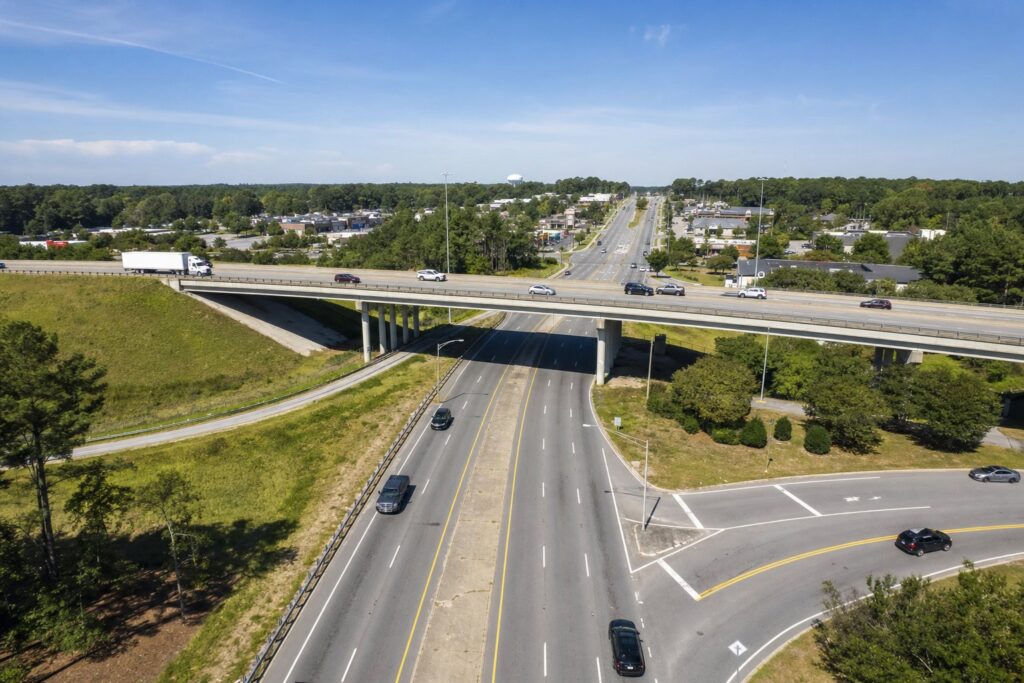
The I-20 / Bush River Road interchange is dangerous for motorcyclists because it forces high-speed interstate traffic and slower suburban traffic into the same merge and weave zone within a few hundred feet. On the west side of Columbia — the Woodland Hills and Seven Oaks area of Lexington County — riders exiting I-20 must slow abruptly to meet a 4-lane, 40-mph arterial, while drivers entering the interstate are accelerating hard. That speed differential is exactly the condition that produces sideswipe and rear-end crashes, and a motorcycle offers no crumple zone to absorb them.
According to the National Highway Traffic Safety Administration, motorcyclists are roughly 22 times more likely to die in a crash than occupants of passenger vehicles per mile traveled — a gap driven largely by the rider's lack of physical protection. According to the Insurance Institute for Highway Safety, the most common multi-vehicle motorcycle crash involves a car turning left in front of an oncoming rider, which is precisely the failure-to-yield scenario that plays out daily where cars turn across Bush River Road's opposing lanes.
Graeham C. Gillin, a partner and Chief Operating Officer at Roden Law, points out that jurors and adjusters in Columbia consistently underestimate how quickly a rider must react at an interchange like this one, where a driver drifting out of an I-20 off-ramp lane leaves a motorcyclist only a fraction of a second to brake or swerve. Building that timeline — often from a single dashcam frame or one witness — is where a case is won or lost.
The Crash Patterns We See on This Corridor
The crash patterns on the I-20 / Bush River Road corridor fall into a handful of repeatable, provable scenarios, and identifying yours early shapes the entire claim. Each one carries a different liability theory and a different evidence checklist.
| Crash type | Where it happens | Who is usually at fault |
|---|---|---|
| Merge / weave sideswipe | I-20 on- and off-ramps | Merging driver failing to yield |
| Left-turn failure-to-yield | Bush River Road signals & driveways | Left-turning driver who "didn't see" the rider |
| Rear-end in ramp queue | Backed-up exit ramps toward Bush River Road | Following driver |
| Hit-and-run | Suburban arterial grid, driver flees toward I-20 | Fleeing at-fault driver (John Doe claim) |
| Single-vehicle evasive crash | Interchange curves and ramps | Often another driver who forced the maneuver |
Left-turn crashes are the corridor's signature. On a 4-lane, 40-mph road, a driver turning left across two opposing lanes has to judge the closing speed of an oncoming motorcycle — and they routinely misjudge it, or never register the narrow headlight at all. These are the same mechanics behind left-turn motorcycle accidents everywhere, but the interchange's traffic mix makes them especially frequent here. When a rider lays the bike down to avoid a turning car and no contact occurs, the case can look like a single-vehicle motorcycle crash — even though another driver caused it. Reconstructing that sequence is critical.
Which County — and Which Court — Handles Your Crash
Which court hears your case depends on the exact spot where you went down, because the I-20 corridor here runs right along the Lexington–Richland county line. A crash on the Lexington County side is generally filed in the Lexington County Court of Common Pleas, Eleventh Judicial Circuit in Lexington. A crash east of the line falls to the Richland County Court of Common Pleas, Fifth Judicial Circuit in Columbia. The county line also changes which agency investigated your wreck and where the report lives — a detail that trips up out-of-state insurers and can delay a claim if it is not sorted out immediately.
According to the South Carolina Department of Public Safety, the state records tens of thousands of traffic collisions each year across its road network, and pulling the correct FR-10 and collision report for the right county is the first step in preserving your claim. Our team confirms the venue before we do anything else, so the deadline clock and the filing court are never in question. If your crash also involved other vehicles or unclear fault, our Columbia car accident lawyers and broader personal injury lawyers in Columbia handle the full range of Midlands crash claims.
South Carolina Law That Decides Your Motorcycle Claim
South Carolina law gives you a real path to compensation after a motorcycle crash, but three rules do most of the work — and insurers use each of them against riders. Knowing them before you talk to an adjuster protects your recovery.
The deadline. In South Carolina, you generally have three years from the date of injury to file a personal injury lawsuit (S.C. Code § 15-3-530(5)). If a government entity is a defendant — for example, a claim tied to public road design or a government vehicle — the South Carolina Tort Claims Act (S.C. Code §§ 15-78-110, 15-78-80) imposes a shorter two-year window unless a verified claim is filed, so those cases demand fast action.
The fault rule. South Carolina follows modified comparative negligence with a 51% bar. You can recover as long as your share of fault does not exceed 50%, and your damages are reduced by your percentage of fault (Nelson v. Concrete Supply Co., 303 S.C. 243, 399 S.E.2d 783 (1991)). Insurers lean on this hard against riders, alleging you were speeding, splitting, or in the wrong lane position — which is why building your own liability evidence early matters.
The helmet myth. South Carolina requires helmets only for motorcycle operators and passengers under 21 (S.C. Code § 56-5-3660). If you are an adult rider, choosing not to wear a helmet is legal, and an insurer cannot automatically slash your claim over it. That argument is contestable, and we contest it.
According to the Centers for Disease Control and Prevention, helmets are estimated to reduce the risk of death in a motorcycle crash by about 37% for riders — a public-health statistic insurers sometimes twist into a fault argument that South Carolina law does not support for adults. We keep the focus where it belongs: on the driver who caused the crash. For the deeper legal framework, see our motorcycle accident attorneys pillar and our local Columbia motorcycle accident lawyers page.
When the Driver Flees: Hit-and-Run and John Doe Claims
If the driver who hit you fled toward I-20, you may still recover through a John Doe uninsured motorist claim against your own policy. Fleeing the scene of an injury crash is a crime in South Carolina (S.C. Code § 56-5-1210), and the resulting criminal file often becomes powerful civil evidence. Even when the at-fault driver is never identified, S.C. Code § 38-77-170 lets you tap the uninsured motorist coverage that every South Carolina auto policy must carry (S.C. Code § 38-77-150) — but only if you meet strict conditions, generally physical contact or independent witness corroboration.
That corroboration requirement is why the minutes after a hit-and-run matter so much: a witness's phone number, a nearby business camera, or debris in the roadway can make the difference. Our guidance on hit-and-run motorcycle accidents and general hit-and-run accident claims walks through exactly what to preserve. For a full evidence checklist, read our post on gathering evidence after a motorcycle crash.
What to Do After a Crash on This Corridor
The smartest thing you can do after a motorcycle crash near the I-20 / Bush River Road interchange is get medical care immediately and preserve evidence before it vanishes. Lexington Medical Center sits under two miles away, and prompt treatment both protects your health and creates the medical record your claim depends on. From there, document the scene, get witness contact information, and avoid recorded statements to the other driver's insurer until you have talked to a lawyer.
Riders often make avoidable mistakes in those first days — read our list of mistakes to avoid after a motorcycle accident and our what to do after a car accident in Columbia checklist. If you ride, walk, or bike this corridor regularly, our overview of the most dangerous roads and intersections in Columbia and our Columbia bicycle accident lawyers page cover the surrounding risks. When you are ready, an I-20 Bush River Road motorcycle accident lawyer in Columbia, SC at Roden Law will handle the rest — no fees unless we win.
Frequently Asked Questions
Q: How long do I have to file a motorcycle accident lawsuit after a crash on Bush River Road?
A: In South Carolina, you generally have three years from the date of injury to file a personal injury lawsuit (S.C. Code § 15-3-530(5)). If a government entity is involved, the South Carolina Tort Claims Act shortens that to two years (S.C. Code §§ 15-78-110, 15-78-80) unless a verified claim is filed. Because interchange evidence disappears fast, do not wait to act.
Q: Do I need an I-20 Bush River Road motorcycle accident lawyer in Columbia, SC, or can I handle the claim myself?
A: You can technically handle it yourself, but insurers routinely blame riders for the crash to cut payouts under South Carolina's 51% comparative fault rule. A lawyer preserves ramp-camera footage, locks down witnesses, pins the correct county venue, and counters the insurer's fault arguments — usually recovering far more than an unrepresented rider, at no upfront cost.
Q: Which court will hear my case — Lexington or Richland County?
A: It depends on the exact crash location, because the I-20 corridor here straddles the county line. A crash on the Lexington County side is generally filed in the Lexington County Court of Common Pleas (Eleventh Judicial Circuit); a crash east of the line goes to the Richland County Court of Common Pleas (Fifth Judicial Circuit) in Columbia.
Q: The driver who hit me fled toward I-20. Can I still recover anything?
A: Yes, potentially. South Carolina's John Doe statute (S.C. Code § 38-77-170) lets you recover from your own mandatory uninsured motorist coverage (S.C. Code § 38-77-150) when the at-fault driver is unknown. You generally must show physical contact or independent witness corroboration, so preserving evidence and witness details immediately is critical.
Q: Can the insurance company blame me because I was not wearing a helmet?
A: Not automatically. South Carolina requires helmets only for operators and passengers under 21 (S.C. Code § 56-5-3660). An adult rider's choice not to wear one is legal, and insurers cannot use it to erase your claim. It is a contestable argument, and Roden Law contests it while keeping the focus on the at-fault driver.
Q: How much does it cost to hire Roden Law for a motorcycle crash claim?
A: Nothing upfront. Roden Law handles motorcycle accident cases on a contingency fee basis — you pay no legal fees unless we win your case. Your initial case review is free. That means you can get an experienced Columbia motorcycle attorney working on your claim without any financial risk while you focus on recovering.
About the Author
Graeham C. Gillin is a partner and Chief Operating Officer at Roden Law and is licensed by the South Carolina Bar. He has spent his career representing injured riders and crash victims across the Midlands, including motorcyclists hurt on Columbia's west-side interstate corridors. If you were injured at the I-20 / Bush River Road interchange, call Roden Law's Columbia office at (803) 219-2816 or 1-844-RESULTS for a free case review — no fees unless we win.
About the Author