
If you or a loved one was hurt on the water this summer, a jet ski accident lawyer Murrells Inlet riders and renters can actually reach is exactly what you need before an insurance adjuster calls. A crash in the inlet's channels can change a vacation in an instant — a concussion, a shattered wrist, a stack of emergency-room bills. In South Carolina, you generally have three years from the date of injury to file a personal-injury claim (S.C. Code § 15-3-530). At Roden Law, we work on a contingency fee basis — nothing upfront and no legal fees unless we win.
Key Takeaways
- The deadline. In South Carolina you have three years from the injury date to file a jet ski injury claim (S.C. Code § 15-3-530) — only two years if a government entity is at fault (S.C. Code § 15-78-110).
- The rules of the water. SC's personal-watercraft statute (S.C. Code § 50-21-870) sets operator age, required flotation, the engine cut-off lanyard, and minimum distances — and a violation is strong evidence of negligence.
- Impairment. Operating a jet ski under the influence violates S.C. Code § 50-21-112, exposing the operator to the same civil liability as a drunk driver.
- The rental outfit. A rental operator can share liability for entrusting a machine to an unqualified or impaired rider or skipping the required safety orientation.
- Insurance. Your auto uninsured-motorist coverage does not follow you onto the water; recovery usually comes from the at-fault operator's boat or homeowner's policy — or the outfit's commercial coverage.
- Venue. Murrells Inlet straddles the Horry/Georgetown county line, so where the crash happened decides which county's court hears your case.
- Vacationers. If you were treated here and went home out of state, you can still start and pursue the claim remotely — Roden Law handles the file after you leave.
Why the inlet's channels produce so many jet ski injuries
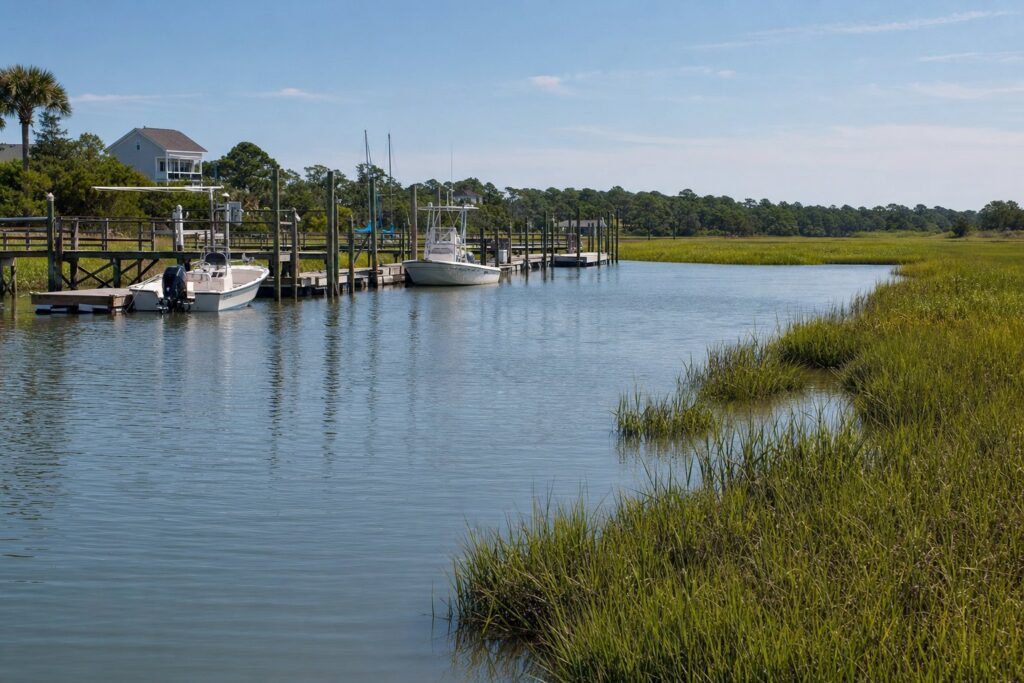
Murrells Inlet concentrates more personal-watercraft traffic into narrow water than almost anywhere on the Grand Strand, and that density is what turns a fun ride into an injury claim. Rental docks, charter operators, and private owners all launch into the same tidal channels behind the Murrells Inlet Historic District, then compete for the same deep water on the same afternoon tide. Put a first-time renter on a powerful machine after a few minutes of instruction, and collisions almost write themselves.
According to the U.S. Coast Guard's recreational boating statistics, personal watercraft account for a large share of reported recreational-vessel injuries each year — disproportionate to their numbers in the water — and operator inexperience ranks among the leading contributing factors. The crashes we see follow familiar patterns: jet-ski-to-jet-ski collisions within the same rental group, riders thrown at speed by a wake or sudden turn, and rented watercraft striking anchored fishing charters near the docks. Our boating accident practice overview walks through how these cases are built.
The South Carolina rules every rider and renter is bound by
South Carolina's personal-watercraft statute (S.C. Code § 50-21-870) is the backbone of most inlet jet ski claims because it sets the operating rules and a violation is strong evidence of negligence. The statute governs the minimum operator age, required flotation devices, use of the engine cut-off lanyard, and minimum distances from other vessels, docks, and swimmers. When an operator ignores those rules and hurts someone, that violation gives an injured rider or passenger a concrete legal footing.
According to the U.S. Coast Guard, wearing a properly fitted life jacket and using the engine cut-off device are among the most effective steps a personal-watercraft operator can take to prevent serious injury — which is why South Carolina wrote both into the statute. Graeham C. Gillin, a partner and Chief Operating Officer at Roden Law, points out that the same duties that make a ride safe also define the standard of care a jury measures the at-fault operator against, so a missed lanyard or an illegal close pass often becomes the center of the case rather than a footnote. If your injuries were severe, our Myrtle Beach brain injury lawyers can explain how head trauma at speed changes a claim's value.
When drinking turns an afternoon on the water into a liability case
Operating a jet ski while impaired is illegal in South Carolina and carries the same civil exposure as drunk driving on the highway. Boating under the influence violates S.C. Code § 50-21-112, and an impaired operator who injures a passenger or another rider faces a negligence claim that is often clear-cut — a risk that peaks on holiday weekends when boat traffic and drinking both surge.
According to the U.S. Coast Guard's recreational boating statistics, alcohol use is consistently one of the leading known contributing factors in fatal recreational boating incidents nationwide. That matters for your claim: proof of impairment not only supports liability, it can affect how South Carolina's comparative-negligence rule divides fault. To see how those losses get valued, read how pain and suffering is calculated in South Carolina.
When the rental outfit shares the blame
A jet ski rental operator can be held directly liable when it hands a powerful machine to someone obviously unqualified or impaired, a theory called negligent entrustment. South Carolina rental outfits owe duties beyond collecting a signature and a credit card: they are expected to screen riders, provide the required safety orientation, and refuse to launch a customer who is visibly drunk or incapable of handling the watercraft. When an outfit skips the orientation or rents to an underage or intoxicated rider who then causes a crash, it can share the blame for the resulting injuries.
This matters financially as much as legally. A rental company usually carries commercial coverage a private owner does not, which can mean the difference between a token recovery and one that actually covers your medical care and lost income. A skilled jet ski accident lawyer Murrells Inlet families rely on will investigate the rental paperwork, orientation records, and the outfit's coverage early — before that evidence disappears. Our Myrtle Beach boating accident lawyers handle this kind of layered liability, and you can read a related breakdown of jet ski accidents in Charleston.
Why your auto insurance won't rescue you on the water
Recovery for a Murrells Inlet jet ski injury almost always comes from a boat, homeowner's, or commercial policy — not your car insurance — because standard auto uninsured-motorist coverage applies to vehicles on the road, not personal watercraft on the water. Many riders are shocked that the UM and underinsured-motorist coverage they pay for every month does not follow them onto the inlet. When the at-fault operator is uninsured, compensation runs through their boat or homeowner's liability policy, or the rental outfit's commercial policy.
According to the National Association of Insurance Commissioners, personal watercraft are typically covered under a boat or watercraft policy rather than an auto policy, and coverage limits vary widely from one owner to the next. That is why identifying every available policy early is one of the most valuable things we do. Graeham C. Gillin notes that a crowded inlet crash often has several responsible parties — the operator, the machine's owner, and the rental company — each with separate coverage, and finding all of them turns a thin claim into a full recovery.
Which county's court hears your Murrells Inlet case
Where your crash happened decides the venue, because Murrells Inlet straddles the Horry/Georgetown county line. An incident on the inlet side generally belongs in the Georgetown County Court of Common Pleas (Fifteenth Judicial Circuit), while a crash north of the county line falls under the Horry County Court of Common Pleas. Smaller disputes — claims of $7,500 or less — can be heard in Georgetown County Magistrate Court. Because the line runs through the water people ride on, pinpointing the exact crash location is not a technicality — it determines which courthouse your case is filed in.
Here is how a Murrells Inlet jet ski claim compares to a routine South Carolina car accident claim on the details clients ask about most:
| Detail | Jet ski / PWC claim | Car accident claim |
|---|---|---|
| Filing deadline | 3 years (S.C. Code § 15-3-530); 2 years vs. a government entity (§ 15-78-110) | 3 years (S.C. Code § 15-3-530) |
| Primary coverage | Operator's boat or homeowner's policy, or the rental outfit's commercial policy | At-fault driver's auto liability; your own UM/UIM if they're uninsured |
| Governing safety rules | PWC statute (S.C. Code § 50-21-870); BUI (§ 50-21-112) | Motor-vehicle and DUI statutes |
| Venue near the inlet | Georgetown or Horry County, by exact crash location | County where the crash occurred |
South Carolina's comparative-negligence rule applies to both: under the state's 51% bar, you can recover as long as you are not more than 50% at fault, with damages reduced by your share (Nelson v. Concrete Supply Co.). Our Myrtle Beach car accident lawyers handle the road-side matters when a crash involves both a vehicle and the water.
Hurt on vacation and already home? The claim still works
You can start and pursue a South Carolina jet ski claim from another state, so being home before the paperwork begins does not cost you the case. Most people injured in the inlet are visitors treated at the Grand Strand's emergency departments, then home before an insurer is involved. Roden Law handles these files remotely — we gather the incident report, rental records, and medical documentation, and communicate by phone, email, and video so you never travel back to manage the claim.
The one thing that does not pause is the clock. Even from out of state, your three-year deadline under S.C. Code § 15-3-530 keeps running, so the sooner the file is opened the better. To follow a simple sequence, see our guide on what to do after a boat accident and this South Carolina accident checklist. For related reading, see our Bucksport Marina boating accident guide and our boating safety guide.
Talk to a Murrells Inlet jet ski accident lawyer today
You do not have to sort out the statutes, the county line, and the insurance policies alone. Roden Law's Murrells Inlet office is right in the community you were hurt in — 631 Bellamy Ave. Suite C-B, Murrells Inlet, SC 29576. With $300M+ recovered and 5,000+ cases handled, our team knows how these claims are built.
📞 Call (843) 612-1980 or 1-844-RESULTS for a Free Case Review — No Fees Unless We Win.
About the Author
Graeham C. Gillin is a partner and Chief Operating Officer at Roden Law, licensed by the South Carolina Bar. If a jet ski crash on the inlet upended your summer, his team is ready to help — for related matters, our Myrtle Beach wrongful death lawyers and our Dick Pond Road truck accident guide cover the south Strand.
Frequently Asked Questions
About the Author