
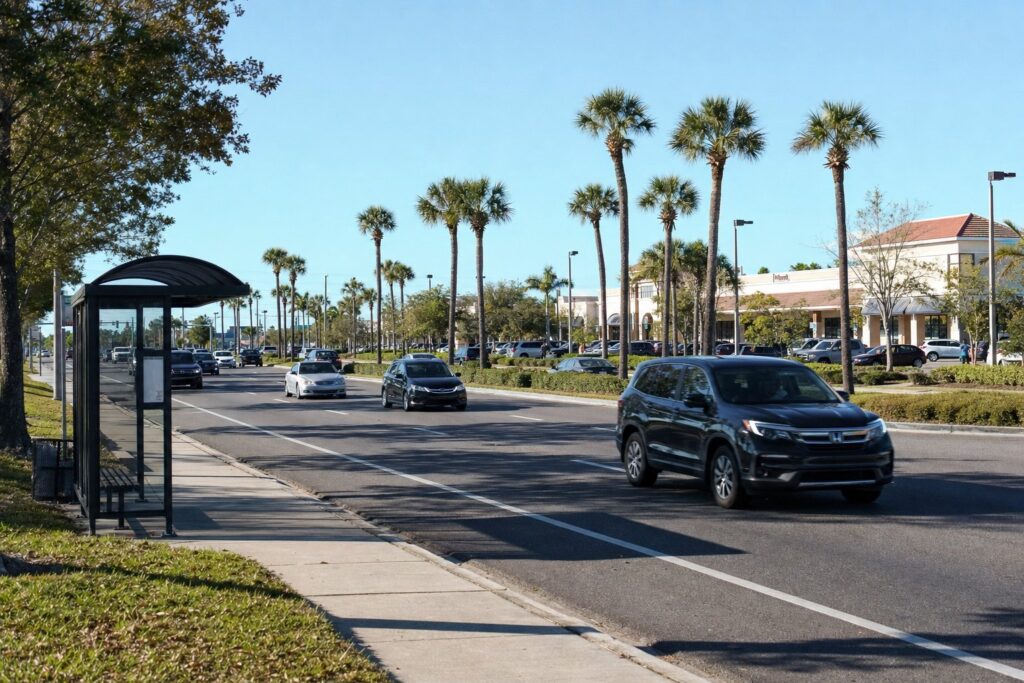
If you were hurt riding, driving near, or walking to a bus on Rivers Avenue, the single most important thing you need from a bus accident lawyer Rivers Avenue North Charleston victims can trust is the answer to one question: who was at fault? On this corridor, that answer decides whether you have three years to file — or only two, with a cap on what you can recover. Getting it wrong can quietly end your case before it starts.
Key Takeaways
- Your deadline depends on the defendant. If a public bus caused your injury, you may have only 2 years and face damage caps under the South Carolina Tort Claims Act (S.C. Code §§ 15-78-110, 15-78-120).
- If a private driver caused it, you have 3 years from the injury date (S.C. Code § 15-3-530) and can tap mandatory uninsured-motorist coverage (S.C. Code § 38-77-150).
- Public buses are common carriers, owing passengers the highest degree of care — a lower proof burden than an ordinary negligence claim.
- Three crash patterns dominate Rivers Avenue: cars striking buses at stops, onboard falls from hard braking, and riders hit crossing to a stop.
- South Carolina's 51% bar lets you recover if you are not more than 50% at fault, with damages reduced by your share (Nelson v. Concrete Supply Co.).
- Which side of the Goose Creek Boulevard county line your crash happened on decides whether Charleston or Berkeley County hears your case.
Who Hit You Decides Your Deadline
The defendant's identity — public agency or private driver — controls your filing deadline, your damage limits, and your proof burden. On a corridor where a transit bus, a shopper's SUV pulling into North Rivers Plaza, and a rider stepping off at a stop can all collide in one event, that identity is not always obvious in the first days. That is exactly why it matters to sort out early.
There are two forks. When a public transit bus injures you — through a driver's error, a sudden stop, or an unsafe merge — your claim falls under the South Carolina Tort Claims Act, which shortens the window to 2 years and caps damages (S.C. Code §§ 15-78-110, 15-78-120). When a private driver causes the harm — rear-ending a stopped bus, cutting off a merging bus, or striking a rider in the roadway — the ordinary 3-year deadline (S.C. Code § 15-3-530) and mandatory uninsured-motorist coverage (S.C. Code § 38-77-150) apply instead.
According to the Federal Transit Administration, public transit travel is statistically safer per mile than travel by private automobile, which is one reason riders are often stunned to learn how little time a claim against a government operator allows. The gap between two years and three is not a technicality — it is often the difference between a paid case and a dismissed one.
| If the at-fault party is… | Filing deadline | Damage caps | Key coverage / statute |
|---|---|---|---|
| A public transit bus (government) | 2 years (S.C. Code § 15-78-110) | Yes — statutory caps (S.C. Code § 15-78-120) | Tort Claims Act; common-carrier duty |
| A private driver | 3 years (S.C. Code § 15-3-530) | No statutory cap | Mandatory UM coverage (S.C. Code § 38-77-150) |
Graeham C. Gillin, a partner and Chief Operating Officer at Roden Law, points out that the earliest days after a Rivers Avenue bus crash are when this fork is decided, because notice requirements and evidence preservation for a government defendant look nothing like an ordinary car-accident claim — and the shorter clock is already running. Identifying the right defendant early is not paperwork; it is the whole case.
When the Public Bus Is at Fault
If the transit operator's own bus caused your injury, you benefit from the common-carrier standard — the highest degree of care the law imposes. Public buses are common carriers under South Carolina law, meaning the operator owes passengers more than the ordinary duty of reasonable care that a private motorist owes. That lower proof burden helps riders injured by a lurching start, a slammed stop, or an unsafe pull-out from a Rivers Avenue curb.
The catch is procedural. Because the defendant is a government entity, the bus accident claims run through the Tort Claims Act: a 2-year deadline and statutory damage caps (S.C. Code §§ 15-78-110, 15-78-120). Many victims assume every South Carolina injury claim gets three years, sit on it, and lose the right to recover. A school bus crash liability situation follows the same government-defendant logic, and the same trap.
According to the American Public Transportation Association, local bus service is the most heavily used form of public transit in the country, so the volume of boarding and alighting passengers on a busy arterial like Rivers Avenue is genuinely high. More riders at more stops means more chances for the exact onboard and curbside injuries that trigger these Tort Claims Act deadlines.
When a Private Driver Is at Fault
If a private motorist caused the crash, you generally have 3 years from the date of injury to file (S.C. Code § 15-3-530), and you are not bound by the government damage caps. This is the fork that applies when a distracted driver rear-ends a bus stopped at The Promenade at Northwoods, sideswipes a bus merging back into traffic, or strikes a rider crossing Rivers Avenue to reach the far-side stop.
South Carolina requires every auto policy to carry uninsured-motorist coverage (S.C. Code § 38-77-150), which matters enormously here. If the private driver flees — and a driver who leaves the scene of an injury crash violates S.C. Code § 56-5-1210 — or carries no insurance, your own UM coverage can step in. If you were a bus passenger struck by that uninsured driver, coverage questions get layered, and sorting them is core work for North Charleston car accident lawyers. For the broader framework, our car accident practice overview walks through how these claims fit together.
How Rivers Avenue Bus Crashes Happen
These crashes cluster around three recurring patterns, all driven by the same fact: bus stops on Rivers Avenue sit directly on a fast, four-lane arterial. According to the National Highway Traffic Safety Administration, the size and weight disparity between a bus and a passenger vehicle means occupants of the smaller vehicle absorb the most severe injuries in a collision — a dynamic that plays out every time a car meets a bus near Northwoods Mall.
The first pattern is cars striking buses at stops — rear-end and sideswipe strikes as a bus decelerates or pulls back into 45-mph traffic. The second is onboard injuries from hard braking: standing passengers and riders not yet seated are thrown when a driver brakes hard at closely spaced stops. According to the Centers for Disease Control and Prevention, falls are among the leading causes of nonfatal injury nationwide, and a standing bus rider has nothing to arrest a sudden fall. The third is riders struck crossing Rivers Avenue mid-block to reach a stop on the far side — the overlap with North Charleston pedestrian accident lawyers work, and the reason we track Rivers Avenue pedestrian accidents closely. The dangers of this corridor on foot are covered in our look at Rivers Avenue pedestrian dangers.
Turning conflicts add a fourth layer. The strip of plazas — North Rivers Plaza, The Promenade at Northwoods, and the drive to Northwoods Mall — feeds constant driveway turns across the bus lane. Hospital shift changes and holiday retail surges concentrate all of it on the same few signals.
Where Injured Riders and Drivers Get Treated
Serious Rivers Avenue crash victims are typically treated first at HCA Healthcare Trident Hospital, the nearest emergency department right on the corridor. From there, riders and drivers with brain or spinal injuries often move to MUSC Health Rehabilitation Hospital nearby for specialized recovery. That treatment path is not just medical background — it is evidence of the severity, cost, and permanence of an injury, which is exactly what drives the value of a claim.
Where a case involves a head injury, the long arc of rehabilitation becomes central to damages, and that is the focus of our North Charleston brain injury lawyers. Documenting the full cost — future care, lost earning capacity, and the human toll — is how how pain and suffering is calculated in South Carolina turns into a real number. In the gravest outcomes, families may need North Charleston wrongful death lawyers to pursue a claim on behalf of the estate.
Fault, Court, and Getting It Right Locally
Two more rules shape a Rivers Avenue bus case: how fault is shared, and where the case is heard. South Carolina follows a modified comparative negligence standard — the 51% bar. You can recover as long as you are not more than 50% at fault, but your damages are reduced by your percentage of fault (Nelson v. Concrete Supply Co.). If a jury finds you 20% responsible for stepping into the roadway, a $100,000 award becomes $80,000; cross the 51% line, and you recover nothing.
Venue turns on geography. Most Northwoods-area cases are filed in the Charleston County Court of Common Pleas (Ninth Judicial Circuit), with smaller claims of $7,500 or less heard in Charleston County Magistrate's Court. But Goose Creek Boulevard marks the Berkeley County line — the same crash pattern one block north can land in the Berkeley County Court of Common Pleas instead. Getting venue right from the first filing avoids costly delay. If your crash was farther up US 52, our Chicora-Cherokee US 52 car accident guide covers that segment, and every case should start with what to do after a South Carolina car accident.
About the Author
Graeham C. Gillin is a partner and Chief Operating Officer at Roden Law and is licensed by the South Carolina Bar. If you were hurt in a bus crash on the Rivers Avenue / Northwoods corridor, our North Charleston office at 2703 Spruill Ave can review your case at no cost — you pay nothing upfront and no fees unless we win.
📞 Call (843) 612-6561 — Free Case Review, No Fees Unless We Win.
Frequently Asked Questions
About the Author