
Key Takeaways
The Port of Savannah generates 14,000–16,000 truck moves per day on local roads including Bay Street (through the Historic District), DeRenne Avenue, Abercorn Street, and Dean Forest Road. Port truck crashes involve complex liability chains: truck driver, trucking company, chassis leasing company, cargo shipper, and terminal operator may all be responsible. The port's $1.9 billion expansion will increase truck volumes further. Georgia gives victims 2 years to file (O.C.G.A. § 9-3-33) with recovery if less than 50% at fault.
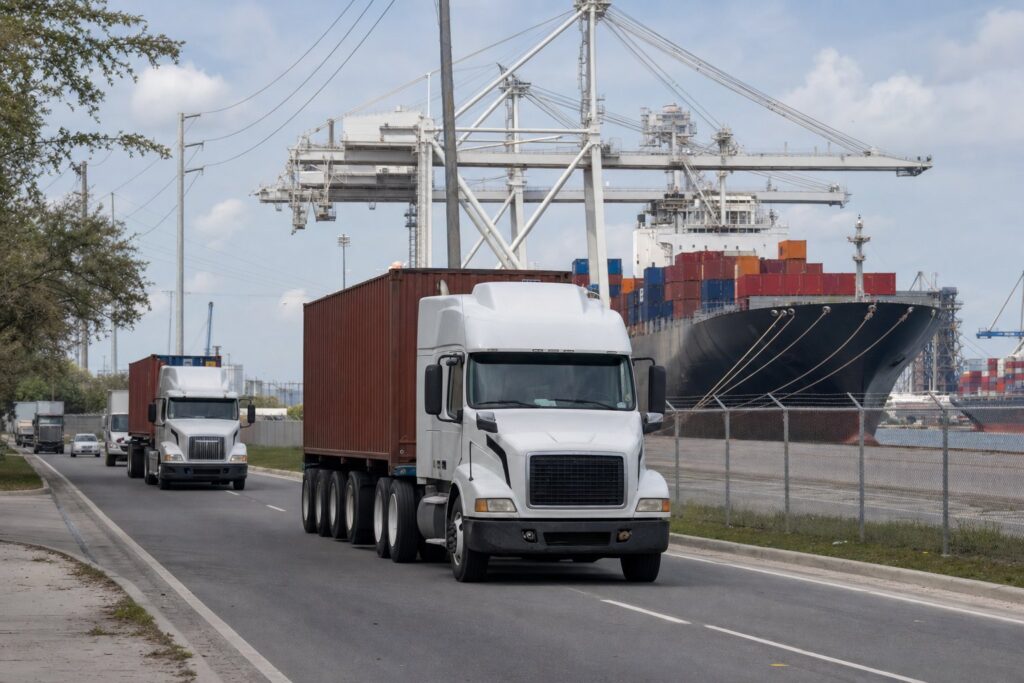
Port of Savannah: 14,000-16,000 Truck Moves Per Day on Local Roads
The Port of Savannah is the fastest-growing container port on the U.S. East Coast, processing 5.9 million TEUs in 2023 with 14,000 to 16,000 truck moves per day Monday through Friday. Under a $1.9 billion master expansion plan, the Georgia Ports Authority is growing vessel berths from 7 to 12 and truck lanes from 53 to 100 by 2030.
For Savannah residents, this means one thing: more trucks on more roads, every year. And the crashes are not limited to the interstates. Port trucks travel through residential neighborhoods, retail corridors, and historic districts on their way to and from the terminals.
Port of Savannah Truck Route Map
The port’s primary truck routes radiate outward from the Garden City Terminal:
Interstate Routes
- I-16 Westbound: The primary freight corridor, carrying containers to distribution centers in Macon, Atlanta, and the Southeast. 30,000+ truck trips daily through Chatham County.
- I-95 North/South: Connects port traffic to the Eastern Seaboard freight network — Jacksonville to the south, Charleston and beyond to the north.
- I-516: Auxiliary interstate connecting southern Savannah to the port area and I-16. Compact urban expressway with short merge zones.
Local Surface Streets
These are the routes where port trucks mix directly with passenger vehicles, pedestrians, and cyclists in Savannah neighborhoods:
Bay Street (Through Historic District)
Bay Street runs through the heart of Savannah’s Historic District — one of the most pedestrian-heavy areas in the city. Despite this, port-related truck traffic uses Bay Street as an east-west connector. The combination of 80,000-pound trucks, tourists crossing cobblestone streets, horse-drawn carriages, and narrow lanes creates a collision risk that is unique to Savannah.
DeRenne Avenue
DeRenne Avenue bisects residential neighborhoods on Savannah’s south side while serving as a major commercial corridor. Port trucks use DeRenne to access I-516 and the southern approach to the port area. The road carries high traffic volume through a series of signalized intersections where trucks must stop, start, and turn across multiple lanes of traffic.
Abercorn Street Extension
Abercorn Street is a 10-mile retail and commercial corridor stretching from downtown to Savannah’s southern suburbs. It is lined with shopping centers, restaurants, and medical offices — generating constant turning traffic. The intersection of Abercorn and White Bluff Road is one of the busiest on the corridor, where retail traffic from Oglethorpe Mall meets the White Bluff Road commuter route. Truck traffic on this corridor adds mass and severity to every crash.
Dean Forest Road
Dean Forest Road connects the Pooler warehouse and distribution district to I-16. Heavy truck traffic flows from logistics facilities to the interstate on a road that also serves residential communities. The I-16/Dean Forest Road interchange is a high-volume truck entry point.
Staging Areas and Distribution Hubs
- Morgan Lakes Industrial Park: Adjacent to the port, this staging area handles containers waiting for pickup or delivery. Trucks entering and exiting create constant turning and merging hazards on surrounding roads.
- Northport Area: Staging and logistics operations north of the Garden City Terminal generate additional truck traffic on local roads.
- Pooler Distribution Centers: Nearly 3 million square feet of warehouse space near I-95 and I-16, including World Distribution Services’ 500,000+ sq ft facility. See our Pooler Warehouse District guide.
Why Port Truck Crashes Are Different
Port of Savannah truck operations create unique liability factors:
Chassis Leasing
Many port trucks operate on leased chassis — the trailer frame that carries shipping containers. The chassis owner may be different from the trucking company, the container owner, and the cargo shipper. When a chassis defect (worn tires, failed brakes, broken lights) causes a crash, the chassis leasing company bears liability separate from the truck driver or carrier.
Intermodal Equipment
Containers arriving by ship are transferred to truck chassis at the terminal. If the container is improperly secured to the chassis, overweight, or has an uneven weight distribution, the resulting instability can cause rollovers, lost loads, and brake failures on public roads. The terminal operator, container packer, and shipping line may all share liability.
Independent Owner-Operators
Many port truckers are independent owner-operators who lease their authority from larger carriers. This creates complex insurance questions — the driver’s policy, the carrier’s policy, and potentially the port’s umbrella coverage may all apply. Identifying the correct insurance is critical to maximizing your recovery.
Schedule Pressure
Port trucks operate on appointment windows. Missing a pickup or delivery window means hours of delay and lost revenue. This financial pressure incentivizes speeding, cutting rest breaks, and aggressive driving — all of which increase crash risk.
Savannah Intersection Crash Data
Key dangerous intersections on port truck routes include:
| Intersection | Hazard |
|---|---|
| Abercorn & White Bluff | 1 in 4 accidents classified as dangerous |
| I-16 & Chatham Parkway | Tied for most dangerous in Savannah area |
| DeRenne & Abercorn | One of the highest-volume intersections in Chatham County |
| King George & Abercorn | Site of a tanker truck crash that caused a fiery collision |
Your Legal Rights
- Statute of limitations: 2 years in Georgia (O.C.G.A. § 9-3-33)
- Comparative fault: Less than 50% at fault to recover (O.C.G.A. § 51-12-33)
- Multiple defendants: Driver, trucking company, chassis lessor, container shipper, terminal operator
- Federal regulations: FMCSA hours-of-service, maintenance, cargo securement rules apply to all commercial trucks
Free Consultation
Roden Law’s Savannah office handles truck accident cases involving Port of Savannah traffic on contingency — no fees unless we recover compensation. We understand the complex liability chains unique to port trucking. Call (912) 303-5850.
Related resources: Jimmy DeLoach Connector Truck Accidents | Bay Street Truck Traffic in the Historic District
Related Pages
Frequently Asked Questions
About the Author

Eric Roden
Founding Partner, CEOEric Roden has represented injury victims from the outset of his career and has never advocated on behalf of insurance companies. He focuses on wrongful death, automobile accidents, nursing home negligence, and workers’ compensation law. In 2013, he became a founding partner of Roden Law, dedicated to providing advocacy for injured clients. Education J.D., University […]
View Full Profile →Want more from Roden Law in your Google results?