

Key Takeaways
I-16 is a main truck route for Port of Savannah freight, and the port handles 14,000 to 16,000 truck moves a day (Georgia Ports Authority). Federal crash data recorded 66 deaths on I-16 statewide from 2020 through 2024. The corridor features active GDOT construction zones, two-lane rural stretches, and relentless tractor-trailer volume. In 2024, 197 people died in Georgia crashes involving large trucks (NHTSA). You have 2 years to file an injury claim (O.C.G.A. § 9-3-33) and can recover damages if less than 50% at fault.
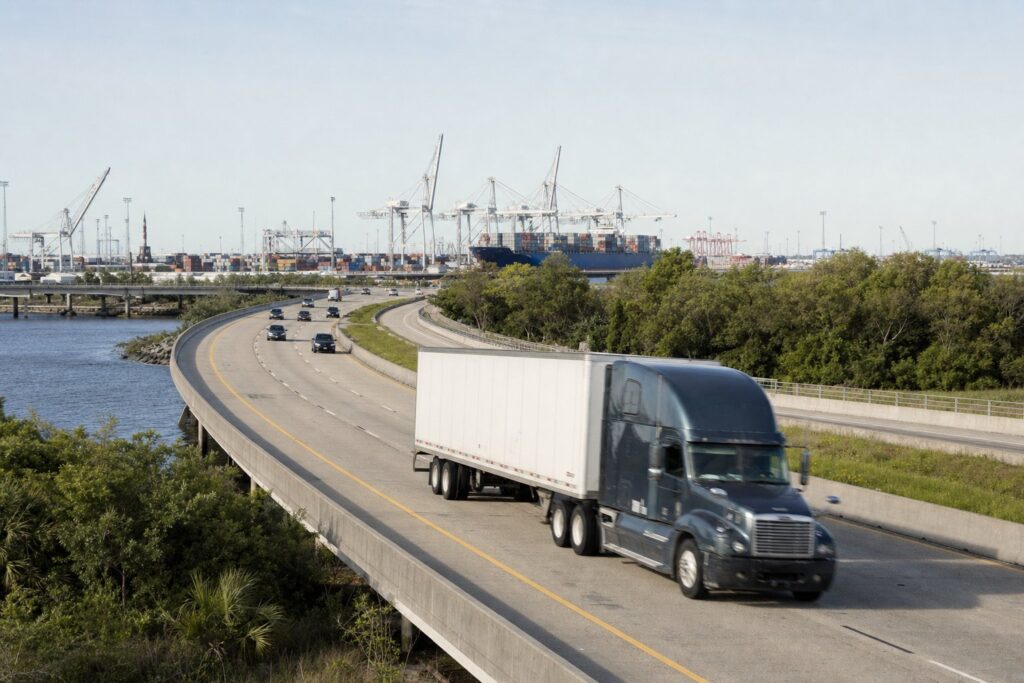
I-16: A Main Truck Corridor Out of the Port of Savannah
Interstate 16 connects Savannah to Macon across about 166 miles of Central Georgia. It is a main truck route for freight from the Port of Savannah, the fourth-busiest container port in the United States, and federal crash data recorded 66 deaths on I-16 statewide from 2020 through 2024 (NHTSA Fatality Analysis Reporting System).
The result: a relentless stream of tractor-trailers, container chassis, and heavy commercial vehicles mixing with commuter traffic through construction zones, narrow lanes, and congested interchanges. For Savannah-area residents, I-16 is not just a highway — it is one of the region’s main truck corridors.
I-16 Truck Accident Statistics
- Federal crash data recorded 61 fatal crashes and 66 deaths on I-16 across Georgia from 2020 through 2024, including 14 fatal crashes in Chatham County (NHTSA FARS)
- The Port of Savannah handles 14,000 to 16,000 truck moves a day, Monday through Friday (Georgia Ports Authority), and much of that traffic reaches I-16 at Dean Forest Road and I-516
- A January 2026 chain-reaction crash involving a tractor-trailer, two box trucks and a pickup on eastbound I-16 in Bleckley County, near the Twiggs County line, killed 1 person and seriously injured 2 (Georgia State Patrol)
- GDOT is widening I-16 between I-95 and I-516 (exits 157 to 164), and the work zone brings narrowed lanes, lane shifts, and bottlenecks
- 197 people died in Georgia crashes involving large trucks in 2024, and 173 of them were in other vehicles or on foot (NHTSA, Traffic Safety Facts: Large Trucks)
- Bibb County (the Macon end of I-16) recorded 6,103 traffic crashes countywide in 2024 (Georgia Governor’s Office of Highway Safety)
Why I-16 Is So Dangerous
Port of Savannah Freight Volume
The Port of Savannah handled nearly 5.7 million TEUs (twenty-foot equivalent units) in 2025, its second-busiest year after the 2022 record of about 5.9 million (Georgia Ports Authority). Most of its containers leave by truck and the rest by rail. Trucks reach I-16 at Dean Forest Road (exit 160) and by the Jimmy DeLoach Parkway (exit 152), which also connects the port to I-95, on the way to distribution centers in Macon, Atlanta, and beyond. This means:
- Container trucks operating on tight delivery schedules
- Overweight and improperly secured loads from hasty port departures
- Drivers unfamiliar with local roads navigating I-16 for the first time
- Chassis leased from third-party companies with inconsistent maintenance standards
Active Construction Zones
GDOT has finished rebuilding the I-16/I-95 interchange and is widening I-16 between I-95 and I-516 in Chatham County. The work zone — through the interchanges at Dean Forest Road, Chatham Parkway, and I-516 — creates:
- Narrowed lanes that leave no room for error when a truck drifts
- Temporary routes and lane shifts that confuse drivers
- Speed differentials between slowing work-zone traffic and trucks entering from ramps
- Concrete barriers that eliminate escape routes during emergencies
Two-Lane Stretches
For most of its roughly 166-mile length, including west of I-95 in Pooler, I-16 has two lanes in each direction; only the stretch between I-95 and I-516 has three. Passing a slow-moving truck requires using the left lane — the same lane used by oncoming traffic during crossover crashes and by other trucks attempting the same pass. Head-on and sideswipe crashes on these two-lane stretches are frequently fatal.
High-Risk Spots on I-16
I-16 & Chatham Parkway
Trucks exiting I-16 at Chatham Parkway encounter a surface road with commercial development, traffic lights, and turning vehicles — a dramatic speed reduction that catches following drivers off guard.
I-16 & I-95 Interchange
A primary freight junction for Port of Savannah truck traffic. GDOT has finished rebuilding the interchange, but widening work continues just east of it toward I-516, with lane shifts and merging patterns that change as the project progresses.
I-16 & Dean Forest Road
Heavy truck traffic from Pooler-area warehouses enters I-16 here. The merge is short and the volume is high, creating dangerous conditions for passenger vehicles caught between entering trucks.
Rural Middle Georgia (Twiggs to Laurens Counties)
A long rural stretch with two lanes in each direction. The January 2026 fatal chain-reaction crash happened here, in Bleckley County near the Twiggs County line. The only rest areas on I-16 are in Laurens County, near mileposts 44 and 46, so tired drivers have few places to stop on long, straight stretches.
Common I-16 Truck Crash Types
- Rear-end in congestion: Port-bound truck traffic creates stop-and-go conditions near I-95 and I-516 interchanges. Trucks following too closely cannot stop in time.
- Jackknife crashes: Hard braking on wet pavement (common during Georgia’s afternoon thunderstorms) causes trailers to swing out across multiple lanes
- Construction zone sideswipes: Narrowed lanes during GDOT reconstruction leave inches between trucks and passenger vehicles
- Cargo spills: Improperly secured containers or cargo shifting during transit
- Head-on crossover: On the two-lane rural stretches, a tire blowout or drowsy trucker crossing the median produces unsurvivable head-on collisions
Georgia Truck Accident Law
- Statute of limitations: 2 years from injury (O.C.G.A. § 9-3-33)
- Comparative fault: Recovery allowed if less than 50% at fault (O.C.G.A. § 51-12-33)
- Punitive damages: Available for willful misconduct, including knowingly dispatching fatigued drivers or falsifying maintenance records
- FMCSA violations: Georgia has adopted the Federal Motor Carrier Safety Regulations as state rules, so a violation can support a negligence per se claim (O.C.G.A. § 51-1-6), as long as it caused the crash
What to Do After an I-16 Truck Crash
- Move to safety if possible — Secondary crashes are a serious risk on I-16, especially in construction zones
- Call 911 — Georgia State Patrol responds to I-16 crashes. Request medical assistance.
- Document the truck: Company name, USDOT number (on the cab door), trailer number, and cargo type
- Photograph everything: Vehicle damage, road conditions, construction zone signage, mile markers, and your injuries
- Get medical attention — Memorial Health in Savannah is the region’s Level I trauma center
- Contact a truck accident attorney within 24-48 hours — Evidence preservation is time-critical
Free Consultation
Roden Law’s Savannah office is located minutes from I-16 and handles truck accident cases along the entire corridor. Contingency fee — no fees unless we recover compensation. Call (912) 303-5850 for a free consultation.
Related resources: I-16 / I-95 Construction Zone Truck Accidents
Related Pages
Frequently Asked Questions
About the Author

Eric Roden
Founding Partner, CEOEric Roden has represented injury victims from the outset of his career and has never advocated on behalf of insurance companies. He focuses on wrongful death, automobile accidents, nursing home negligence, and workers’ compensation law. In 2013, he became a founding partner of Roden Law, dedicated to providing advocacy for injured clients. Education J.D., University […]
View Full Profile →