

Key Takeaways
The Carolina Crossroads project is a $2.69 billion SCDOT initiative reconfiguring 14 miles of the I-20/I-26/I-126 corridor in Columbia, including the I-20/I-26 interchange known as “Malfunction Junction”, and carrying 134,000+ vehicles daily. Construction began in 2021 with completion targeted for the mid-2030s. In May 2025, a driver was killed rear-ending a Mack truck on I-26 near mile marker 122 at 3 a.m. Permanent ramp closures, including the I-26 off-ramp to Bush River Road (closed November 2024), create driver confusion and sudden braking hazards. South Carolina gives injury victims 3 years to file (S.C. Code § 15-3-530) and allows recovery if less than 51% at fault. Contact Roden Law's Columbia office at (803) 219-2816.
Carolina Crossroads: A $2.69 Billion Fix for “Malfunction Junction”
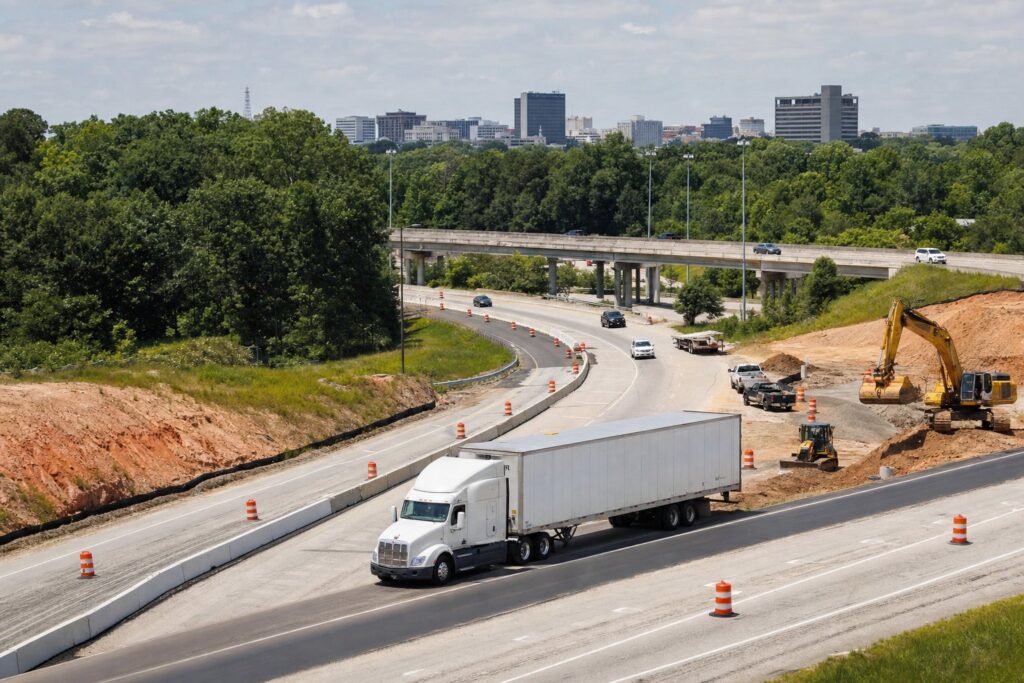
The Carolina Crossroads project is a $2.69 billion SCDOT initiative reconfiguring 14 miles of the I-20/I-26/I-126 corridor in Columbia, which includes the I-20/I-26 interchange long known as “Malfunction Junction.” More than 134,000 vehicles daily pass through this corridor. Construction began in November 2021 with a target completion in the mid-2030s, meaning drivers and truckers will navigate active construction for more than a decade.
The project is projected to save commuters 112 hours annually when complete. But until then, the corridor is a shifting maze of closed ramps, temporary lane configurations, new bridges under construction, and unfamiliar routing — all carrying the same massive traffic volume through a progressively constricted space. For the thousands of commercial trucks that transit the I-20/I-26 interchange daily, the construction zone creates conditions where crashes are more likely and more dangerous.
Recent Fatal and Serious Crashes in the Carolina Crossroads Zone
May 2025: Fatal Rear-End Crash on I-26
In May 2025, a driver was killed after rear-ending a Mack truck on I-26 near mile marker 122 at approximately 3:00 a.m. Rear-end crashes with commercial trucks are among the most deadly collision types because of the massive weight differential. In a construction zone with concrete barriers and no shoulders, a passenger vehicle that strikes the rear of a stopped or slow-moving truck has no escape path. The 3:00 a.m. timing suggests the victim may not have seen the truck in time — construction zone lighting, reflective tape on the truck’s rear, and work zone sight distances are all factors that determine whether a driver can detect and avoid a stopped truck.
Permanent Ramp Closures Create Driver Confusion
In November 2024, SCDOT permanently closed the I-26 off-ramp to Bush River Road as part of the Carolina Crossroads reconfiguration. Permanent ramp closures — as opposed to temporary lane shifts — fundamentally change the routing that drivers and truckers have relied on for decades. GPS systems may not update immediately, sending truck drivers toward closed ramps where sudden braking and last-second lane changes create rear-end and sideswipe hazards. The Bush River Road corridor already handles heavy truck traffic from nearby distribution centers and commercial properties.
Phase 2 Completion: New Bridges and Shifting Traffic
Phase 2 of the project, which included work on I-20 at Broad River Road and the construction of three new bridges, was completed in early 2025. Each phase completion brings relief to one section of the corridor but shifts construction activity — and its associated hazards — to the next section. Drivers who have adapted to one set of lane configurations must now learn a new one. The interchanges where I-20, I-26 and I-77 meet add their own merges and lane choices for commercial truckers.
Why Carolina Crossroads Is Dangerous for Truck Traffic
134,000+ Daily Vehicles Through Active Construction
The I-20/I-26/I-126 corridor carries more than 134,000 vehicles per day, including thousands of commercial trucks serving Columbia’s warehousing, manufacturing, and distribution industries. The construction zone does not reduce this traffic volume — it compresses it into fewer lanes with tighter margins. During peak hours, the combination of congestion, construction barriers, and truck traffic creates stop-and-go conditions where rear-end crashes are inevitable.
A Multi-Year Timeline of Shifting Configurations
With construction running from 2021 into the mid-2030s, truckers who use this corridor regularly face years of shifting lane configurations. A driver who transited the interchange last month may find entirely different lane alignments, ramp locations, and merge points on the next trip. This constant change is particularly dangerous for commercial truck drivers who rely on muscle memory and route familiarity to navigate complex interchange systems at highway speeds.
Nighttime Construction and Reduced Visibility
Much of the Carolina Crossroads work occurs at night to minimize daytime traffic disruption. The May 2025 fatal crash at 3:00 a.m. occurred during these nighttime construction hours when visibility is reduced, temporary lane markings may be less visible, and construction equipment may be operating near travel lanes. Truck drivers operating during nighttime hours may be fatigued, further reducing reaction times in an already hazardous environment.
Liable Parties in Carolina Crossroads Construction Zone Crashes
| Potentially Liable Party | Basis for Liability |
|---|---|
| Truck driver | Following too closely, speeding in work zone, fatigued driving during nighttime construction hours, failure to adjust for construction zone conditions |
| Trucking company | HOS violations, pressure driving through construction zones, failure to update routing for closed ramps and lane changes |
| SCDOT / project owner | Inadequate work zone signage, improper lighting during nighttime construction, failure to update ramp closure information (subject to SC Tort Claims Act, S.C. Code §§ 15-78-110, 15-78-120) |
| Construction contractor | Equipment in travel lanes, inadequate lane transition design, improperly placed barriers, failure to follow MUTCD standards |
| GPS / navigation provider | Failure to update routing data for permanent ramp closures, directing trucks toward closed exits |
What to Do After a Truck Crash in the Carolina Crossroads Zone
- Call 911 immediately — South Carolina Highway Patrol responds to crashes on the I-20/I-26/I-126 corridor. If you are in the construction zone with no shoulder, stay in your vehicle with seatbelt fastened and hazard lights on.
- Document the work zone: Photograph construction signage, speed limit signs, barrier placement, ramp closure signs, lane markings, and any construction equipment near the crash scene. These conditions change frequently.
- Record the truck: Company name, USDOT number, trailer number, and cargo type.
- Get medical treatment: Prisma Health Richland Hospital is Columbia’s Level 1 trauma center. Get evaluated even if you feel fine — rear-end crashes with commercial trucks frequently cause traumatic brain injuries and spinal cord injuries with delayed symptoms.
- Contact a truck accident attorney within 24–48 hours — ELD data, event data recorder information, construction zone traffic control plans, and dash cam footage must be preserved before the trucking company or SCDOT can alter them.
South Carolina Law: Deadlines & Fault Rules
- Statute of limitations: 3 years from the date of injury (S.C. Code § 15-3-530)
- Comparative fault: South Carolina allows recovery if you are less than 51% at fault. Your compensation is reduced by your percentage of fault.
- SC Tort Claims Act: Claims against SCDOT are subject to the SC Tort Claims Act. Suit must be filed within two years, or three years if a verified claim is filed with the agency within one year (S.C. Code §§ 15-78-110, 15-78-80), and recovery is capped at $300,000 per person and $600,000 per occurrence (S.C. Code § 15-78-120).
Free Consultation — Roden Law Columbia
Roden Law’s Columbia office handles truck accident cases in the Carolina Crossroads construction zone and throughout the Midlands. We understand this corridor’s complexity, work with accident reconstruction experts, and fight for full compensation. Call (803) 219-2816 for a free consultation — no fees unless we win.
Related resources: Columbia Interstate Interchange Truck Accidents | Bush River Road & I-26 Truck Accidents
Related Pages
Frequently Asked Questions
About the Author

Ivy S. Montano
AssociateIvy S. Montano serves as an Associate at Roden Law in the Savannah office. She is a native of Darien, Georgia, and began her legal career focusing on defending the rights of children with a focus in juvenile dependency and delinquency cases. Prior to joining Roden Law, she worked for a large firm handling insurance […]
View Full Profile →