

Key Takeaways
The 16@95 Improvement Projects are a $511.8 million GDOT design-build project widening I-16 from 4 to 6 lanes and fully reconstructing the I-16/I-95 interchange in Chatham County. The construction zone funnels the Port of Savannah's 14,000–16,000 daily truck moves through active lane shifts and narrowed lanes with no shoulders. In March 2026, a tractor-trailer veered across all lanes of I-95 southbound, struck a concrete wall, and killed the driver — shutting down all lanes of I-95 in both directions for hours. Georgia gives injury victims 2 years to file a lawsuit (O.C.G.A. § 9-3-33) and allows recovery if less than 50% at fault. Contact Roden Law's Savannah office at (912) 303-5850.
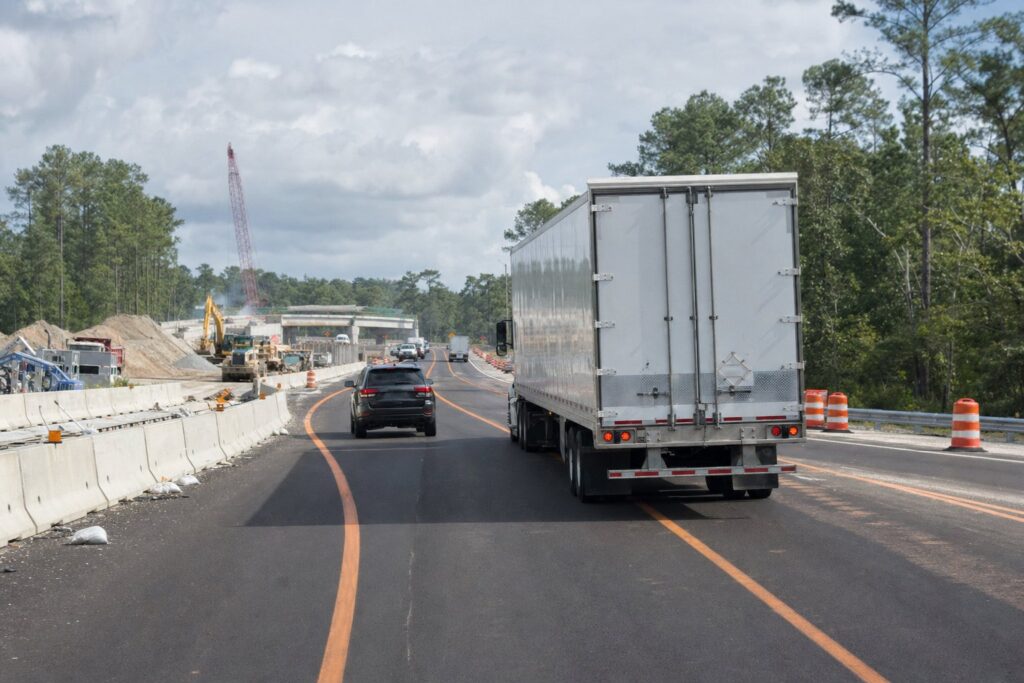
The 16@95 Improvement Projects: A $511.8 Million Construction Zone
The 16@95 Improvement Projects represent a $511.8 million GDOT design-build initiative transforming the I-16/I-95 interchange in Chatham County. The project widens I-16 from four to six lanes between Milepost 156 and Milepost 164, fully reconstructs the I-16/I-95 interchange, and adds a third westbound lane that opened in February 2025. For drivers and truckers navigating the interchange, this means years of active lane shifts, reduced shoulders, concrete barriers mere feet from travel lanes, and constantly changing traffic patterns — all in a corridor that already handles massive truck volume from the Port of Savannah.
The Port of Savannah moved 5.7 million TEUs in 2025, generating 14,000–16,000 truck moves daily. A significant share of those trucks funnel through the I-16/I-95 interchange, where active construction narrows lanes, eliminates shoulders, and forces drivers through unfamiliar configurations.
Recent Fatal and Serious Truck Crashes at the I-16/I-95 Construction Zone
March 2026: Tractor-Trailer Fatal on I-95 Southbound
In March 2026, a tractor-trailer veered across all lanes of I-95 southbound and struck a concrete wall protecting the Pine Barren Road overpass piers. The driver was ejected and killed. The crash shut down all lanes of I-95 in both directions for hours, stranding motorists and diverting freight traffic onto local roads throughout Chatham County. This crash occurred in a section where construction barriers narrow the travel lanes and eliminate the emergency shoulder, leaving no margin for error when a truck driver loses control.
December 2025: Semi-Truck Crash at SR 26/US 80
In December 2025, a semi-truck crash blocked the two right lanes of I-95 at SR 26/US 80, creating miles of backups through the construction zone. When a crash blocks lanes inside a work zone with no shoulder and concrete barriers on both sides, traffic has nowhere to go. Secondary rear-end crashes are common as vehicles decelerate rapidly into stopped traffic with limited sight distance around construction equipment and lane barriers.
July 2025: I-95/I-16 Interchange Backup
In July 2025, an accident at the I-95/I-16 interchange backed up morning commuters for miles during peak travel hours. The interchange reconstruction has eliminated familiar ramp configurations, replacing them with temporary ramps and lane shifts that change as construction progresses. Drivers — particularly out-of-state truckers unfamiliar with the current layout — navigate these shifting patterns daily, increasing the risk of wrong-lane merges and sudden stops.
Why the 16@95 Construction Zone Is Uniquely Dangerous for Trucks
Massive Truck Volume Meets Active Construction
The I-16/I-95 interchange is the primary routing point for port freight moving between the Port of Savannah and destinations throughout the Southeast. The construction zone funnels 14,000–16,000 daily truck moves through active lane shifts, narrowed lanes, and temporary ramp configurations. An 80,000-pound tractor-trailer needs approximately 525 feet to stop from 55 mph — distance that may not exist when construction barriers compress the roadway and eliminate shoulders.
Eliminated Shoulders and Recovery Space
Construction zones replace wide shoulders with concrete jersey barriers placed feet from the travel lane. When a tire blows, a driver drifts, or a sudden stop occurs, there is no recovery space. The March 2026 fatal crash demonstrates what happens when a truck leaves the travel lane inside a construction zone — there is nothing between the truck and the fixed structures the barriers are protecting.
Constantly Shifting Lane Configurations
As the 16@95 project progresses through its phases, lane alignments, ramp locations, and merge points change. Truck drivers who transited this interchange a month ago may find a completely different configuration. GPS and navigation systems lag behind these changes, sending drivers into closed ramps or wrong lanes. Each lane shift creates a new learning curve — and a new window for error.
Liable Parties in Construction Zone Truck Crashes
| Potentially Liable Party | Basis for Liability |
|---|---|
| Truck driver | Speeding in work zone, distracted driving, failure to obey reduced speed limits and lane markings |
| Trucking company | HOS violations, pressure driving through construction zones, failure to train on work zone navigation |
| GDOT / project owner | Inadequate signage, improper lane transition design, failure to maintain safe traffic control devices (subject to Georgia sovereign immunity rules) |
| Construction contractor | Improperly placed barriers, inadequate work zone lighting, equipment encroaching on travel lanes, failure to follow MUTCD standards |
| Cargo shipper / loader | Overloaded or improperly secured cargo affecting braking distance in reduced-speed zones |
What to Do After a Truck Crash in the I-16/I-95 Construction Zone
- Call 911 immediately — Georgia State Patrol responds to crashes on I-16 and I-95. If you are in the construction zone with no shoulder, stay in your vehicle with your seatbelt fastened until emergency responders arrive.
- Document the work zone: Photograph construction signage, speed limit signs, lane markings, barrier placement, and any construction equipment near the crash scene. These conditions change rapidly as the project progresses.
- Record the truck: Company name, USDOT number, trailer number, and cargo type. Port-related trucks may be operating under multiple carrier relationships.
- Get medical treatment: Memorial Health University Medical Center in Savannah is the region’s Level 1 trauma center. Get evaluated even if you feel fine — high-speed construction zone crashes frequently cause traumatic brain injuries and spinal injuries with delayed symptoms.
- Contact a truck accident attorney within 24–48 hours — ELD data, dash cam footage, construction zone traffic control plans, and the truck’s event data recorder must be preserved before the trucking company or contractor can alter them.
Georgia Law: Deadlines & Fault Rules
- Statute of limitations: 2 years from the date of injury (O.C.G.A. § 9-3-33)
- Comparative fault: Georgia allows recovery if you are less than 50% at fault. Your compensation is reduced by your percentage of fault (O.C.G.A. § 51-12-33).
- Work zone speed violations: Georgia law doubles fines for speeding in active construction zones, and work zone speeding can be used as evidence of negligence in a civil case.
Free Consultation — Roden Law Savannah
Roden Law’s Savannah office handles truck accident cases in the I-16/I-95 construction zone and throughout Chatham County. We understand this corridor’s unique dangers, work with accident reconstruction experts, and fight for full compensation. Call (912) 303-5850 for a free consultation — no fees unless we win.
Related resources: I-16 Truck Accidents in Savannah | I-95 Truck Accidents: Savannah to Brunswick
Related Pages
Frequently Asked Questions
About the Author

Eric Roden
Founding Partner, CEOEric Roden has represented injury victims from the outset of his career and has never advocated on behalf of insurance companies. He focuses on wrongful death, automobile accidents, nursing home negligence, and workers’ compensation law. In 2013, he became a founding partner of Roden Law, dedicated to providing advocacy for injured clients. Education J.D., University […]
View Full Profile →