By Graeham C. Gillin — Partner, Roden Law · Charleston, South Carolina
If you were hurt where the Mark Clark Expressway (I-526) empties onto the streets around Faber Place Drive, the honest way to choose a Wando Gardens Faber Place Drive best car accident lawyer is to test what a firm already knows about this half-mile before you sign anything. Ask how a 60 mph highway feeding a short neighborhood collector produces disputed-fault merge and turning crashes, which policy pays when the at-fault driver carried minimum limits, and which Charleston County court hears the case. A firm working from a city-wide page answers all three in generalities. You have three years from the date of injury to file in South Carolina (S.C. Code Ann. § 15-3-530(5)) — but the evidence that sets your case value disappears within days.
Key Takeaways
- The deadline. South Carolina gives you three years from the date of injury to sue (S.C. Code Ann. § 15-3-530(5)).
- If a government entity is a defendant, that drops to two years (S.C. Code Ann. § 15-78-110), with statutory damages caps (S.C. Code Ann. § 15-78-120).
- The fault rule. You recover only if your fault share is 50% or less (Nelson v. Concrete Supply Co., 303 S.C. 243, 399 S.E.2d 783 (1991)).
- The mandatory liability floor is just $25,000/$50,000/$25,000 (S.C. Code Ann. § 38-77-140), so serious I-526 injuries routinely exhaust the at-fault policy.
- Uninsured motorist coverage is required on every South Carolina policy (S.C. Code Ann. § 38-77-150); underinsured coverage must be offered (S.C. Code Ann. § 38-77-160).
- Your suit is filed in Charleston County Court of Common Pleas, Ninth Judicial Circuit; magistrate court caps out at $7,500 (S.C. Code Ann. § 22-3-10).
- Roden Law's North Charleston office at 2703 Spruill Ave shares ZIP 29405 with Wando Gardens; we work on contingency — no fees unless we win. Call 844-RESULTS.
What Corridor Knowledge Sounds Like Where I-526 Meets Faber Place Drive
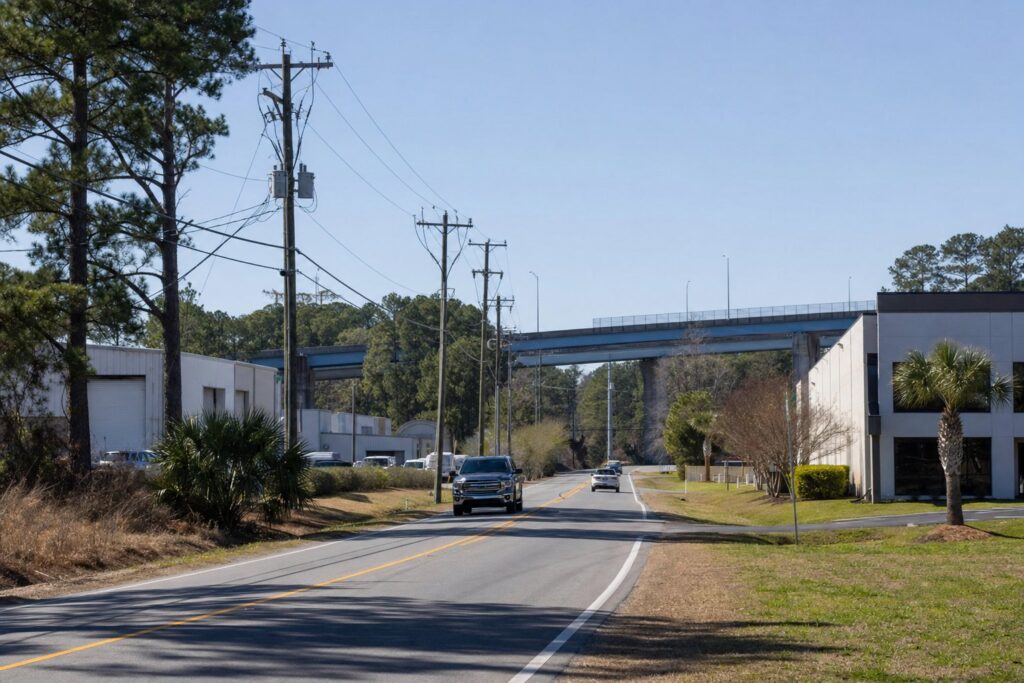
The test is whether a firm can describe this transition before you do. Faber Place Drive is a short collector — a few tenths of a mile inside Wando Gardens, North Charleston 29405 — while the Mark Clark Expressway (I-526) beside it is a two-lane motorway posted at 60 mph. Highway traffic sheds speed directly into a street that also serves commercial driveways and a residential grid, so conflicts here cluster at entry and exit points instead of spreading along a corridor.
That geometry produces a repeatable set of claims: deceleration-zone rear-end impacts, merge collisions, and left-turn or driveway-entry crashes where each driver insists the other moved first. According to the Insurance Institute for Highway Safety, speeding was a factor in 392 of South Carolina's 1,038 traffic deaths in 2024 — 38% of the total — and a 60 mph facility discharging into a low-speed grid is where that differential is felt.
The same expressway also carries freight traffic on the I-526 corridor, and Dorchester Road (SC 642) absorbs the overflow whenever I-526 backs up. A lawyer who names those pressures unprompted is telling you something a five-star review cannot.
Why a Wando Gardens Claim Is Valued Differently Than a City-Wide North Charleston Claim
Where your collision started changes the mechanism, the fault argument and the size of the policy behind it. A firm that treats every North Charleston crash as one product misjudges yours. Who the defendant is matters just as much: Charleston County School District 4 Regional Stadium sits under a mile away, so a crash involving a district vehicle runs on the South Carolina Tort Claims Act calendar instead of the ordinary one.
| Where the crash started | Typical mechanism | What usually drives value |
|---|---|---|
| Mark Clark Expressway (I-526), 60 mph | Rear-end and chain-reaction impacts in queued traffic | Injury severity beyond what vehicle damage suggests; commercial policies |
| I-526 ramps and deceleration zones | Merge conflicts where highway speed meets local speed | Sequence of movements; witnesses; dashcam footage |
| Faber Place Drive, a short collector | Left-turn and driveway-entry collisions against through traffic | Disputed right-of-way; minimum-limits policies |
| Dorchester Road (SC 642) | Through traffic at unstandardized speeds meeting turning movements | Speed evidence, roadway conditions, often a second insurer |
The South Carolina Rules a Firm Should Explain at the First Meeting
Start with the calendar — it is the one thing no lawyer can fix later. You have three years from the date of injury to file a South Carolina personal-injury lawsuit (S.C. Code Ann. § 15-3-530(5)), and a wrongful-death action is brought by the estate's personal representative (S.C. Code Ann. §§ 15-51-10, 15-51-20). One exception matters here.
| Claim type | South Carolina deadline | Authority |
|---|---|---|
| Personal injury | 3 years from the date of injury | S.C. Code Ann. § 15-3-530(5) |
| Wrongful death | 3 years; brought by the estate's personal representative | S.C. Code Ann. §§ 15-51-10, 15-51-20 |
| Against a government entity (district vehicle, public roadway) | 2 years; 3 years only if a verified claim is filed within 1 year | S.C. Code Ann. §§ 15-78-110, 15-78-80 |
Fault is the second rule, and the lever every adjuster pulls on a merge or left-turn crash. Under Nelson v. Concrete Supply Co., 303 S.C. 243, 399 S.E.2d 783 (1991), you recover only if your own share of fault is 50% or less, with any award reduced in proportion; at 51% you recover nothing. Expect the carrier to argue you left a driveway without clearing traffic, followed too closely as I-526 traffic slowed, or merged without signaling — see why insurers dispute Charleston crash claims. Graeham C. Gillin, a partner in Roden Law's Charleston office, tells clients from this part of North Charleston that the fault percentage is effectively negotiated in the first three weeks — from the collision report, the scene photographs and the witnesses — long before anyone discusses a settlement figure, which is why how fast a firm investigates matters more than how loudly it advertises.
One argument the insurer cannot make: South Carolina bars seat-belt non-use as evidence of negligence or comparative negligence (S.C. Code Ann. § 56-5-6540(C)).
The Policy Question to Ask Before Anyone Quotes You a Number
Ask which policy pays before you ask what the case is worth. South Carolina's mandatory liability minimum is only $25,000 per person, $50,000 per accident and $25,000 in property damage (S.C. Code Ann. § 38-77-140) — an amount one ambulance ride and one surgery can exhaust. Uninsured motorist coverage is required on every South Carolina auto policy (S.C. Code Ann. § 38-77-150), and underinsured coverage must be offered to you (S.C. Code Ann. § 38-77-160), sitting excess over the at-fault limits. According to the Insurance Institute for Highway Safety, 563 of South Carolina's 1,038 traffic deaths in 2024 — 54% — happened in urban areas, the developed setting this corridor sits in. A firm that cannot walk that coverage sequence in the first conversation is guessing at your case value. Our explainer on uninsured motorist claims on the Mark Clark Expressway covers the neighboring version of this problem.
Two variations come up here. If the other driver fled — and this compact grid puts a fleeing driver onto a limited-access highway within moments — South Carolina permits a "John Doe" claim under S.C. Code Ann. § 38-77-170, conditioned on a prompt police report and corroboration. If the crash proves fatal, the claim belongs to the estate's personal representative; our North Charleston wrongful death lawyers page explains who holds that authority.
Six Questions to Ask Before You Sign a Fee Agreement
Ask these on the free consultation and listen for specifics, not reassurance. A firm that has handled claims here answers without hedging:
- Is mine a highway-speed case or a local-street case, and where does I-526 traffic slow into the Wando Gardens grid?
- Which policy do you expect to pay — the at-fault driver's, or my own?
- What share of fault will the insurer put on me, and how will you rebut it?
- Is any government entity a potential defendant, and does that shorten my deadline?
- Which court will my case be filed in, and have you tried cases there?
- Who handles my file day to day, what do you charge, and what costs come out of the settlement?
None of this is rude — you are asking what the firm should have volunteered. For a second data point, compare the answers to how to judge counsel after an I-26 crash in Tenmile.
Where a Wando Gardens Case Is Actually Filed
Charleston County Court of Common Pleas, Ninth Judicial Circuit, hears personal-injury and wrongful-death actions arising in Wando Gardens and the rest of North Charleston.
According to the South Carolina Judicial Branch, the Court of Common Pleas is the state's trial court of general jurisdiction for civil matters — where any serious claim from this neighborhood belongs. Three other forums come up: Charleston County Magistrate Court, capped at $7,500 (S.C. Code Ann. § 22-3-10) and limited to minor property-damage matters; North Charleston Municipal Court, which hears the traffic charge written at the scene while your civil claim proceeds separately; and the U.S. District Court for the District of South Carolina, Charleston Division, where an out-of-state trucking or rideshare defendant may remove the case. Our guide to filing in Charleston, Berkeley, or Dorchester County sorts out the county question, and how long a Charleston injury case takes sets expectations before you commit.
What to Do in the First Week After a Crash Off I-526
Get evaluated the same day, even if you feel functional. The nearest full-service hospital, Bon Secours Saint Francis Hospital, is roughly three miles away, so people here often skip the ambulance or wait until morning — and that gap is the first thing an adjuster uses to argue you were not badly hurt. Describe every symptom, including headaches, memory trouble and nausea, and keep every record. Our North Charleston brain injury lawyers page explains why delayed-onset head-injury symptoms get discounted.
Then protect the evidence. Photograph vehicle positions, debris and sight lines before the lane clears, collect witness names yourself, and ask about camera coverage on the Faber Place Drive frontage within days — business systems overwrite footage quickly. According to the Insurance Institute for Highway Safety, 212 of the 520 South Carolina drivers killed in 2024 — 41% — had a blood alcohol concentration of 0.08% or higher, so if impairment is suspected, tell the responding officer and confirm it appears in the report.
Roden Law has recovered more than $300 million across 5,000+ cases and holds a 4.9-star average from 500+ reviews. Start with our car accident lawyers in North Charleston page, or tell our North Charleston personal injury lawyers what this crash has cost you.
About the Author
Graeham C. Gillin is a partner at Roden Law and is admitted to practice law in South Carolina, handling motor-vehicle, catastrophic-injury and wrongful-death claims out of the firm's Charleston office, including collisions on the Mark Clark Expressway (I-526) and the North Charleston streets that feed it. For the statewide picture, see our car accident practice overview.
Free Case Review — No Fees Unless We Win. 📞 Call 844-RESULTS, or reach our North Charleston office at 2703 Spruill Ave, (843) 612-6561.
Frequently Asked Questions
About the Author