

Key Takeaways
Rivers Avenue (US-52) is one of Charleston County's five deadliest roads in SCDOT traffic data — four of which run through North Charleston — and is the city's primary commercial corridor. Heavy truck traffic from port and industrial facilities, Boeing South Carolina, and commercial development create constant hazards. Recent crashes include a cement truck rollover and a tractor-trailer striking the I-526 overhead sign. South Carolina gives victims 3 years to file (S.C. Code § 15-3-530) with recovery if less than 51% at fault.
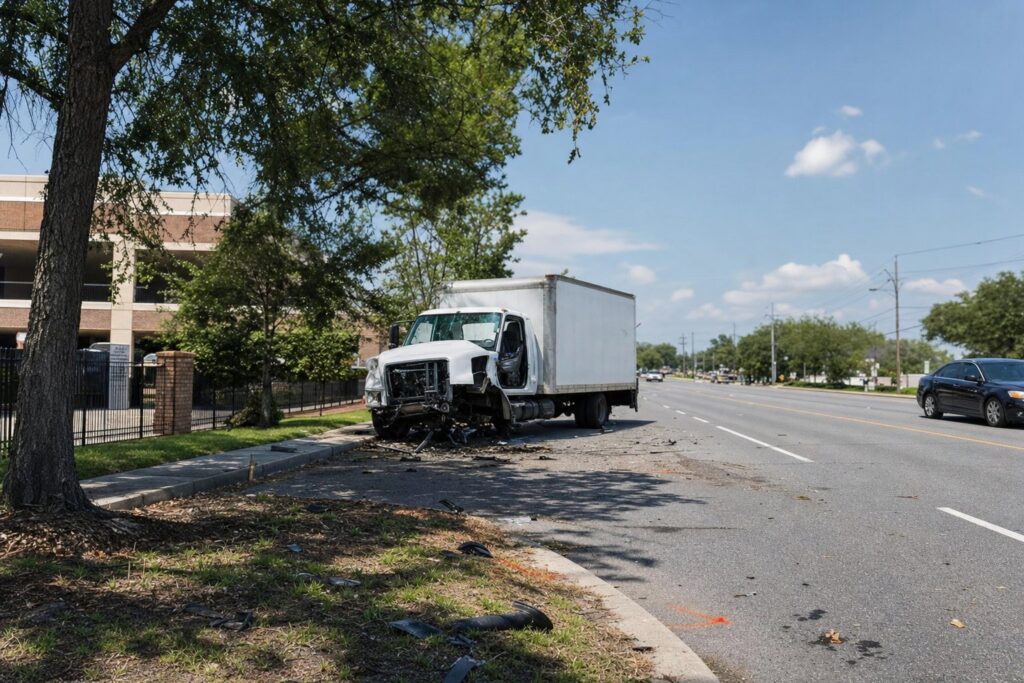
Truck Accidents on Rivers Avenue, North Charleston
Rivers Avenue (US-52) is North Charleston’s primary commercial corridor. South Carolina Department of Transportation traffic data places it among Charleston County’s five deadliest roads — four of which run through North Charleston, alongside Dorchester Road, Ashley Phosphate Road and Remount Road (Live 5 News, July 2026). The road stretches from the I-26/I-526 interchange through the heart of North Charleston’s industrial and commercial district, carrying a volatile mix of heavy truck traffic, local commuters, transit riders, pedestrians, and cyclists.
If you have been injured in a truck accident on Rivers Avenue, you are not alone — and you have legal options.
Why Rivers Avenue Is a Truck Accident Hotspot
Port and Industrial Traffic
Rivers Avenue runs parallel to I-26 through North Charleston’s industrial core. The road serves as an alternative route for trucks accessing the Port of Charleston terminals, Boeing South Carolina’s 787 Dreamliner assembly facility, and dozens of warehouses, distribution centers, and industrial parks. The result is a commercial truck density far exceeding what the road was designed to handle.
Multi-Lane, High-Speed Design
Rivers Avenue is a wide, multi-lane divided highway that encourages high speeds despite heavy commercial driveways, intersections, and pedestrian crossings. Trucks turning into and out of commercial properties create constant speed differentials — a loaded truck decelerating to turn while through-traffic maintains 45-55 mph is a recipe for rear-end collisions.
The Rivers Avenue/I-526 Interchange
This interchange produced 62 injuries between 2011 and 2015 — the highest injury total of any intersection in the tri-county top ten (Post and Courier analysis of preliminary South Carolina Department of Public Safety data). Trucks entering and exiting I-526 merge with Rivers Avenue surface traffic in a compressed space with limited sight lines.
Adjacent to Boeing South Carolina
Boeing’s North Charleston campus generates significant truck traffic — component deliveries, supply chain logistics, and employee commuter traffic. This adds to the already heavy truck volume on Rivers Avenue, particularly during shift changes and delivery windows.
Recent Truck Crashes on Rivers Avenue
- March 2025: A cement truck overturned on Rivers Avenue, shutting down lanes and requiring hazmat response for fluid cleanup
- February 2026: A tractor-trailer struck the I-526 overhead sign near Rivers Avenue, then continued to hit the Eagle Drive overpass on I-26 — demonstrating the cascading effect of truck crashes on the corridor
- Semi-truck collisions have simultaneously disrupted traffic on both I-26 and I-526 due to the interconnected nature of the corridor
Common Truck Crash Types on Rivers Avenue
Rear-End Collisions
The most common crash type on Rivers Avenue. Trucks following too closely cannot stop in time when traffic ahead slows for turning vehicles, red lights, or pedestrians. At 45 mph, an 80,000-pound truck needs approximately 350 feet to stop — but following distances on Rivers Avenue rarely exceed 100 feet during peak traffic.
Left-Turn Crashes
Trucks turning left across multiple lanes of oncoming traffic create severe T-bone collisions. Rivers Avenue’s commercial driveways and intersections require trucks to cross 4-6 lanes of traffic, and gaps in oncoming traffic are frequently misjudged due to truck acceleration limitations.
Rollover Crashes
Top-heavy trucks — cement mixers, tankers, loaded container trucks — overturn when drivers overcorrect, take turns too fast, or when loads shift. The cement truck rollover in March 2025 is a representative example of this common crash type on Rivers Avenue.
Pedestrian and Cyclist Strikes
Rivers Avenue carries significant pedestrian traffic between bus stops, commercial establishments, and residential areas. Trucks have large blind spots and require wider turning radii, making pedestrians and cyclists at intersections particularly vulnerable. Truck right-turn crashes involving pedestrians in the crosswalk are a recurring pattern.
Underride Crashes
When a passenger vehicle slides under the rear or side of a stopped or slow-moving trailer on Rivers Avenue. These crashes are often fatal because the trailer bypasses the car’s crumple zones. Inadequate underride guards — particularly on older trailers — and poor lighting/reflectors on parked trucks at commercial driveways contribute to these crashes.
Liable Parties in a Rivers Avenue Truck Accident
| Liable Party | Common Basis for Liability |
|---|---|
| Truck driver | Following too closely, distraction, failure to yield, speeding, fatigue |
| Trucking company | Negligent hiring, HOS violations, pressure to make deliveries, inadequate training for urban driving |
| Cargo shipper/loader | Overweight or improperly secured loads causing rollover or cargo spills |
| Vehicle/parts manufacturer | Defective brakes, steering, tires, or underride guards |
| Property owner | Poorly designed commercial driveway with inadequate sight lines |
| Government entity | Road design defects, inadequate signage, signal timing failures (subject to SC Tort Claims Act, S.C. Code § 15-78-80) |
FMCSA Regulations
Commercial trucks on Rivers Avenue must comply with all FMCSA regulations, including:
- Hours of Service: 11 hours driving maximum within a 14-hour duty window
- ELD mandate: Electronic logging of all driving time
- Pre-trip inspections: Required inspection of brakes, tires, lights, and safety equipment
- Cargo securement: Proper load distribution and tie-down requirements
- Drug and alcohol testing: Pre-employment, random, and post-accident testing requirements
Violations of any FMCSA regulation are evidence of negligence. If the trucking company knowingly permitted violations — such as allowing drivers to exceed hours-of-service limits — punitive damages may apply.
What to Do After a Truck Accident on Rivers Avenue
- Call 911 — North Charleston Police Department responds to Rivers Avenue crashes. Request EMS regardless of perceived injury severity.
- Stay at the scene — Do not leave, but move to a sidewalk or parking lot if safe to do so. Rivers Avenue traffic makes staying in the roadway extremely dangerous.
- Document the truck: Company name, USDOT number (on cab door), trailer number, cargo type, and all vehicle damage. Photograph the truck from multiple angles.
- Get witness information: Rivers Avenue crashes are often witnessed by nearby business employees, bus riders, and other motorists.
- Seek medical treatment: Trident Medical Center is the closest hospital for most Rivers Avenue crashes.
- Contact a truck accident attorney within 24-48 hours — Evidence preservation is time-critical. ELD data, dash cam footage, and dispatch records can disappear within days.
South Carolina Law
- Statute of limitations: 3 years from the date of injury (S.C. Code § 15-3-530)
- Comparative fault: Recovery is allowed if you are less than 51% at fault
- Punitive damages: Available for willful or reckless safety violations by the trucking company or driver
Free Consultation — Roden Law
Roden Law’s Charleston office represents truck accident victims throughout the Rivers Avenue corridor. We investigate every crash thoroughly — preserving evidence, identifying all liable parties, and fighting for maximum compensation. Call (843) 790-8999 for a free consultation. No fees unless we win.
Related resources: North Charleston Truck Accident Guide | I-526 Truck Accidents | Ashley Phosphate & I-26 Truck Accidents | Most Dangerous Roads & Intersections in North Charleston | Dorchester Road Truck Accidents
Related Pages
Frequently Asked Questions
About the Author

Graeham C. Gillin
Partner, COOGraeham C. Gillin serves as both attorney and Chief Operating Officer at Roden Law. He brings multifaceted expertise with a professional background spanning business management and commercial construction. His diverse experience positions him to lead the firm’s management, growth, and operational success. Education J.D., Charleston School of Law Bachelor’s Degree, Montana State University Bar Admission […]
View Full Profile →