

Key Takeaways
I-526 (Mark Clark Expressway) connects the Port of Charleston's two major terminals and carries some of the heaviest commercial truck traffic in South Carolina. Port truck crashes involve multiple liable parties: driver, carrier, chassis leasing company, terminal operator, and cargo shipper. South Carolina gives victims 3 years to file (S.C. Code § 15-3-530) with recovery if less than 51% at fault.
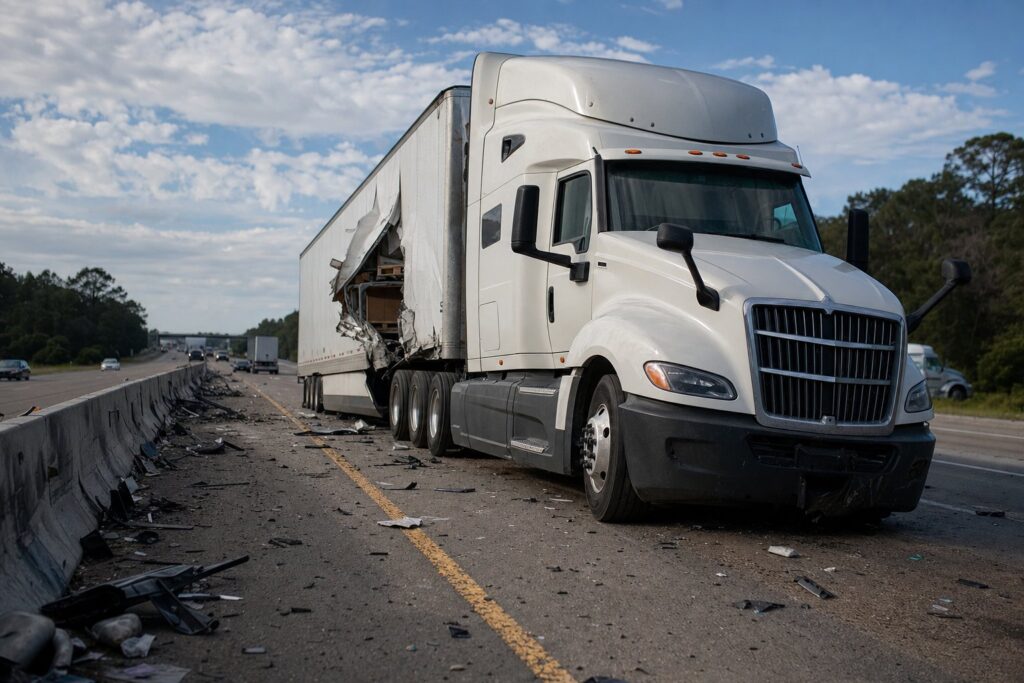
Truck Accidents on I-526: Charleston’s Most Dangerous Freight Corridor
I-526 (Mark Clark Expressway) is the primary beltway connecting North Charleston, West Ashley, and Mount Pleasant — and it carries some of the heaviest commercial truck traffic in South Carolina. The highway serves as the main artery between the Port of Charleston’s two major container terminals, funneling thousands of loaded tractor-trailers through residential and commercial areas every day.
If you or a family member has been injured in a truck accident on I-526, understanding the unique hazards of this highway and your legal rights is the first step toward recovering compensation.
Why I-526 Is Dangerous for Truck Traffic
Port Terminal Access
I-526 directly connects the two busiest Port of Charleston facilities:
- Wando Welch Terminal in Mount Pleasant — accessible via Long Point Road and I-526 eastbound
- Hugh Leatherman Terminal in North Charleston — accessible via Port Access Road and the I-26/I-526 interchange
The Port of Charleston is the 9th largest port in the United States and has the deepest water in the Southeast, handling increasingly larger container vessels. Each vessel offload generates hundreds of individual truck trips, creating sustained periods of heavy truck density on I-526 throughout the day and night.
The I-26/I-526 Interchange
This interchange is the primary merge point for port trucks entering I-526 from the Hugh Leatherman Terminal and I-26 corridor traffic heading toward Mount Pleasant. The combination of high speed, merging traffic, and heavy trucks creates a consistently dangerous environment.
Narrow Lanes and Sharp Curves
Portions of I-526 were designed decades before the current volume of truck traffic. The highway features sections with narrow lanes that provide minimal clearance for 53-foot trailers, sharp interchange ramps that challenge trucks with high centers of gravity, and limited shoulder space that leaves no margin for error when trucks drift.
Ongoing Widening Project
The I-526 widening project — intended to alleviate congestion — has introduced construction zones with lane shifts, reduced speed limits, concrete barriers, and heavy construction equipment. Construction zones increase rear-end collisions as traffic patterns shift unpredictably, and trucks require significantly more stopping distance than passenger vehicles.
Common Truck Crash Types on I-526
Rear-End Collisions
An 80,000-pound fully loaded truck needs approximately 525 feet to stop from 65 mph — nearly two football fields. When I-526 traffic stops suddenly near interchange ramps or construction zones, trucks frequently cannot brake in time. The mass differential means a rear-end collision with a truck is catastrophic for the passenger vehicle.
Merge and Lane-Change Crashes
I-526’s interchange ramps create constant merging conflicts. Trucks accelerating from terminal access roads merge into high-speed traffic, while passenger vehicles attempt to navigate around slower trucks. Blind spots on tractor-trailers extend 20 feet in front, 30 feet behind, and across both adjacent lanes — making lane changes inherently dangerous.
Jackknife Accidents
When a truck’s trailer swings outward, forming a 90-degree angle with the cab, the resulting jackknife sweeps across multiple lanes. Wet pavement on I-526 — common during Charleston’s frequent rain — combined with hard braking is the primary trigger. A jackknifed truck on I-526 can block the entire highway.
Rollovers
Top-heavy container trucks and tankers overturn on I-526’s curved interchange ramps, particularly when loaded unevenly or traveling above the advisory speed for curves. Rollovers on elevated sections of I-526 can send debris onto roads below.
Tire Blowouts
Port container trucks frequently use chassis with retreaded tires, which have higher failure rates than new tires. A tire blowout at highway speed sends debris across travel lanes and can cause the driver to lose control, striking adjacent vehicles. FMCSA regulations require pre-trip tire inspections, and failure to comply is evidence of negligence.
Who Is Liable for an I-526 Truck Accident?
Truck accident liability on I-526 often involves multiple parties:
| Potentially Liable Party | Basis for Liability |
|---|---|
| Truck driver | Speeding, fatigue, distraction, failure to check blind spots, impaired driving |
| Trucking company / motor carrier | Negligent hiring, pressure to violate hours-of-service rules, inadequate training, failure to maintain fleet |
| Port terminal operator | Overloaded containers, improperly secured cargo, unsafe loading procedures |
| Chassis leasing company | Defective leased chassis (brakes, tires, lights, coupling) — common in intermodal port operations |
| Truck or parts manufacturer | Defective brakes, steering systems, coupling mechanisms, or tire failures |
| Maintenance provider | Negligent inspection or repair of safety-critical systems |
| Construction contractor | Unsafe lane shifts, inadequate signage, or hazardous construction zone design during I-526 widening |
Intermodal port trucking is especially complex because the truck driver, the motor carrier, the chassis owner, and the container shipper are often four different entities — each potentially liable for different aspects of the crash.
FMCSA Regulations That Apply
Commercial trucks on I-526 must comply with federal safety regulations including:
- Hours of Service (HOS): Maximum 11 hours of driving within a 14-hour window after 10 consecutive hours off duty
- Electronic Logging Devices (ELD): Digital recording of driving hours — ELD data is critical evidence but can be overwritten within days
- Pre-trip inspections: Drivers must inspect brakes, tires, lights, steering, and coupling devices before each trip
- Cargo securement: Containers must be properly locked to chassis; loose cargo shifting in transit causes rollovers
- Drug and alcohol testing: Post-accident testing is required for crashes involving fatalities or certain injury/vehicle-damage thresholds
Any violation of these federal regulations constitutes evidence of negligence per se, and willful violations may support punitive damages.
What to Do After a Truck Accident on I-526
- Move to safety if possible — Secondary crashes from following traffic are a leading cause of additional injuries on I-526. Stay inside your vehicle with hazard lights on if you cannot exit safely.
- Call 911 immediately — South Carolina Highway Patrol responds to I-526 crashes. Request medical assistance even if injuries seem minor — adrenaline masks pain.
- Document the truck: Company name, USDOT number (displayed on the cab door), trailer number, license plates, and the type of cargo. Photograph everything.
- Note the location: Mile markers, nearest exit, direction of travel. I-526 crash locations affect which emergency room and which law enforcement jurisdiction responds.
- Get medical attention: MUSC Health, Roper St. Francis, or Trident Medical Center are the closest trauma facilities depending on the crash location on I-526.
- Contact a truck accident attorney within 24-48 hours — ELD data, dash cam footage, and dispatch records can be overwritten or destroyed quickly. A spoliation preservation letter must be sent immediately.
South Carolina Truck Accident Law
- Statute of limitations: 3 years from the date of injury (S.C. Code § 15-3-530)
- Comparative fault: You can recover compensation if you are less than 51% at fault for the accident. Your damages are reduced by your percentage of fault.
- Punitive damages: Available when the trucking company or driver acted with willful, wanton, or reckless disregard for safety — such as falsifying ELD logs, knowingly dispatching a fatigued driver, or ignoring known mechanical defects
- Government entity claims: If the I-526 widening project or road design contributed to the crash, claims against SCDOT or contractors may be subject to the SC Tort Claims Act (S.C. Code § 15-78-80)
Free Consultation — Roden Law Charleston
Roden Law’s Charleston office handles I-526 truck accident cases on contingency — you pay no fees unless we recover compensation. We send spoliation preservation letters within hours, retain accident reconstruction experts, and identify every liable party in the chain. Call (843) 790-8999 for a free consultation.
Related resources: Port truck accidents in Charleston | Rivers Avenue Truck Accidents | I-526 through Mount Pleasant and the Wando Bridge | I-526 Lowcountry Corridor Construction Zone
Related Pages
Frequently Asked Questions
About the Author

Graeham C. Gillin
Partner, COOGraeham C. Gillin serves as both attorney and Chief Operating Officer at Roden Law. He brings multifaceted expertise with a professional background spanning business management and commercial construction. His diverse experience positions him to lead the firm’s management, growth, and operational success. Education J.D., Charleston School of Law Bachelor’s Degree, Montana State University Bar Admission […]
View Full Profile →