
Last reviewed: 2026-06-16
If you or someone you love was hurt in a boat crash on the Waccamaw River or the Atlantic Intracoastal Waterway, a Bucksport boating accident lawyer can help you protect your claim before critical deadlines pass. A wreck at the Bucksport Marina ramp, a wake-induced capsizing on the ICW, or a collision in a no-wake zone can change your life in seconds — mounting medical bills, lost income, and pain that disrupts everything. You deserve answers, and you deserve them now. At Roden Law, we never charge upfront fees, and you pay nothing unless we win your case.
Key Takeaways
- In South Carolina you generally have 3 years from the date of injury to file a boating-injury lawsuit (S.C. Code Ann. § 15-3-530); wrongful-death actions also run 3 years from the date of death.
- Any boating crash causing injury, death, or more than $2,000 in property damage must be reported to the South Carolina Department of Natural Resources within 48 hours (S.C. Code Ann. § 50-21-113).
- Boating under the influence is its own offense under S.C. Code Ann. § 50-21-112 — a separate framework from the auto DUI statutes.
- Your auto insurance UM/UIM coverage under S.C. Code Ann. § 38-77-160 does not automatically extend to watercraft, so never assume your car policy fills a boat-crash coverage gap.
- South Carolina's 51% comparative-fault bar lets you recover if you are 50% or less at fault, with damages reduced by your share (Nelson v. Concrete Supply Co.).
- Bucksport's remote river landings on US-701 mean slow EMS response, so on-water injuries are often more severe by the time help arrives.
- Roden Law's Myrtle Beach office works boating cases on contingency — no fees unless we win.
Why Bucksport's Water Is More Dangerous Than It Looks
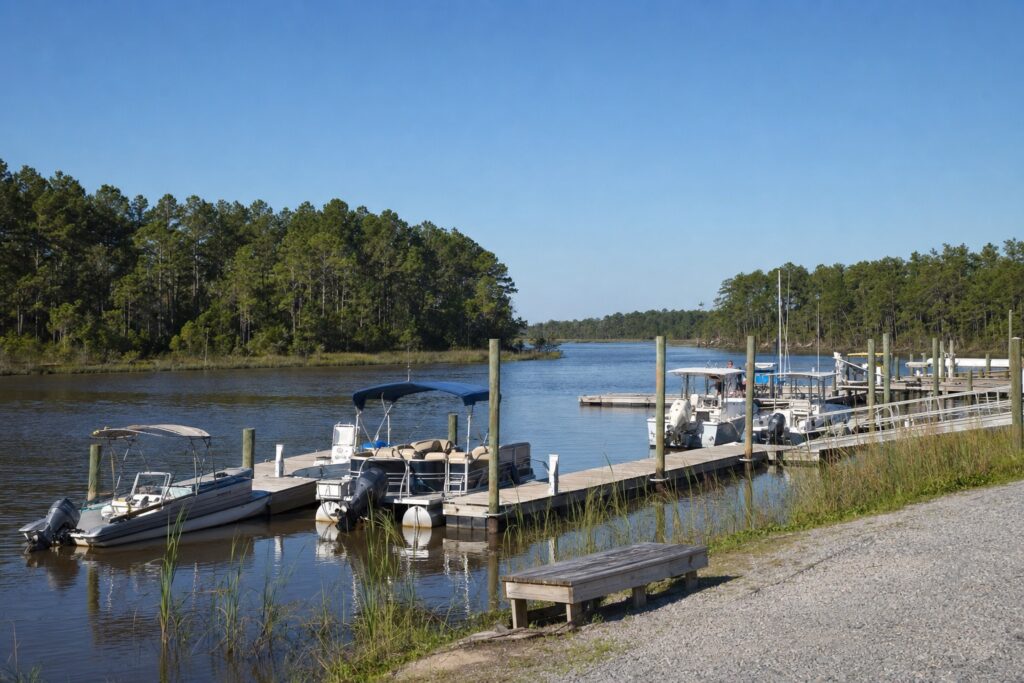
Bucksport’s water is far more dangerous than it looks because the confluence of the Waccamaw River and the Atlantic Intracoastal Waterway in southwestern Horry County mixes local fishing and pontoon traffic with transient ICW cruisers passing through.
The risks here are specific to the geography. The Waccamaw narrows into blind bends that cut reaction time between approaching vessels. Large boats and barges on the Intracoastal Waterway throw wake big enough to swamp or destabilize a small craft. Congestion builds around the Bucksport Marina ramp and fuel dock, where no-wake-zone violations are common on a busy weekend. And because Bucksport is a rural, unincorporated river community, the launch sites and landings off US-701 are remote — when someone is hurt on the water, EMS simply takes longer to reach them.
According to U.S. Coast Guard data, alcohol use is the leading known contributing factor in fatal recreational boating accidents nationwide — a sobering reality on a corridor where boating and drinking too often go together. According to South Carolina Department of Natural Resources reporting, alcohol is consistently among the top contributing factors in the boating fatalities the agency investigates each year. Graeham C. Gillin, a partner and Chief Operating Officer at Roden Law, points out that the combination of inexperienced seasonal operators, heavy summer traffic, and alcohol turns the Bucksport stretch of the Waccamaw and ICW into one of the most underestimated injury settings in the entire Grand Strand region.
The First 48 Hours: South Carolina's Boating-Crash Report Rule
The single most time-sensitive duty after a boat wreck is the reporting requirement. Under S.C. Code Ann. § 50-21-113, any boating accident that causes injury, death, or more than $2,000 in property damage must be reported to the South Carolina Department of Natural Resources within 48 hours. This is separate from — and faster than — the deadline to file a lawsuit.
According to South Carolina Department of Natural Resources guidance, this report is the official record investigators rely on to reconstruct what happened, and a missing or late report can complicate both the criminal investigation and your civil injury claim. If you were too badly hurt to file it yourself, that is something a Bucksport boating accident lawyer can help address — but the clock starts the moment the crash occurs.
If you are able, our guide on what to do after a boat accident walks through the immediate steps that protect both your health and your claim. The short version: get medical care, document the scene and the other vessel, identify witnesses, and make sure the SCDNR report is filed on time.
Boating Under the Influence Is Not the Same as a DUI
People assume a drunk-boating case works like a drunk-driving case. It does not. Boating under the influence is governed by its own statute — S.C. Code Ann. § 50-21-112 — which is a distinct legal framework from South Carolina's auto DUI laws. The thresholds, the testing rules, and the way the offense interacts with your civil injury claim are specific to watercraft.
That distinction matters for your recovery. An operator's BUI charge can be powerful evidence of negligence in your civil case, but the criminal process and your injury claim are separate tracks. We handle the civil side — proving liability and pursuing compensation — while coordinating with the criminal timeline. If alcohol was a factor in your wreck, our team that handles boating under the influence (BUI) cases can explain how it strengthens your claim.
The Insurance Trap: Your Car Policy May Not Cover a Boat Crash
This is the mistake that costs Bucksport boating victims the most. Many people assume the uninsured/underinsured motorist coverage on their auto policy will protect them if the at-fault boater has little or no insurance. It often will not. South Carolina's UM/UIM statute, S.C. Code Ann. § 38-77-160, governs motor vehicle coverage and does not automatically extend to watercraft.
Unlike cars, recreational boats are not required to carry liability insurance in South Carolina, so an at-fault operator may have no coverage at all. That makes identifying every possible source of recovery — the boat owner's homeowner or watercraft policy, a rental company's policy, or a separately purchased watercraft UM endorsement — one of the first things a Bucksport boating accident lawyer investigates. Graeham C. Gillin notes that the firm has seen too many injured boaters wrongly assume their car insurance had them covered, only to discover the gap after the bills had already arrived.
| Issue | On the water (boat crash) | On the road (car crash) |
|---|---|---|
| Governing impairment statute | BUI — S.C. Code Ann. § 50-21-112 | Auto DUI statutes |
| Mandatory liability insurance | Not required for recreational boats | Required for registered vehicles |
| Auto UM/UIM (§ 38-77-160) applies | Not automatically — watercraft generally excluded | Yes, applies to the vehicle |
| Crash-reporting agency | SCDNR within 48 hours (§ 50-21-113) | Law enforcement / SCDMV |
| Statute of limitations | 3 years (§ 15-3-530) | 3 years (§ 15-3-530) |
Common Bucksport-Area Boat Crashes We Handle
The wrecks on this corridor follow patterns set by the water itself:
- Boat-on-boat collisions in the marina basin and no-wake zones, often from congestion near the ramp and fuel dock.
- Wake-induced capsizing and passenger ejection on the Intracoastal Waterway, when barge or large-vessel wake hits a small boat.
- Propeller-strike injuries to swimmers and to passengers thrown into the water.
- Dock and slip injuries while boarding or stepping off at Bucksport Marina — see our dock and marina injury claims page.
- Pontoon incidents, reflecting the heavy pontoon traffic on the Waccamaw — our pontoon boat accidents page covers these in depth.
- Jet ski and personal watercraft collisions and ejections, driven by inexperienced seasonal renters; our jet ski and personal watercraft accident claims page explains those cases.
Severe wakes, propeller injuries, and capsizings frequently send victims to Conway Medical Center, the nearest full-service hospital, or to Grand Strand Medical Center in Myrtle Beach, the designated regional trauma center. According to U.S. Coast Guard statistics, the majority of people who die in boating accidents drown, and most of those drowning victims were not wearing a life jacket — a stark reminder of how quickly an on-water injury becomes life-threatening when help is far away.
How Fault Is Decided — and Where Your Case Is Filed
South Carolina follows a modified comparative-negligence rule with a 51% bar. Under the standard set in Nelson v. Concrete Supply Co., you can recover only if you are 50% or less at fault, and your damages are reduced by your percentage of fault. So if a court finds you 20% responsible for a collision, your recovery is reduced by 20% — but you are not barred from recovering. Our explainer on how being partially at fault affects your South Carolina case breaks this down with examples.
If your case requires a lawsuit, Horry County personal injury claims are filed in the Court of Common Pleas for the 15th Judicial Circuit in Conway, with smaller matters heard in the Horry County Magistrate Court. And the deadline is firm: you generally have three years from the date of injury under S.C. Code Ann. § 15-3-530. Our overview of South Carolina's 3-year statute of limitations explains the narrow exceptions — but you should never count on one.
Why Roden Law
Roden Law has recovered more than $300 million for injured clients, handled 5,000+ cases, and carries 62 years of combined experience across our offices. Our Myrtle Beach office at 631 Bellamy Ave. Suite C-B in Murrells Inlet serves the Grand Strand, including the Bucksport river community. As South Carolina boating accident lawyers, we investigate the vessels, the wake, the operators, and every available insurance policy — and we do it on contingency.
If your wreck involved a commercial vessel or a barge on the Intracoastal Waterway, our Myrtle Beach maritime injury lawyers handle those distinct maritime claims, and for boaters launching from the same market our Myrtle Beach boating accident lawyers page covers local service-area details. For background on liability, our piece on the common causes of boating accidents and your legal rights is a useful starting point, and families dealing with a crash farther down the corridor can read about Georgetown County crash claims downstream on the corridor.
📞 Call 844-RESULTS for a Free Case Review — No Fees Unless We Win.
Frequently Asked Questions
Q: How long do I have to file a boating accident lawsuit after a crash near Bucksport?
A: In South Carolina, you generally have 3 years from the date of injury to file a personal injury lawsuit, including for boating crashes, under S.C. Code Ann. § 15-3-530. Wrongful-death actions also run three years from the date of death. Waiting risks losing your right to recover entirely, and evidence on the water disappears fast, so contacting a Bucksport boating accident lawyer early protects your claim.
Q: Do I have to report a boat accident on the Waccamaw River or Intracoastal Waterway?
A: Yes. Under S.C. Code Ann. § 50-21-113, any boating accident causing injury, death, or more than $2,000 in property damage must be reported to the South Carolina Department of Natural Resources within 48 hours. This is separate from filing a lawsuit. The SCDNR report becomes the official record investigators and insurers rely on, so a missing or late report can weaken your civil claim.
Q: Will my car insurance cover me if I'm hurt in a boat crash?
A: Often not. South Carolina's uninsured/underinsured motorist coverage under S.C. Code Ann. § 38-77-160 governs motor vehicles and does not automatically extend to watercraft. Because recreational boats are not required to carry liability insurance in South Carolina, an at-fault boater may have no coverage at all, making a full insurance investigation one of the first things your lawyer should do.
Q: Is boating under the influence treated like a DUI in South Carolina?
A: No. Boating under the influence is governed by its own statute, S.C. Code Ann. § 50-21-112, which is a separate framework from South Carolina's auto DUI laws. In your civil injury case, an operator's BUI charge can serve as strong evidence of negligence, but the criminal process and your compensation claim move on separate tracks.
Q: What if I was partly at fault for the boating accident?
A: You may still recover. South Carolina uses a modified comparative-negligence rule with a 51% bar (Nelson v. Concrete Supply Co.): you can recover as long as you are 50% or less at fault, with your damages reduced by your share. For example, being found 25% at fault reduces your recovery by 25% but does not eliminate it.
Q: Where would my Bucksport boating accident lawsuit be filed?
A: Horry County personal injury lawsuits are filed in the Court of Common Pleas for the 15th Judicial Circuit in Conway, with smaller claims heard in the Horry County Magistrate Court. Bucksport sits in southwestern Horry County, so a crash on its stretch of the Waccamaw River or Intracoastal Waterway falls under that court's jurisdiction. Roden Law's Myrtle Beach office handles these cases on contingency.
About the Author
Graeham C. Gillin is a partner and Chief Operating Officer at Roden Law and is licensed by the South Carolina Bar. He leads the firm's personal injury team across its Grand Strand and Lowcountry offices, including the Myrtle Beach office serving Murrells Inlet, Conway, and the Bucksport river community. This article is for general information and is not legal advice; for guidance on a specific boating accident, contact a licensed South Carolina attorney.
About the Author