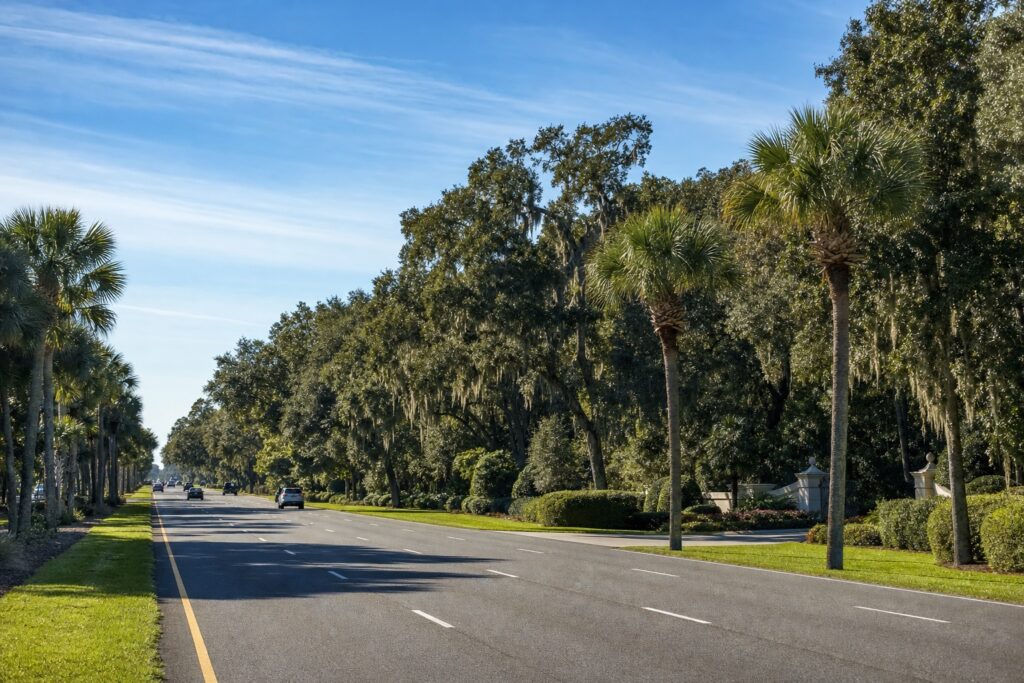
If you or a loved one was hurt in a crash on U.S. Highway 17 between North Litchfield Beach and Pawleys Island, you need a Litchfield Beach Pawleys Island car accident lawyer who understands that Georgetown County — not Horry County — is the jurisdiction your case sits in. The Ocean Highway is the single artery feeding the entire south Grand Strand, and a wreck there isn't like a Myrtle Beach fender-bender. It's a resort-corridor crash, often involving out-of-state renters, plantation-community traffic, and the South Carolina 25/50/25 minimum-coverage problem that quietly leaves serious injuries underfunded.
This guide is for Litchfield Retreat residents, North Litchfield Beach homeowners, Litchfield Plantation members, and anyone who drives the Ocean Highway between Murrells Inlet and Georgetown. It covers what to do at the scene, how Georgetown County jurisdiction shapes your case, the three-year South Carolina deadline, and the specific recovery levers — UM/UIM stacking, SC Tort Claims Act notice, multi-state policy analysis — that decide whether a Pawleys crash victim is made whole.
Key Takeaways
- South Carolina gives you three years from the date of the crash to file a personal-injury lawsuit under S.C. Code § 15-3-530(5). Wrongful-death claims share the same three-year window.
- Litchfield Beach and Pawleys Island sit in Georgetown County, not Horry County. Your case proceeds in the Georgetown County Court of Common Pleas (15th Judicial Circuit) in Georgetown — not the Myrtle Beach courthouse.
- U.S. Highway 17 (Ocean Highway / Kings Highway) is the only continuous north–south road through the corridor — making every plantation entrance, retail right-turn, and beach access a recurring crash geometry.
- South Carolina's 25/50/25 minimum-liability limits under S.C. Code § 38-77-140 rarely cover a serious US-17 corridor crash. UM/UIM stacking under S.C. Code § 38-77-160 is the recovery lever that closes the gap.
- Modified comparative negligence applies under Nelson v. Concrete Supply Co.: if you are 50% or less at fault, you recover, with the award reduced by your share.
- Tidelands Waccamaw Community Hospital in Murrells Inlet is the closest emergency department — about six miles north on US-17. Document treatment from the first ER visit forward.
- Roden Law is contingency-fee — no upfront cost, no legal fees unless we win your case.
Why US-17 Through Litchfield and Pawleys Is Its Own Crash Problem
If you live in Litchfield Retreat, Litchfield Plantation, or North Litchfield Beach, you already know the Ocean Highway is overworked. It is the lone continuous north–south corridor for Pawleys Island, Murrells Inlet, Brookgreen Gardens visitors, and Huntington Beach State Park traffic — about 2.2 miles south of the Litchfield neighborhoods. There is no parallel relief route. When US-17 backs up, every plantation entrance becomes a left-turn pressure cooker.
According to the Federal Highway Administration's Office of Safety, undivided and partially-divided rural highways like US-17's resort segments account for a disproportionate share of fatal and serious-injury crashes because driver speeds rise the moment signal density drops. The Litchfield-Pawleys segment hits that profile squarely — long divided stretches between signalized openings, unsignalized plantation entrances, and limited acceleration lanes for cars merging from gated subdivisions.
According to the South Carolina Department of Public Safety's most recent Traffic Collision Fact Book, Georgetown County recorded hundreds of traffic collisions in the latest reporting year, with a measurably higher injury rate per crash than the statewide average — consistent with the rural-highway geometry that defines US-17 south of Murrells Inlet.
Layer the seasonal surge on top of that. According to U.S. Census Bureau population data and the South Carolina Department of Parks, Recreation & Tourism, the Grand Strand sees its visitor count multiply between Memorial Day and Labor Day — and the Pawleys / Litchfield corridor catches a meaningful slice of that traffic on Friday-arrival and Sunday-departure days.
Graeham C. Gillin, a partner and Chief Operating Officer at Roden Law, points out that this resort-corridor profile is what makes Pawleys cases different from inland South Carolina car crashes. The at-fault driver is frequently an out-of-state weekend renter operating on a home-state policy, the witnesses go home Sunday afternoon, and the scene evidence — skid marks, debris fields, signal-timing logs — degrades within days. The window to lock in proof is short, and it closes faster than the three-year statute would suggest.
The Corridor's Recurring Crash Types
Crashes on US-17 through Litchfield and Pawleys follow recurring patterns rather than striking at random. They cluster in predictable geometries:
- Left-turn / oncoming collisions at plantation-community entrances — a driver waiting to turn left into Litchfield Retreat, Litchfield Plantation, or a North Litchfield beach-access road misjudges an oncoming gap.
- Rear-end crashes at retail right-turn lanes along the Pawleys Island commercial strip and near Hammock Shops Village.
- Golf-cart and low-speed-vehicle crashes at unsignalized US-17 crossings — a recurring geometry where plantation residents try to cross the highway between neighborhood segments. South Carolina golf-cart and LSV rules under S.C. Code § 56-2-100 and § 56-3-115 strictly limit where these vehicles can legally operate.
- Pedestrian and bicyclist strikes at beach-access crossings — most acute on summer Saturday afternoons.
- Rideshare and TNC crashes during Friday and Saturday evening peaks, when Murrells Inlet restaurant traffic floods the corridor.
- Wet-weather rear-end and hydroplane crashes following Lowcountry afternoon thunderstorms — a near-daily June through September pattern.
- Hit-and-run and uninsured-motorist crashes on the corridor's residential feeder streets, where seasonal-rental occupants frequently carry only SC minimum limits or nothing at all.
According to the National Highway Traffic Safety Administration (NHTSA), hit-and-run crashes have risen substantially over the past decade nationwide, and roughly one in eight U.S. drivers is uninsured per the Insurance Research Council — figures that map directly onto the seasonal-rental population on the Grand Strand and make the analysis below load-bearing.
Georgetown County, Not Horry County — Why the Distinction Matters
The Pawleys Island / Litchfield corridor sits in Georgetown County. That is true even though Roden Law's nearest office is in Murrells Inlet (Horry County) and the Grand Strand reads as one media market. The line moves the entire case.
| Case feature | Georgetown County | Horry County (for comparison) |
|---|---|---|
| Trial court | Georgetown County Court of Common Pleas | Horry County Court of Common Pleas |
| Judicial circuit | 15th Judicial Circuit (Georgetown) | 15th Judicial Circuit (Conway / Horry) |
| Small civil claims | Georgetown County Magistrate's Court (civil claims up to $7,500) | Horry County Magistrate's Court |
| Federal venue | U.S. District Court for the District of South Carolina, Florence Division | Same — D.S.C., Florence Division |
| Common SC statute of limitations | 3 years — S.C. Code § 15-3-530(5) | 3 years — same |
The 15th Judicial Circuit covers both Georgetown and Horry, but the courthouse, the judges, the clerks, and the local rules in Georgetown are not interchangeable with Conway's. Filing in the wrong venue costs time you do not have, and a Litchfield Beach Pawleys Island car accident lawyer who tries the Georgetown courthouse regularly is meaningfully different from one who only handles Horry cases.
If the at-fault party is a state agency — for example, a claim against the South Carolina Department of Transportation over signage, signal timing, or US-17 highway design — the South Carolina Tort Claims Act (S.C. Code § 15-78-10 et seq.) controls. That statute caps damages and cuts the deadline to two years from discovery (S.C. Code § 15-78-110), against the general three-year personal-injury rule. Filing a verified claim with the agency within one year (S.C. Code § 15-78-80) is optional and restores the third year. Missing the two-year deadline on a US-17 design-defect theory ends the claim before discovery starts.
The South Carolina Statute of Limitations — and Why It Isn't a Cushion
Under S.C. Code § 15-3-530(5), you have three years from the crash date to file a personal-injury lawsuit in South Carolina. Wrongful-death claims share the same three-year clock. That sounds generous compared to Georgia's two-year window, but on a Pawleys corridor crash it gets eaten fast. Out-of-state witnesses become unreachable. Plantation-community surveillance footage cycles. Tidelands Waccamaw and Tidelands Georgetown Memorial medical records require records subpoenas that take weeks. SCDOT signal-timing data has to be requested before it overwrites.
Read South Carolina's three-year personal-injury statute of limitations for the full breakdown.
Modified Comparative Negligence and the 50% Bar
South Carolina follows a modified comparative-negligence rule under Nelson v. Concrete Supply Co., 303 S.C. 243 (1991). You recover only if your share of fault is 50% or less, and your award is reduced by your percentage. Cross 51% and you recover nothing.
That number is not abstract. On the Litchfield-Pawleys corridor, defense carriers routinely argue the injured plaintiff was speeding (S.C. Code § 56-5-1520 — basic speed law), turned across oncoming traffic at an unsignalized opening (§ 56-5-1810 — right-of-way at intersections), or was distracted. Fault gets carved up. The difference between a 35% allocation and a 51% allocation is the difference between full recovery and nothing — and it usually turns on physical evidence captured in the first 72 hours.
The SC 25/50/25 Problem and How UM/UIM Stacking Solves It
Under S.C. Code § 38-77-140, South Carolina's minimum auto-liability limits are 25/50/25 — $25,000 per person, $50,000 per accident, $25,000 property damage. A serious US-17 corridor crash blows through $25,000 in ER charges alone. Tidelands Waccamaw's emergency department is the first stop for most Litchfield crash victims, with Tidelands Georgetown Memorial about 14 miles south and Grand Strand Medical Center (the region's Level II trauma center) about 17 miles north. Any of those hospitalizations puts you over the minimum policy limit before discharge.
That's where S.C. Code § 38-77-160 does the real work. Uninsured-motorist (UM) coverage under § 38-77-150 is mandatory; underinsured-motorist (UIM) coverage is offered and frequently stackable across vehicles on the same household policy. On a Pawleys crash with an out-of-state renter driver carrying their home-state minimum, stacking your own UIM policy is often the only path to full recovery. Read South Carolina UM/UIM stacking explained for the mechanics. (The post is written for Georgia but covers the SC stacking analysis where the rules differ.)
Graeham C. Gillin notes that the firm's Pawleys and Litchfield clients are disproportionately retirees on fixed incomes — exactly the population least able to absorb the gap between a 25/50/25 policy and the real cost of orthopedic surgery, weeks of rehabilitation, and lost retirement income. The UM/UIM stacking analysis is not a footnote on these cases; it is frequently the case.
What to Do at the Scene of a US-17 Crash
The plantation-community geometry actively complicates post-crash documentation. Gated subdivisions, single-access roads, and pockets of poor cell coverage all slow the response. Take these steps in order:
- Call 911 immediately. Even a low-speed plantation-entrance collision needs a police report — SC Highway Patrol or Georgetown County Sheriff will respond on the US-17 segment.
- Photograph everything before vehicles move — final positions, debris fields, skid marks, signage, signal phase, and weather. Lowcountry afternoon storms erase rubber and water marks within hours.
- Get the other driver's policy declarations page, not just an insurance card. Out-of-state renters often carry minimum home-state limits that look different on the dec page than on the card.
- Identify out-of-state witnesses and get phone numbers, not just license plates. Weekend renters leave on Sunday and are not coming back.
- Get evaluated at Tidelands Waccamaw (the closest ER, about 6 miles north on US-17), Tidelands Georgetown Memorial, or Grand Strand Medical Center. Same-day documentation is foundational to the claim.
- Do not give a recorded statement to the other driver's carrier before talking to a lawyer.
For a deeper checklist, see our step-by-step guide after a South Carolina car crash and protecting your rights after a Myrtle Beach car accident.
Special Corridor Issues Worth Knowing
Out-of-state renters and multi-state policy analysis. When the at-fault driver is from Ohio, Pennsylvania, or anywhere out of state, their home-state auto policy still applies — but South Carolina choice-of-law rules govern the dispute. Coverage stacking, set-offs, and bad-faith analysis can vary sharply across states.
Drunk-driver and rideshare exposure. Friday and Saturday evenings on US-17 between Murrells Inlet and Pawleys are the corridor's highest DUI-risk windows. Roden Law's drunk driver accident lawyers and rideshare and Uber accident lawyers handle these — and see also summer DUI accident risk along the coast for the Memorial-Day-to-Labor-Day seasonal pattern.
Hit-and-run. Under S.C. Code § 56-5-6240, leaving the scene is a crime — and a hit-and-run claim is paid through your own UM coverage. See our hit-and-run accident lawyers practice page.
Commercial trucking. US-17 carries continuous commercial-vehicle volume between Charleston and Wilmington. Truck crashes invoke federal motor-carrier regulations on top of South Carolina law — see Myrtle Beach, SC truck accident lawyers.
Golf-cart and LSV crashes at US-17 crossings — see Myrtle Beach, SC golf cart accident lawyers. Roadway eligibility, operator licensure, and permit status under § 56-2-100 and § 56-3-115 control liability.
Pedestrian and bicyclist strikes at beach-access crossings — see Myrtle Beach pedestrian accident lawyers and South Carolina pedestrian right-of-way rules.
Fatal corridor crashes. Wrongful-death actions on the Pawleys / Litchfield segment also fall under the three-year § 15-3-530 window. See Myrtle Beach wrongful death attorneys for filing mechanics, including the South Carolina personal-representative requirement.
The pillar for this corridor is Myrtle Beach, SC car accident lawyers — that is the geographic Roden hub for Pawleys and Litchfield clients, and our Roden Law personal injury team covers every related claim type. For the broader corridor picture, also see Myrtle Beach's most dangerous roads and intersections.
About the Author
This guide was reviewed by Graeham C. Gillin, a partner and Chief Operating Officer at Roden Law and CEO. Graeham is licensed by the South Carolina Bar. Roden Law's Myrtle Beach office serves the Pawleys Island and Litchfield Beach corridor from 631 Bellamy Ave., Suite C-B, Murrells Inlet, SC 29576 — about six miles north of Litchfield on US-17. Call (843) 612-1980 or 1-844-RESULTS for a free case review. No fees unless we win.
Frequently Asked Questions
About the Author