

Key Takeaways
A golf cart needs a DMV permit decal and registration certificate before it may use a South Carolina public highway — S.C. Code § 56-2-90(A). The operator must be at least 16 with a valid driver's license, carrying the registration, proof of insurance and the license — § 56-2-90(B). With no local ordinance: daylight only, secondary highways posted 35 mph or less, within four miles of the registered address — § 56-2-90(D). Every golf-cart passenger under 12 must wear a fastened safety belt on public roads — § 56-2-90(E). Section 56-2-105, the golf-cart statute from 2012 to 2025, was repealed on May 22, 2025 and is no longer law. File a South Carolina injury lawsuit within three years — S.C. Code § 15-3-530 — and recover if less than 51% at fault (Nelson v. Concrete Supply Co.).
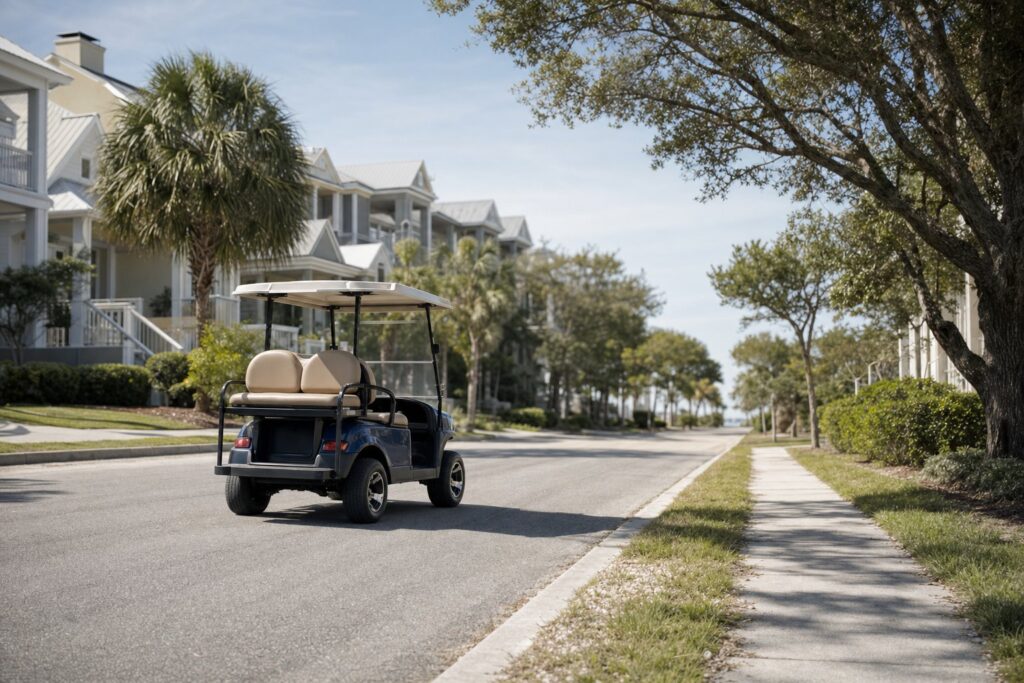
South Carolina golf cart laws allow golf carts on some public roads, and the price of admission is a permit: a Department of Motor Vehicles permit decal and registration certificate, roads posted 35 mph or less, and an operator at least 16 with a valid driver’s license. That rule is S.C. Code § 56-2-90, added by 2025 Act No. 64 effective May 22, 2025 — the section that replaced the old golf-cart statute, § 56-2-105.
Are golf carts street legal in South Carolina?
A permitted golf cart is street legal in South Carolina on the roads the statute allows, and the permit comes first: the owner must obtain a decal and registration certificate from the Department of Motor Vehicles with proof of ownership and proof of liability insurance — S.C. Code § 56-2-90(A). According to the South Carolina Legislative Services Agency’s published text of § 56-2-90, the fee is five dollars and the decal must be replaced every five years, or when the owner changes address, whichever comes sooner (read 2026-09-19).
The rules under § 56-2-90, subsection by subsection
South Carolina sets a statewide default and then lets a municipality or county adjust parts of it by ordinance, so each rule below carries both.
| Rule | Default under the statute | What an ordinance may change | Subsection |
|---|---|---|---|
| Permit | DMV decal and registration certificate; proof of ownership, proof of liability insurance, $5 fee; replaced every five years or on a change of address | No proof of property ownership or rental may be demanded for a decal | (A), (C)(4) |
| Operator | At least 16, valid license, carrying registration, proof of insurance (§ 38-77-140) and license | Nothing — statewide | (B) |
| Roads | Secondary highways posted 35 mph or less; may cross a faster highway at an intersection | Hours, methods, locations — still only at 35 mph or less | (C)(1), (D)(2), (D)(4) |
| Distance | Within four miles of the registration address, or of a gated community’s entrance | Locations, by ordinance | (D)(3) |
| Time of day | Daylight only | Night operation, for carts with working headlights and taillights | (C)(2), (D)(1) |
| Passengers under 12 | Fastened safety belt required | Nothing — statewide | (E) |
Local ordinances vary from town to town under § 56-2-90(C), which also lets a municipality or county designate separated cart paths, so the only reliable source for the rule on your street is the municipal or county code.
What the 2025 law changed
The 2025 act carried the old rule forward and added four things. Section 56-2-90 kept the permit, the $5 fee and five-year decal, the operator age of 16, the license requirement, the 35 mph limit and the four-mile radius; new are the local power to allow night operation with working lights, the power to designate separated cart paths, the bar on demanding proof of property ownership for a decal, and the belt rule for passengers under 12.
According to the South Carolina General Assembly’s record for H. 3292, the bill was ratified on May 20, 2025, signed by the Governor on May 22, 2025, and became 2025 Act No. 64 — adding § 56-2-90 and repealing § 56-2-105 the same day. Anything stating the rule under § 56-2-105 today describes a repealed section.
Golf cart or low-speed vehicle? Two different vehicles
A golf cart and a low-speed vehicle are separate categories in South Carolina law, and which one you own decides which rules apply. Low-speed vehicles are governed by S.C. Code § 56-2-100: an LSV may run only on highways posted 35 mph or less, may cross a faster highway at an intersection, and must meet Federal Motor Vehicle Safety Standard 500 (49 C.F.R. § 571.500) on any highway.
According to the South Carolina Legislative Services Agency’s Title 56 definitions, a low-speed vehicle is a four-wheeled motor vehicle attaining more than 20 mph and not more than 25 mph in one mile, with a gross vehicle weight rating under 3,000 pounds. According to the U.S. Government Publishing Office’s text of 49 C.F.R. § 571.500, an LSV must also carry headlamps, turn signals, taillamps, stop lamps, reflectors, mirrors, a parking brake, a conforming windshield, a VIN and seat belts (2023 CFR edition, read 2026-09-19).
Speeding up a golf cart puts it outside both categories: § 56-2-120(A) says the State will not issue vehicle identification numbers to retrofitted golf carts, which therefore do not qualify as low-speed vehicles here.
The insurance a golf cart permit requires
Proof of liability insurance is a condition of the permit itself, and the operator must carry that proof on the road — S.C. Code § 56-2-90(A) and (B). Subsection (B)(2) ties the coverage to S.C. Code § 38-77-140, the state’s minimum automobile liability limits: $25,000 for bodily injury to one person, $50,000 for bodily injury to two or more people in one accident, and $25,000 for property damage (S.C. Code Title 38, Chapter 77, read 2026-09-19).
If you are hurt in a golf cart crash
A golf-cart crash is a negligence claim in South Carolina: you prove that someone else’s carelessness caused your injuries, and you recover as long as you are less than 51% at fault, under Nelson v. Concrete Supply Co. The filing deadline is three years from the date of injury — S.C. Code § 15-3-530.
Expect an insurer to comb § 56-2-90 for something to pin on you — an expired decal, a road posted 45 mph, dusk instead of daylight. A violation is the insurer’s comparative-fault argument to prove, not an automatic bar, and it does not excuse the driver who ran the stop sign. Because a golf cart is self-propelled it is a motor vehicle under S.C. Code § 56-1-10(7), and South Carolina’s DUI statute (§ 56-5-2930) applies to anyone driving one on a public road.
Graeham C. Gillin, a partner and the Chief Operating Officer at Roden Law who handles South Carolina injury cases from the Charleston office, points out that these claims are usually won on the physical record — permit paperwork, the posted speed limit, light conditions and the damage pattern — before anyone argues percentages.
According to the Insurance Institute for Highway Safety’s state-by-state fatality figures, 1,038 people died in South Carolina motor-vehicle crashes in 2024, a rate of 18.9 per 100,000 residents (2024 FARS data) — the traffic a vehicle with no doors or airbags shares. Our golf cart accident lawyers page explains how these claims are built, with detail on golf cart and vehicle collision claims, golf cart rollover injuries and golf cart DUI cases — state traffic laws, including DUI, apply to a cart on a public road. South Carolina sets no helmet requirement for golf carts, covered with the rules that do apply on our South Carolina helmet laws page.
About the Author
Graeham C. Gillin is a partner and Chief Operating Officer at Roden Law, admitted in South Carolina and practicing from the firm’s Charleston office at 127 King Street, Suite 200. Free case review: (843) 790-8999 · No fees unless we win.
Frequently Asked Questions
About the Author

Graeham C. Gillin
Partner, COOGraeham C. Gillin serves as both attorney and Chief Operating Officer at Roden Law. He brings multifaceted expertise with a professional background spanning business management and commercial construction. His diverse experience positions him to lead the firm’s management, growth, and operational success. Education J.D., Charleston School of Law Bachelor’s Degree, Montana State University Bar Admission […]
View Full Profile →