

Key Takeaways
In Georgia, a child under eight must be properly restrained in an appropriate, federally approved child passenger restraint, such as a car seat or booster seat, in a rear seat (O.C.G.A. § 40-8-76). A child over 4 feet 9 inches tall must use a safety belt instead. A child under eight may ride in front only if the vehicle has no appropriate rear seat, or every appropriate rear seat is taken by other children; a physician's written statement about a medical condition is a separate exception. The 40-pound provision governs lap-belt use; it is not a front-seat rule. A violation carries a fine of up to $50 for a first conviction and up to $100 after that. Under § 40-8-76(c), a violation is not negligence per se. If another driver injured your child, Roden Law offers a free case review, with no fees unless we win.
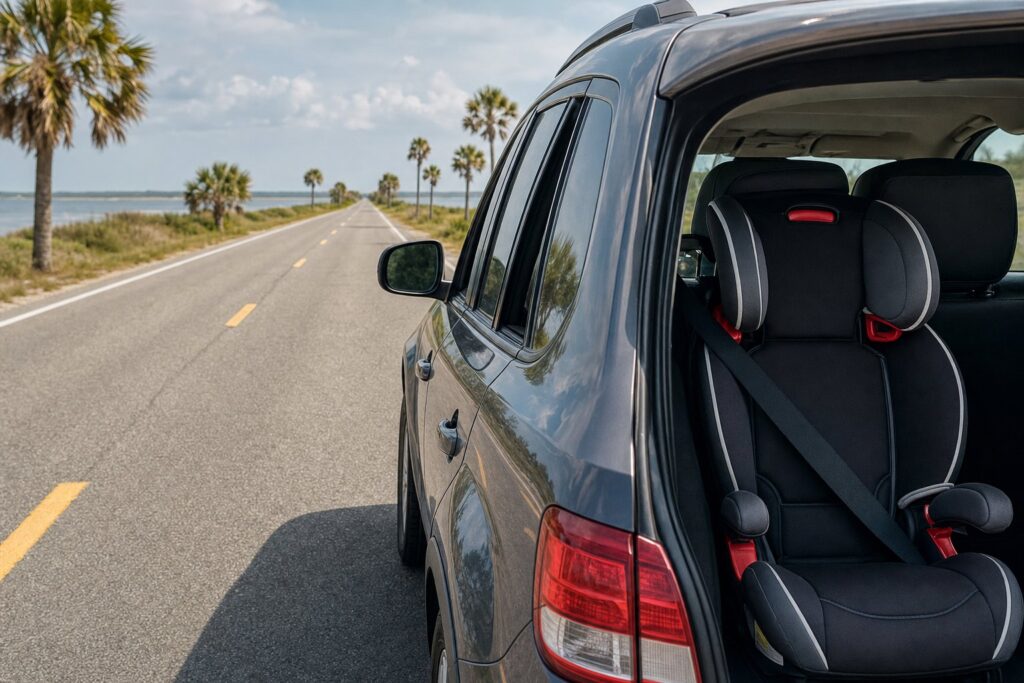
In Georgia, a child under eight must ride in a rear seat, properly restrained in an appropriate, federally approved child passenger restraint such as a car seat or booster seat, under O.C.G.A. § 40-8-76. A child over 4 feet 9 inches tall must use a safety belt instead. This guide explains that rule, when a child may ride up front, the fine for a violation, and what a car seat question can mean for an injury claim after a crash. If another driver hurt your child, Roden Law offers a free case review and charges no fees unless we win.
What is the car seat law in Georgia?
Georgia’s car seat law requires a driver to properly restrain any child under eight in an appropriate, federally approved child passenger restraining system, in a rear seat of the vehicle (O.C.G.A. § 40-8-76). The rule applies in passenger cars, vans and pickup trucks. Taxis and public transit vehicles are excluded.
The statute also sets an installation requirement, and it has four exits and exceptions that parents ask about most:
- Installation: a driver is not complying unless the seat is installed and used according to the manufacturer’s directions.
- Height: a child over 4 feet 9 inches tall must be restrained by a safety belt instead of a child restraint.
- Front seat: a child under eight may ride in front only if the vehicle has no appropriate rear seating position, or every appropriate rear position is occupied by other children.
- Lap belt: a child who weighs at least 40 pounds may be secured by a lap belt only if the vehicle has no lap-and-shoulder belts, or all of them except the driver’s are being used by other children.
- Medical: these requirements do not apply when the child’s parent or guardian obtains a physician’s written statement that a physical or medical condition of the child prevents restraining the child in the way the law requires.
At what age can a child stop using a car seat in Georgia?
Georgia law allows a child to move from a car seat or booster to a safety belt at age eight, or earlier once the child is over 4 feet 9 inches tall (O.C.G.A. § 40-8-76). The law sets the minimum. Whether your child is actually ready depends on how the adult belt fits.
Safety guidance, not law: the table below separates what Georgia requires from the stage-by-stage practice many parents follow. The guidance column is practical advice, keyed to the height and weight limits printed on each seat’s label; it is not a legal requirement.
| Stage | Safety guidance (not law) | What Georgia law requires |
|---|---|---|
| Rear-facing car seat | Use until your child passes the seat’s rear-facing height or weight limit | Under eight: an appropriate, federally approved restraint, in a rear seat (O.C.G.A. § 40-8-76) |
| Forward-facing seat with a harness | Use until your child passes the harness height or weight limit | |
| Belt-positioning booster seat | Use until the adult lap-and-shoulder belt fits without it | |
| Safety belt alone | Use once the belt fits the way it fits an adult | Allowed at age eight, or earlier if over 4 feet 9 inches tall |
Run this fit check before your child rides with the belt alone, in every vehicle: back flat against the seat, knees bent at the seat’s edge, the lap belt low across the upper thighs and hips, and the shoulder belt across the middle of the chest and shoulder, away from the neck. If any answer is no, keep using the booster. That check is safety guidance, not a legal test.
Can a child sit in the front seat in Georgia?
A child under eight may sit in the front seat in Georgia only if the vehicle has no appropriate rear seating position for the child, or every appropriate rear position is already occupied by other children (O.C.G.A. § 40-8-76). A physician’s written statement about the child’s medical condition is a separate exception. The front-seat exception turns on rear-seat availability and carries no weight condition.
Many websites say a child must weigh 40 pounds to ride up front. That confuses two provisions: the 40-pound figure belongs to the lap-belt rule covered below. If your child must ride in front, move the vehicle seat as far back as it goes and follow the airbag warnings in your vehicle and car seat manuals.
When can a child be secured by a lap belt in Georgia?
A child who weighs at least 40 pounds may be secured by a lap belt only when the vehicle has no lap-and-shoulder belts, or when all of them except the driver’s are being used by other children (O.C.G.A. § 40-8-76). The 40-pound provision governs lap-belt use and nothing else.
For everyday driving, remember that a belt-positioning booster is designed to work with a lap-and-shoulder belt. The booster raises your child so the shoulder portion crosses the chest and shoulder, which a lap belt alone cannot do.
What is the fine for a car seat violation in Georgia?
A car seat violation in Georgia carries a fine of up to $50 for a first conviction and up to $100 for a later one, with no additional fees or surcharges (O.C.G.A. § 40-8-76). The larger cost of an unrestrained or poorly restrained child is measured in injuries, which is why the stage guidance above matters more than the fine.
Does a car seat violation affect an injury claim in Georgia?
Georgia limits what a car seat violation can do to an injury claim, under O.C.G.A. § 40-8-76(c). A violation is not negligence per se or contributory negligence per se, and the same subsection provides that it cannot be the basis for cancelling insurance coverage or raising insurance rates. If an adjuster raises a car seat question about your child’s crash, talk to a lawyer before you answer it.
Seat belts follow a separate section. For lawsuits commenced on or after April 21, 2025, O.C.G.A. § 40-8-76.1(d), as amended that year, allows seat belt non-use to be considered as evidence on negligence, comparative negligence, causation, assumption of risk and apportionment of fault, and it may diminish recovery. The statute sets no percentage cap on that reduction, and the court can still exclude the evidence under the rules of evidence.
Driving into South Carolina? South Carolina has its own child passenger restraint law. See our South Carolina car seat laws guide before you cross the state line.
What should I do if my child was hurt in a Georgia car accident?
Get your child medical care first, even if the injuries look minor, and keep every record from that visit. Then protect the evidence:
- Keep the car seat or booster rather than throwing it away. It is evidence, and its manual tells you whether it must be replaced after a crash.
- Photograph the seat, how it was installed, the vehicles and the scene.
- Get the crash report number and the names of any witnesses.
- Let a lawyer handle calls from the other driver’s insurer.
Georgia’s general deadline to file a personal injury lawsuit is two years from the date of injury under O.C.G.A. § 9-3-33. A child’s own injury claim generally must be filed within two years after the child turns 18, with some exceptions (O.C.G.A. § 9-3-90(b)). A parent’s claim for the child’s medical bills may run on a shorter clock, so confirm both dates with a lawyer early rather than assuming you have more time. Our guide to the Georgia statute of limitations for injury claims explains the deadlines, and our Georgia car accident settlement value guide covers what a claim may be worth.
Talk to a Georgia car accident lawyer for free
A crash that injures your child is every parent’s worst moment, and you should not have to face the insurance companies alone. Roden Law’s Georgia car accident lawyers investigate the crash, deal with the insurers and pursue full compensation for your child’s injuries. If the crash happened in Chatham County, see our Savannah car accident lawyers page, or visit our Savannah office or Darien office. For injuries beyond vehicle crashes, see our Georgia personal injury lawyers. Call 1-844-RESULTS or (912) 303-5850 for a free case review. You pay nothing upfront and no legal fees unless we win your case.
Frequently Asked Questions
About the Author

Tyler Love
Founding Partner, CTOTyler has represented numerous individuals across Georgia who suffered injuries from negligence or workplace incidents. He began his career in Cartersville at Akin & Tate under accomplished trial lawyers, then relocated to Savannah where he handled personal injury and workers’ compensation cases at a local firm. In 2013, Tyler became a founding partner of Roden […]
View Full Profile →