

Key Takeaways
Logging trucks on US-17 and rural roads in McIntosh and Glynn counties create unique hazards: unsecured heavy timber on open trailers, slow operating speeds creating dangerous speed differentials, and debris shedding onto the roadway. FMCSA cargo securement regulations (49 CFR § 393.116) set specific tie-down requirements for logs. Multiple parties may be liable including the truck driver, trucking company, loading crew, and timber harvesting company. Georgia provides 2 years to file (O.C.G.A. § 9-3-33) with recovery if less than 50% at fault.
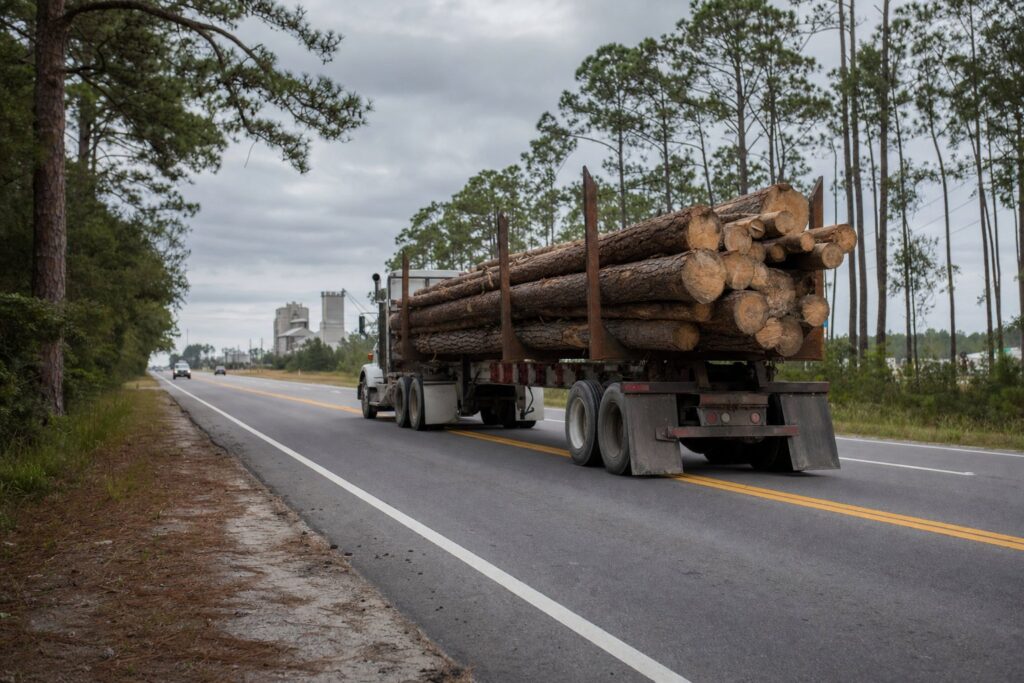
Logging Trucks on US-17: A Unique Danger in Coastal Georgia
The timber industry is a significant economic force in McIntosh and Glynn counties, and logging trucks are a daily presence on US-17, local state routes, and rural roads throughout Southeast Georgia’s coastal region. These slow-moving, heavily loaded vehicles create hazards that are fundamentally different from the container trucks and tractor-trailers on I-95 — and the crashes they cause are devastating.
Roden Law’s Darien office is located in the heart of this region, and we regularly handle cases involving logging truck crashes on US-17 and surrounding roads.
Why Logging Trucks Are Uniquely Dangerous
Extreme Weight
A fully loaded logging truck can weigh 80,000 pounds or more — the federal maximum gross vehicle weight. Unlike enclosed trailer trucks, the weight is concentrated in raw timber logs that shift during transport, particularly during turns, braking, and on uneven road surfaces.
Load Securement Challenges
Timber logs are secured with chains, binders, and stakes — not enclosed in a trailer. When chains fail, stakes break, or binders loosen, logs can:
- Roll off the truck into oncoming traffic or following vehicles
- Shift during turns, causing the truck to overturn
- Protrude beyond the trailer, creating collision hazards for passing vehicles
FMCSA cargo securement standards (49 CFR Part 393, Subpart I) require specific tie-down requirements for logs. Violations are common and constitute evidence of negligence.
Slow Speed on Rural Roads
Loaded logging trucks often travel at 25-35 mph on roads with 55 mph speed limits. This creates dangerous speed differentials that lead to:
- Impatient drivers attempting unsafe passes on two-lane roads
- Rear-end collisions when following vehicles encounter a slow-moving truck around a curve
- Head-on crashes when passing vehicles misjudge oncoming traffic distance
Debris Shedding
Logging trucks routinely shed bark, small branches, wood chips, and mud onto the roadway. This debris creates hazards for following vehicles (windshield strikes, tire punctures, loss of traction) and obscures road markings. On wet roads, wood debris becomes especially slippery.
Limited Visibility
The height and width of a loaded logging truck significantly reduces the driver’s rearview visibility. Following vehicles are often invisible to the truck driver, particularly smaller cars and motorcycles. This makes lane changes and turns especially dangerous for nearby traffic.
Dangerous Roads for Logging Trucks
US-17 (Coastal Route)
US-17 through McIntosh and Glynn counties is the primary route for logging trucks moving timber from harvesting sites to sawmills and processing facilities. The two-lane highway passes through Darien, connects to I-95, and runs through rural areas with limited passing zones.
State Route 99
SR-99 through McIntosh County serves timber operations in the county’s interior. The narrow, winding road has minimal shoulders and no center turn lanes, making encounters with logging trucks especially treacherous.
US-341 / US-25
These routes connecting Darien to Jesup and interior Georgia carry logging truck traffic from inland timber operations. The rural two-lane configuration creates the same passing-zone dangers as US-17.
Who Is Liable for a Logging Truck Accident?
Logging truck crashes often involve multiple liable parties:
| Party | Potential Liability |
|---|---|
| Truck driver | Speeding, fatigue, failure to use slow-vehicle markings |
| Trucking company / timber company | Negligent hiring, vehicle maintenance failures, schedule pressure |
| Loading crew | Improper log loading, inadequate securement, overweight loads |
| Truck/trailer manufacturer | Defective stakes, bolsters, or securement hardware |
| Timber harvesting company | If different from trucking company, may bear liability for loading operations |
Georgia Law for Logging Truck Accidents
- Statute of limitations: 2 years (O.C.G.A. § 9-3-33)
- Comparative fault: Recovery if less than 50% at fault (O.C.G.A. § 51-12-33)
- FMCSA cargo securement: Federal regulations specify minimum tie-down requirements for logs (49 CFR § 393.116). Violations are evidence of negligence.
- Georgia log truck weight limits: Georgia enforces federal gross vehicle weight limits of 80,000 pounds. Overweight trucks cause increased stopping distance, tire failures, and road damage.
- Slow-moving vehicle requirements: Georgia law requires vehicles traveling significantly below the speed limit to use hazard lights or slow-moving vehicle emblems. Failure to do so creates liability.
What to Do After a Logging Truck Crash
- Call 911 — McIntosh County Sheriff or Georgia State Patrol will respond. Be prepared for longer rural response times.
- Move to safety — If logs have spilled onto the road, get well away from the debris zone
- Document the scene: Truck company name, the condition of load securement (chains, stakes, binders), any logs on the roadway, debris on the road surface, and vehicle damage
- Photograph log securement: This is critical evidence. If chains appear loose, broken, or missing, photograph them before the scene is cleared.
- Seek medical attention — Southeast Georgia Health System in Brunswick is the nearest major medical facility for McIntosh County crashes
- Contact an attorney — Logging companies may attempt to clear the scene quickly, destroying evidence of improper loading
Free Consultation — Darien Office
Roden Law’s Darien office at 1108 North Way is located in the heart of McIntosh County’s logging truck corridor. We understand the timber industry, FMCSA cargo securement standards, and the unique dangers of logging truck crashes on US-17 and rural roads. Call (912) 303-5850 — free consultation, no fees unless we win.
Related Pages
Frequently Asked Questions
About the Author

Eric Roden
Founding Partner, CEOEric Roden has represented injury victims from the outset of his career and has never advocated on behalf of insurance companies. He focuses on wrongful death, automobile accidents, nursing home negligence, and workers’ compensation law. In 2013, he became a founding partner of Roden Law, dedicated to providing advocacy for injured clients. Education J.D., University […]
View Full Profile →