

Key Takeaways
Every motorcycle operator and passenger in Georgia must wear a helmet, at any age — O.C.G.A. § 40-6-315. The helmet statute states a traffic duty; it sets no rule about evidence, admissibility or damages in a civil case. You can recover in Georgia as long as you are less than 50% at fault — O.C.G.A. § 51-12-33 — with your award reduced by your share. Insurers use helmet non-use to push a rider's fault percentage upward; that is an adjuster's argument, not a rule the helmet statute imposes. Georgia injury lawsuits generally must be filed within two years of the crash — O.C.G.A. § 9-3-33. Bicycle riders under 16, and everyone on a Class III e-bike, must wear a bicycle helmet — O.C.G.A. § 40-6-296(d) and § 40-6-303(c) — and both sections say a violation is not evidence of negligence.
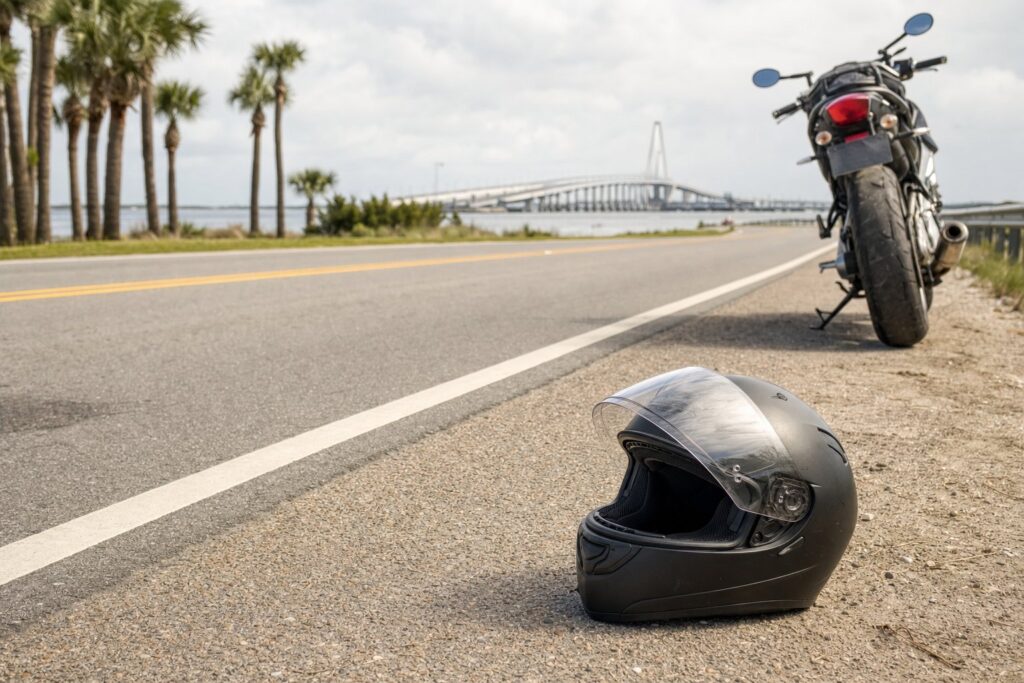
Georgia requires a helmet for every motorcycle operator and every passenger, at every age, on public roads throughout the state. That rule is O.C.G.A. § 40-6-315, and it carries no adult exemption and no waiver for experienced riders. What helmet use means for your injury claim is a separate question, answered below.
What O.C.G.A. § 40-6-315 Requires
Wear an approved helmet, every ride. The requirement reaches the operator and the passenger, applies regardless of age or license class, and applies on public roads statewide; “approved” is the DOT-certified equipment riders already look for.
According to the Georgia Governor’s Office of Highway Safety’s 2024 motorcycle fact sheet (2024 data, published May 2026), 182 motorcyclists died in Georgia traffic crashes that year — 13% of all traffic deaths, from a vehicle class that is under 1% of registrations.
According to the Georgia Governor’s Office of Highway Safety’s helmet-use findings in the same fact sheet, Georgia motorcyclists who were not wearing a helmet were 2.0 times more likely to suffer a fatal injury, and helmet use among crash-involved riders, estimated at 76%, saved about 92 lives in 2024.
Helmet Rules by Vehicle Type in Georgia
One statute per vehicle class. O.C.G.A. § 40-6-315 is Georgia’s motorcycle helmet requirement. Bicycles and e-bikes have their own sections, stated below. Georgia’s rules for mopeds, electric scooters, ATVs and golf carts sit in other parts of the Code and are outside the scope of this page.
| Vehicle | Who must wear a helmet | Statute |
|---|---|---|
| Motorcycle — operator and passenger | Everyone, at any age, on public roads | O.C.G.A. § 40-6-315 |
| Bicycle | Riders and passengers under 16, on any public road, path, lane or sidewalk; an ANSI- or Snell-standard bicycle helmet. No fine or jail for the child, and a violation is not evidence of negligence | O.C.G.A. § 40-6-296(d) |
| E-bike, Class I or II (motor assistance stops at 20 mph) | Riders under 16: an e-bike rider has a bicycle rider’s duties, so the bicycle rule applies | O.C.G.A. § 40-6-301, § 40-6-300(1)–(2) |
| E-bike, Class III (pedal assistance to 28 mph) | Every operator and passenger, at any age; no one under 15 may operate one; a violation is not evidence of negligence | O.C.G.A. § 40-6-303(b)–(c), § 40-6-300(3) |
How those claims work: bicycle accident claims, e-bike accident claims, electric scooter accident claims, and ATV and side-by-side accident claims.
What Riding Without a Helmet Does to a Georgia Injury Claim
The claim survives. A rider who was not wearing a helmet can still pursue full compensation from the driver who caused the crash, and the real contest is over percentages. Under O.C.G.A. § 51-12-33, you recover as long as you are less than 50% at fault, with your award reduced by the share of fault assigned to you, which is why the medical proof described on our motorcycle accident claims page and traumatic brain injury claims page matters so much.
The helmet statute is silent on that arithmetic. Section 40-6-315 states a traffic duty and says nothing about what a jury may hear or how damages are calculated. The pressure comes from the other side’s adjuster, who has every incentive to convert a helmet fact into a fault percentage — our Georgia comparative negligence guide explains how that 50% bar works in practice.
Eric Roden, Roden Law’s founding partner, points out that an insurer’s helmet argument is an argument and not a legal conclusion: a rider’s percentage of fault is decided on the crash evidence, and a case built early on scene photographs, vehicle data, and the treating physicians’ findings leaves that argument far less room to operate.
Whether motorcycle helmet non-use is admissible in a Georgia civil trial, and whether a jury may reduce damages because of it, is a question of Georgia evidence law rather than of § 40-6-315, and one to raise with your attorney. The contrast with Georgia’s bicycle and e-bike rules is instructive: those Code sections say expressly that a helmet violation “shall not constitute negligence per se nor contributory negligence per se or be considered evidence of negligence or liability” (O.C.G.A. § 40-6-296(d)(5); § 40-6-303(c)(5)). The motorcycle statute contains no such sentence in either direction.
According to the Insurance Institute for Highway Safety’s state-by-state fatality figures, Georgia recorded 1,403 traffic deaths in 2024, a rate of 1.15 per 100 million vehicle miles traveled.
According to the Georgia Governor’s Office of Highway Safety’s 2024 fact sheet on motorcyclist injuries, motorcycle traffic-related hospitalizations and emergency room visits in Georgia generated $358.2 million in charges in 2024.
How the Rule Differs Across the State Line
The rule narrows across the line. South Carolina requires helmets for motorcycle riders and passengers under 21, so an adult rider covered by Georgia’s requirement is under a different rule there. Our South Carolina helmet law guide covers that state’s rule and its claim consequences; it publishes shortly, and everything else on this page is Georgia law only.
About the Author
Eric Roden is the founding partner and CEO of Roden Law and is admitted to practice in Georgia. He and the firm’s attorneys have recovered more than $300 million for injured clients, with 5,000+ cases handled and 62 years of combined experience. This page states Georgia law only.
Talk to a Georgia Motorcycle Accident Lawyer
Your claim survives a helmet argument, and it is stronger with counsel handling the adjuster. Roden Law investigates the crash, documents the injuries, and fights the fault percentage from day one.
📞 Call 1-844-RESULTS or our Georgia office line, (912) 303-5850 — free case review, available 24/7. No fees unless we win.
Frequently Asked Questions
About the Author

Eric Roden
Founding Partner, CEOEric Roden has represented injury victims from the outset of his career and has never advocated on behalf of insurance companies. He focuses on wrongful death, automobile accidents, nursing home negligence, and workers’ compensation law. In 2013, he became a founding partner of Roden Law, dedicated to providing advocacy for injured clients. Education J.D., University […]
View Full Profile →