
Last reviewed: 2026-06-26
If you or someone you love was hurt in a tractor-trailer wreck on the St. Andrews corridor, you need a St. Andrews Road 18 wheeler accident lawyer Richland County families can actually reach — one who knows how these freight-fed crashes happen near Widewater Shopping Center and how South Carolina law protects you. A collision with an 80,000-pound rig can change everything in a single afternoon: hospital bills stacking up, missed paychecks, and pain that follows you home. You deserve a calm, experienced advocate who fights for maximum compensation. At Roden Law, we work on a contingency fee basis — you pay nothing upfront and no legal fees unless we win your case.
Key Takeaways
- The deadline. In South Carolina, you generally have 3 years from the crash date to file an 18-wheeler injury lawsuit (S.C. Code Ann. § 15-3-530); claims against a government vehicle can be far shorter.
- The fault rule. You can still recover if you were 50% or less at fault, with your award reduced by your share (Nelson v. Concrete Supply Co.).
- Move fast on evidence. A truck's ECM "black box," driver logs, and dashcam can be erased within weeks — a spoliation letter preserves them.
- More defendants, more coverage. The trucking company, broker, and cargo loader can all share liability beyond the driver.
- Local risk is real. Heavy delivery traffic feeds Widewater Shopping Center and St. Andrews Center, concentrating turning and rear-end crashes on the corridor.
- No upfront cost. Roden Law handles St. Andrews truck cases on contingency — no fees unless we win.
- 📞 Free Case Review — call 1-844-RESULTS.
Why 18-Wheeler Crashes Happen on the St. Andrews Road Corridor
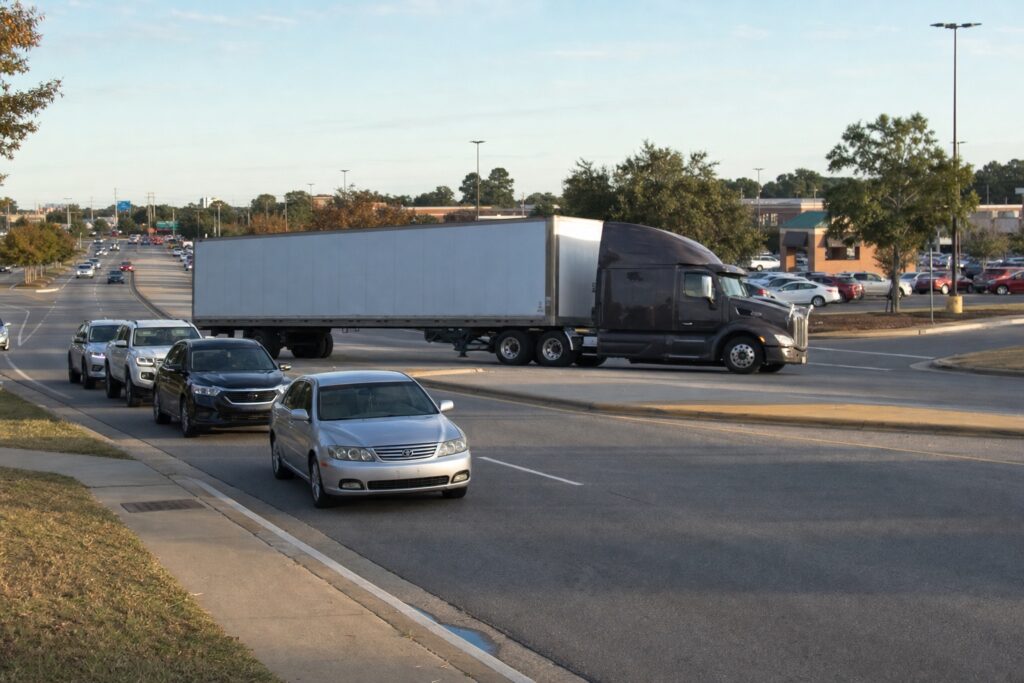
Eighteen-wheeler crashes cluster on the St. Andrews corridor because heavy commercial and delivery vehicles funnel through a dense suburban arterial that was never built for that volume. The Beatty Road and St. Andrews grid feeds two retail centers within roughly a mile — Widewater Shopping Center and St. Andrews Center — so tractor-trailers make tight, low-speed turns across active through-traffic all day long. When a fully loaded rig swings into a shopping-center entrance, the size and weight mismatch with passenger cars turns an ordinary fender-bender into a catastrophic injury.
Several conditions stack the deck along this stretch. The corridor sits beside a tight cluster of schools — Pine Grove Elementary School about a third of a mile off, Seven Oaks School, and Ben Lippen Elementary — which floods the roads with stop-and-go congestion during morning and afternoon pickup. Add weekend retail peaks and family foot traffic near St. Andrews Park and Pine Grove Park, and you get exactly the mixed-use friction where big trucks and small cars collide.
According to the Federal Motor Carrier Safety Administration, large trucks were involved in tens of thousands of injury crashes nationwide in a single recent year, and the occupants of the smaller vehicle bear the overwhelming share of serious harm. According to the South Carolina Department of Public Safety, the state records thousands of collisions involving commercial vehicles each year, with rear-end and turning-movement conflicts among the most common patterns on suburban arterials like this one. Those statewide trends play out in miniature on the St. Andrews corridor every single day.
The Most Common St. Andrews Truck-Crash Scenarios
The most common 18-wheeler crashes here are turning, rear-end, and underride collisions tied to the corridor's retail entrances and stop-and-go congestion. Knowing which scenario you were in shapes the entire investigation — each one points to different evidence and different defendants.
- Wide-turn and right-hook crashes at the entrances to Widewater Shopping Center and St. Andrews Center, where a trailer cuts off a car in the adjacent lane.
- Rear-end collisions when a loaded rig can't stop in time in arterial stop-and-go traffic — a truck needs far more stopping distance than a car.
- Underride crashes, where a smaller vehicle slides under the trailer; these are among the deadliest truck-crash types.
- T-bone and angle crashes at side-street and parking-lot intersections during school-zone congestion near the Pine Grove cluster.
- Jackknife and cargo-shift incidents when an improperly loaded or poorly maintained trailer loses control.
Graeham C. Gillin, a partner and Chief Operating Officer at Roden Law, points out that the crash mechanism is often the single most important early clue in a tractor-trailer case, because a wide-turn collision implicates the driver's training and the company's routing, while an underride or jackknife frequently exposes a maintenance failure or a loading error that a deeper investigation can prove. Reading the scene correctly in the first days often decides how large the eventual recovery can be.
How 18-Wheeler Cases Differ From Ordinary Crash Claims
An 18-wheeler case is fundamentally different from a car-crash claim because it is governed by federal trucking regulations and almost always involves multiple defendants. A standard fender-bender usually pits you against one driver and one insurer. A tractor-trailer wreck can pull in the driver, the motor carrier, a freight broker, the company that loaded the cargo, and the firm responsible for maintenance — each with its own insurance and its own lawyers.
The Federal Motor Carrier Safety Administration sets the rules that often decide these cases. Hours-of-service limits cap how long a driver can operate before resting, and electronic logging devices (ELDs) record that time automatically. When a trucker pushes past those limits, the resulting crash can support a fatigue-based claim. Our team handles exactly these issues in our work on fatigued trucker accident claims and across our broader practice helping clients with 18-wheeler and semi-truck accident lawyers.
The table below shows why the two case types are not interchangeable.
| Factor | Ordinary Car Crash | St. Andrews 18-Wheeler Crash |
|---|---|---|
| Governing rules | SC negligence law | SC negligence law + FMCSA federal regulations |
| Likely defendants | One driver/insurer | Driver, carrier, broker, loader, maintenance firm |
| Key evidence | Police report, photos | ECM "black box," ELD logs, maintenance records, dashcam |
| Insurance limits | Often state minimums | Frequently $750,000+ federal minimums |
| Evidence urgency | Days to weeks | Critical — logs/ECM can be overwritten quickly |
According to the Insurance Institute for Highway Safety, the people most likely to die in large-truck crashes are the occupants of passenger vehicles, which is exactly why these cases demand a heightened standard of proof and aggressive early investigation. You can read our local overview of the most dangerous intersections and roads in Columbia to see how corridor design contributes to these patterns.
South Carolina Law After a Richland County Truck Crash
South Carolina gives you 3 years from the date of the crash to file a personal injury lawsuit after an 18-wheeler wreck (S.C. Code Ann. § 15-3-530). Missing that deadline almost always means losing your right to recover, no matter how strong your case is. There are important exceptions: if a government or school vehicle was involved near the St. Andrews school cluster, the South Carolina Tort Claims Act (S.C. Code Ann. § 15-78-10 et seq.) shortens the filing deadline to two years and caps damages, so those claims need attention immediately.
South Carolina also follows modified comparative negligence with a 51% bar. You can recover as long as you were 50% or less at fault, but your award is reduced by your percentage of fault; at 51% or more, you recover nothing (Nelson v. Concrete Supply Co., 399 S.E.2d 783 (S.C. 1991)). Trucking insurers exploit this rule constantly, trying to shift blame onto you to cut or kill your claim — which is why we explain how being partially at fault affects your South Carolina case to every client. A Richland County truck lawsuit is filed in the Richland County Court of Common Pleas (Fifth Judicial Circuit) at 1701 Main Street, Columbia, while smaller claims may proceed in the Richland County Magistrate Court.
Preserve the Evidence Before It Disappears
The single most urgent step after a St. Andrews tractor-trailer crash is preserving the truck's electronic data before the carrier can overwrite it. An 18-wheeler's engine control module (ECM) records speed, braking, and throttle in the seconds before impact, and the ELD logs the driver's hours — but trucking companies are not required to keep that data indefinitely, and routine overwriting can erase it within weeks.
A St. Andrews Road 18 wheeler accident lawyer Richland County victims hire will send a spoliation letter immediately, putting the carrier on legal notice to preserve the ECM data, driver logs, dispatch records, maintenance files, and any dashcam footage. According to the National Highway Traffic Safety Administration, electronic crash data and event recorders have become central to reconstructing serious collisions, and in truck cases that data is often the difference between a denied claim and a full recovery. The sooner you act, the more evidence survives — which is one more reason not to wait to call a Columbia, SC truck accident lawyers team.
Get Medical Care, Then Get Help
Your health comes first: get evaluated at a trauma center even if you feel "okay," because truck-crash injuries like internal bleeding and concussions can hide for hours. Crash victims from the St. Andrews area are commonly transported to Prisma Health Richland Hospital, the region's Level I trauma center in downtown Columbia, or treated at Lexington Medical Center in West Columbia. Prompt treatment protects both your recovery and the medical record your claim depends on.
Once you are safe, document everything you can and bring it to a lawyer. For a clear walkthrough of those first hours, see our step-by-step guide after a car accident in Columbia, SC and our specific guide on what to do after a Columbia truck accident. If your crash happened along the freeway feeding this area, our Richland County truck-crash guide for the I-20 interchange covers the same freight-corridor issues. When you are ready, the Columbia, SC personal injury lawyers at Roden Law are here to take it from there. The St. Andrews corridor also sees frequent passenger-vehicle wrecks our Columbia, SC car accident lawyers handle.
Frequently Asked Questions
Q: What is the deadline to file an 18-wheeler accident lawsuit in Richland County, SC?
A: In South Carolina, you generally have 3 years from the date of the crash to file a personal injury lawsuit (S.C. Code Ann. § 15-3-530). If a government or school vehicle was involved, the South Carolina Tort Claims Act imposes a shorter, two-year filing deadline, so it is critical to speak with a lawyer quickly. Waiting too long usually means losing your right to recover entirely, regardless of how clear the trucker's fault may be.
Q: Who can be held liable after a tractor-trailer crash on the St. Andrews corridor?
A: Liability after an 18-wheeler crash often extends well beyond the driver. The motor carrier, a freight broker, the company that loaded the cargo, and the firm responsible for truck maintenance can all share fault under South Carolina law and federal FMCSA rules. Identifying every responsible party matters because each carries separate insurance, which can dramatically increase the compensation available for your injuries.
Q: Do I need a St. Andrews Road 18 wheeler accident lawyer Richland County, or can I handle it myself?
A: You can technically handle a claim alone, but 18-wheeler cases involve federal regulations, multiple defendants, and aggressive insurers that ordinary drivers are not equipped to fight. A lawyer preserves the truck's black-box data, proves hours-of-service violations, and counters attempts to blame you under South Carolina's comparative fault rule. Most truck-crash victims recover significantly more with experienced representation than without it.
Q: How much does it cost to hire Roden Law for a truck accident case?
A: Roden Law handles St. Andrews 18-wheeler cases on a contingency fee basis, which means you pay nothing upfront and no legal fees unless we win your case. Your initial case review is free. This structure lets injured people pursue large trucking companies and their insurers without taking on financial risk while they are already dealing with medical bills and lost income.
Q: What if the truck crash was partly my fault?
A: South Carolina follows modified comparative negligence with a 51% bar, so you can still recover as long as you were 50% or less at fault (Nelson v. Concrete Supply Co.). Your award is reduced by your share of fault. Because insurers fight hard to inflate your percentage, having a lawyer build the evidence against the trucker is often what keeps your claim alive and your recovery fair.
Q: How quickly do I need to act to protect evidence?
A: Immediately. A truck's ECM data and electronic logging device records can be overwritten within weeks, and dashcam footage can be lost just as fast. A lawyer sends a spoliation letter right away to legally require the carrier to preserve this evidence. The sooner you call, the more proof survives to support your claim — delay is one of the most common reasons strong truck cases fall apart.
About the Author
This guide was reviewed by Graeham C. Gillin, partner and Chief Operating Officer at Roden Law. Graeham is licensed to practice in both Georgia and South Carolina and has helped injured clients across Richland County and the greater Columbia area pursue maximum compensation in serious truck and commercial-vehicle cases. Roden Law's Columbia office is located at 1545 Sumter St. Suite B, Columbia, SC 29201. With $300M+ recovered, 5,000+ cases handled, and 62 years of combined experience, our team is ready to help.
📞 Free Case Review — No Fees Unless We Win. Call 1-844-RESULTS.
About the Author