Last reviewed: 2026-06-01
If you’ve been hurt in a Heritage, Park West, or Snee Farm collision and you’re searching for a Mount Pleasant Rifle Range Road car accident lawyer, you’re already in the worst part of it — the part where your neck won’t turn the right way, the East Cooper Medical Center bill is sitting on the kitchen counter, and the other driver’s insurance adjuster is calling before your bruising is even visible. Take a breath. You have time, you have rights, and South Carolina law is on your side if you move correctly.
This guide walks you through what makes Rifle Range Road and the wider East Cooper corridor uniquely dangerous, exactly which South Carolina statutes apply, who can pay your bills, and what a Mount Pleasant Rifle Range Road car accident lawyer actually does between the day of the wreck and the day your check clears.
Key Takeaways
- South Carolina personal-injury claims must be filed within three years of the crash under S.C. Code § 15-3-530(5) — do not wait the GA two-year window; that does not apply here.
- Rifle Range Road is a 2-lane secondary (per OpenStreetMap classification) absorbing Park West, Heritage, and Snee Farm cut-through volume — left-turn collisions at subdivision entrances are the dominant crash geometry.
- Chuck Dawley Boulevard (signed as I-526 Business) is 5 lanes wide and posted at 45 mph — rear-end and sideswipe collisions cluster at retail right-turn pockets.
- South Carolina is a modified comparative-negligence state under Nelson v. Concrete Supply Co., 303 S.C. 243 (1991) — you can recover only if your share of fault is 50% or less.
- The state’s minimum auto-liability limit is just 25/50/25 under S.C. Code § 38-77-140 — uninsured/underinsured motorist stacking under § 38-77-160 often becomes the real source of recovery.
- Most serious East Cooper crash victims are routed to East Cooper Medical Center (~1.4 mi from the cluster) before any transfer to MUSC Health’s Level I trauma center downtown.
- Charleston County civil cases proceed in the Charleston County Court of Common Pleas (9th Judicial Circuit); small claims (≤ $7,500) belong in Mount Pleasant Magistrate’s Court.
Why Rifle Range Road Is a Different Kind of Mount Pleasant Crash Scene
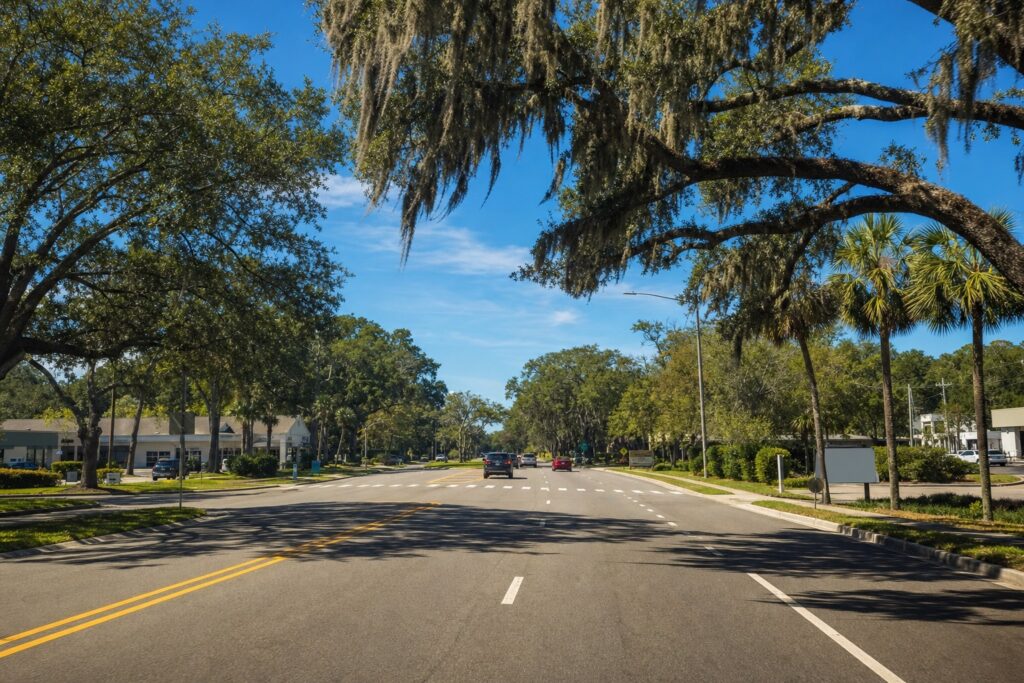
To understand the wrecks happening between Park West and Bowman Road, you have to understand what Rifle Range Road actually is. OpenStreetMap classifies it as a secondary road with 2 lanes — meaning one lane in each direction with left-turn pockets where they exist. That geometry was designed for the Mount Pleasant of forty years ago.
According to the U.S. Census Bureau’s Population Estimates Program, Mount Pleasant’s population grew from roughly 67,000 in 2010 to more than 92,000 by the early 2020s — among the fastest sustained growth rates of any city in South Carolina. Park West, Heritage, and Snee Farm all dump their morning and evening commuter traffic onto a road that was never widened to match. The result is arterial-volume traffic on a residential-geometry corridor — and the crash pattern that follows it.
The dominant wreck on Rifle Range is the left-turn-into-oncoming collision at a subdivision entrance. A southbound driver waiting to turn left into Heritage gets rear-ended by a tailgater. An eastbound driver headed home to Park West misjudges the closing speed of an oncoming sedan and turns across its path. A third driver in a school-zone window at Whitesides Elementary brakes hard for a crossing student and gets hit from behind by a driver who was looking at a phone. None of these are unusual on a national crash-data scale — they’re unusual here because the road is built like a neighborhood lane and used like an arterial.
A few blocks west, Chuck Dawley Boulevard — signed as I-526 Business — takes over as Mount Pleasant’s 5-lane, 45 mph commercial spine. According to South Carolina Department of Transportation (SCDOT) traffic-volume data published in the agency’s annual count program, Chuck Dawley regularly handles tens of thousands of vehicles per day moving between the Ravenel Bridge / US-17 connection and the Belle Hall / Daniel Island side of town. Where Rifle Range produces left-turn wrecks, Chuck Dawley produces rear-end and sideswipe collisions at right-turn retail pockets, where a driver leaving the through lane to enter a shopping center forces sudden braking behind them.
If a tractor-trailer or commercial van is involved in the Chuck Dawley scenario, that’s no longer a passenger-car claim. According to the Federal Motor Carrier Safety Administration (FMCSA), large-truck crashes accounted for 5,936 fatalities in the U.S. in 2022, with hours-of-service violations, defective brakes, and improper loading among the most common citations. That data shapes how our Charleston, SC truck accident lawyers build a Chuck Dawley file — and you can read more about how FMCSA violations strengthen a truck accident claim.
Where Rifle Range Wrecks Happen — and Why
| Corridor segment | Road geometry | Dominant crash type | Why it happens here |
|---|---|---|---|
| Rifle Range Road through Heritage | 2-lane secondary | Left-turn / oncoming at subdivision entrance | No protected left phase; Park West / Heritage commuter peaks |
| Rifle Range Road near Whitesides Elementary | 2-lane with school-zone speed reduction | Pedestrian, bicyclist, rear-end at brake-down | School-bound parents; § 56-5-3220 enforcement |
| Chuck Dawley Boulevard (I-526 Business) | 5-lane primary, 45 mph | Rear-end, sideswipe at retail right-turn pockets | Speed differential at strip-mall access points |
| Bowman Road feeding Rifle Range | 1-lane connector | Single-vehicle run-off-road, head-on at curves | Narrow geometry; cut-through commuter use |
| Chuck Dawley near Trident Tech Mt. Pleasant Campus | 5-lane primary | Class-change-window rear-end and distracted-driver | Trident Tech student volume on commuter spine |
Lowcountry weather magnifies all of it. According to the National Oceanic and Atmospheric Administration (NOAA), the Charleston metro area averages roughly 50 inches of rainfall per year, with intense convective thunderstorms most common between June and September. A flash thunderstorm dropping a quarter-inch in fifteen minutes on Chuck Dawley turns the right-turn-pocket rear-end from a forty-mile-an-hour fender-bender into a head-restraint injury and a totaled vehicle. Hydroplaning at 45 mph is a different physics problem than hydroplaning at 35.
Tourist season makes it worse on the Rifle Range side. Memorial Day through Labor Day, vacationers staying in Mount Pleasant who take the Rifle Range → Coleman → Ben Sawyer route to Sullivan’s Island and Isle of Palms are funneling through a road they do not know — slowing unexpectedly for landmarks, missing the subdivision turn pockets, and adding unfamiliar-driver risk to an already overloaded corridor.
If you want the neighboring-corridor picture, our Coleman Boulevard car accident guide, our Highway 41 Mount Pleasant development crash guide, and our I-526 / Wando Bridge corridor crash guide cover the rest of East Cooper. The ongoing I-526 expansion construction zone crash guide explains how the mainline construction is pushing more cut-through volume onto Chuck Dawley and Rifle Range while work continues.
The South Carolina Law That Will Actually Decide Your Claim
This is the section the insurance adjuster does not want you to read carefully. Every number here is a real statute, and every one of them affects how much you can recover.
Statute of limitations. Under S.C. Code § 15-3-530(5), you have three years from the date of the crash to file a personal-injury lawsuit in South Carolina. A wrongful-death action is also governed by S.C. Code § 15-3-530 with a three-year filing window. That deadline is hard. Miss it and your claim is gone, no matter how clear the liability or how serious the injuries. If you want a deeper walk-through, see our explainer on South Carolina’s three-year personal-injury statute of limitations.
Modified comparative negligence — the 50% bar. South Carolina follows the rule set in Nelson v. Concrete Supply Co., 303 S.C. 243 (1991): a plaintiff may recover only if their share of fault is 50% or less, and the award is reduced by their fault share. If you were 30% responsible for a Rifle Range left-turn wreck, your $100,000 verdict becomes $70,000. If you were 51% responsible, you recover nothing. This is why the first number an adjuster tries to put on you is your fault percentage — and why a Mount Pleasant Rifle Range Road car accident lawyer spends the most file-time fighting that allocation.
Minimum coverage is barely coverage. S.C. Code § 38-77-140 sets South Carolina’s minimum auto-liability limits at 25/50/25 — $25,000 per person bodily injury, $50,000 per accident, $25,000 property damage. According to the Insurance Information Institute, the average bodily-injury claim cost nationally now sits well above that floor — meaning a serious East Cooper crash routinely exhausts the at-fault driver’s policy before your medical bills are paid.
That is where uninsured-motorist coverage under S.C. Code § 38-77-150 and underinsured-motorist coverage and stacking under S.C. Code § 38-77-160 become the real money. South Carolina permits stacking UM/UIM coverage across multiple owned policies in the same household — and a lot of clients have no idea they own coverage that can be stacked until a lawyer pulls the declarations pages. Our South Carolina UM/UIM stacking explained post walks through how this works in practice.
Who broke a traffic law matters. Five statutes do most of the heavy lifting on Rifle Range and Chuck Dawley fault analysis:
- S.C. Code § 56-5-1520 — basic speed law (going too fast for conditions, including wet pavement after a Lowcountry thunderstorm).
- S.C. Code § 56-5-1810 — right of way at intersections.
- S.C. Code § 56-5-1840 — left-turn rules at intersections (the dominant Rifle Range fact pattern).
- S.C. Code § 56-5-3220 — school-zone speed regulation (Whitesides Elementary, Trident Tech).
- S.C. Code § 56-5-2930 — driving under the influence.
- S.C. Code § 56-5-6240 — leaving the scene of an accident (hit-and-run).
When SCDOT is in the picture. If a Chuck Dawley signal-timing problem, a missing sign, or a striping defect on the I-526 Business segment contributed to your wreck, you are now in a South Carolina Tort Claims Act case under S.C. Code § 15-78-10 et seq. — with statutory damage caps and a verified-claim filing requirement before suit. These are technical claims with traps for the unrepresented; do not file them on your own.
Where your case is filed. A typical Rifle Range Road car-accident lawsuit is filed in the Charleston County Court of Common Pleas (9th Judicial Circuit, Charleston). Small civil claims of $7,500 or less can be filed in the Mount Pleasant Magistrate’s Court. If there is diversity jurisdiction — for example, the at-fault driver lives out of state and the amount in controversy exceeds the threshold — the case can be removed to the U.S. District Court for the District of South Carolina, Charleston Division.
What Graeham C. Gillin Wants Heritage and Park West Drivers to Know
Graeham C. Gillin, a partner and Chief Operating Officer at Roden Law, points out that the single biggest fault-allocation mistake he sees in East Cooper left-turn cases is the assumption that the turning driver is always primarily at fault. In real Rifle Range crashes, Roden notes, the speed and following distance of the driver who hit the turning vehicle is often a more significant factor than the lawful left turn itself — and South Carolina’s basic-speed-law statute, § 56-5-1520, can shift a meaningful share of fault back to the rear driver if we develop the speed evidence properly. That development work — pulling event-data-recorder downloads, mapping skid-mark length, and reconstructing closing speed — is where serious car-accident representation earns its fee.
Roden also emphasizes that drivers underestimate how aggressively South Carolina permits UM/UIM stacking under § 38-77-160. Clients walk in convinced the at-fault driver’s 25/50/25 policy is the whole story, he says, and they often have a household stacking position worth several multiples of that — but only if we read the declarations pages correctly within the three-year window. That message generalizes across East Cooper: assume there is more coverage than you think, and let a lawyer prove it.
What To Do Today If You’ve Been Hurt
If you are still in the first 72 hours after a Rifle Range, Bowman, or Chuck Dawley crash, prioritize in this order:
- Get medical care at East Cooper Medical Center, MUSC, or Roper Hospital. Gaps in treatment are the single most reliable way an insurance adjuster discounts a claim. Document everything.
- Do not give a recorded statement to the other driver’s insurer. You are not required to. Politely decline and refer them to your lawyer.
- Photograph the scene if you can — and the vehicles. Even later that day. Skid marks fade; debris gets cleared.
- Pull your own declarations page. Identify your UM and UIM limits. If you live with relatives, pull theirs too — stacking under § 38-77-160 only works if you can prove the policies.
- Call a Mount Pleasant Rifle Range Road car accident lawyer. Roden Law’s personal injury team handles East Cooper crash files on contingency — no fees unless we win.
For a more granular checklist, see our step-by-step guide after a South Carolina car crash.
A few more topical resources for specific corridor patterns: distracted driving accident claims (commuter-corridor texting), drunk driver accident lawyers and the summer DUI accident risk in Charleston (Friday/Saturday rideshare-window crashes), rideshare and Uber accident lawyers and the downtown Charleston rideshare crash guide (TNC carrier policies), commercial van and delivery truck accident lawyers (Chuck Dawley delivery-fleet wrecks), and our Charleston, SC pedestrian accident lawyers — including school zone pedestrian accident claims for Whitesides Elementary fact patterns. Where a crash is fatal, our Charleston wrongful death attorneys handle the estate-administration side of the claim.
Frequently Asked Questions
Q: How long do I have to file a Rifle Range Road car-accident claim in Mount Pleasant?
A: Under S.C. Code § 15-3-530(5), you have three years from the date of the crash to file a personal-injury lawsuit in South Carolina, and wrongful-death claims under the same statute follow the same three-year window. Insurance demand letters can — and usually should — go out long before that deadline.
Q: What if the other driver only had 25/50/25 minimum coverage?
A: South Carolina’s minimum auto-liability limits under S.C. Code § 38-77-140 are $25,000 per person, $50,000 per accident, and $25,000 property damage — often inadequate for a serious East Cooper crash. The real recovery typically comes from your own uninsured-motorist coverage under § 38-77-150 and stacked underinsured-motorist coverage under § 38-77-160.
Q: I was partly at fault for a left-turn wreck on Rifle Range Road. Can I still recover?
A: Yes, if your share of fault is 50% or less. South Carolina follows the modified comparative-negligence rule from Nelson v. Concrete Supply Co., 303 S.C. 243 (1991), reducing your award by your fault percentage. At 51% or more, recovery is barred entirely — which is why fault allocation is the most important fight in the file.
Q: Where will my Mount Pleasant car-accident case be filed?
A: Most Rifle Range and Chuck Dawley Boulevard cases proceed in the Charleston County Court of Common Pleas (9th Judicial Circuit, Charleston). Claims of $7,500 or less belong in the Mount Pleasant Magistrate’s Court. Diversity-jurisdiction cases can be removed to the U.S. District Court for the District of South Carolina, Charleston Division.
Q: Which hospital handles serious East Cooper crash injuries?
A: Most Rifle Range Road and Chuck Dawley Boulevard crash victims are stabilized at East Cooper Medical Center, about 1.4 miles from the cluster center. Serious trauma cases are then routed to MUSC Health’s Level I trauma center in downtown Charleston — roughly 9 miles west via Chuck Dawley and US-17 across the Ravenel Bridge.
Q: What does a Mount Pleasant Rifle Range Road car accident lawyer actually charge?
A: Roden Law handles East Cooper car-accident cases on a contingency-fee basis — no upfront fees, no hourly billing, and no legal fee unless we recover for you. The initial case review is free. Call 1-844-RESULTS or contact our Charleston, SC car accident lawyers team to get started.
About the Author
Graeham C. Gillin is a partner and Chief Operating Officer at Roden Law. He is admitted to practice in South Carolina and Georgia and leads the firm’s car-accident, truck-accident, and wrongful-death practice across the Charleston, Mount Pleasant, Columbia, and Myrtle Beach offices. The firm has recovered more than $300 million for injury clients across the Lowcountry and Coastal Georgia.
Free Case Review — No Fees Unless We Win. Call 1-844-RESULTS.
About the Author