Key Takeaways
The MUSC Medical District along Calhoun Street and Ashley Avenue is one of Charleston's highest-risk pedestrian zones due to heavy foot traffic, distracted drivers, and limited crosswalk infrastructure. Liable parties may include negligent motorists, the City of Charleston, or MUSC itself. South Carolina's 3-year statute of limitations applies (S.C. Code 15-3-530), and comparative fault bars recovery at 51% or more. Georgia claims must be filed within 2 years (O.C.G.A. 9-3-33).
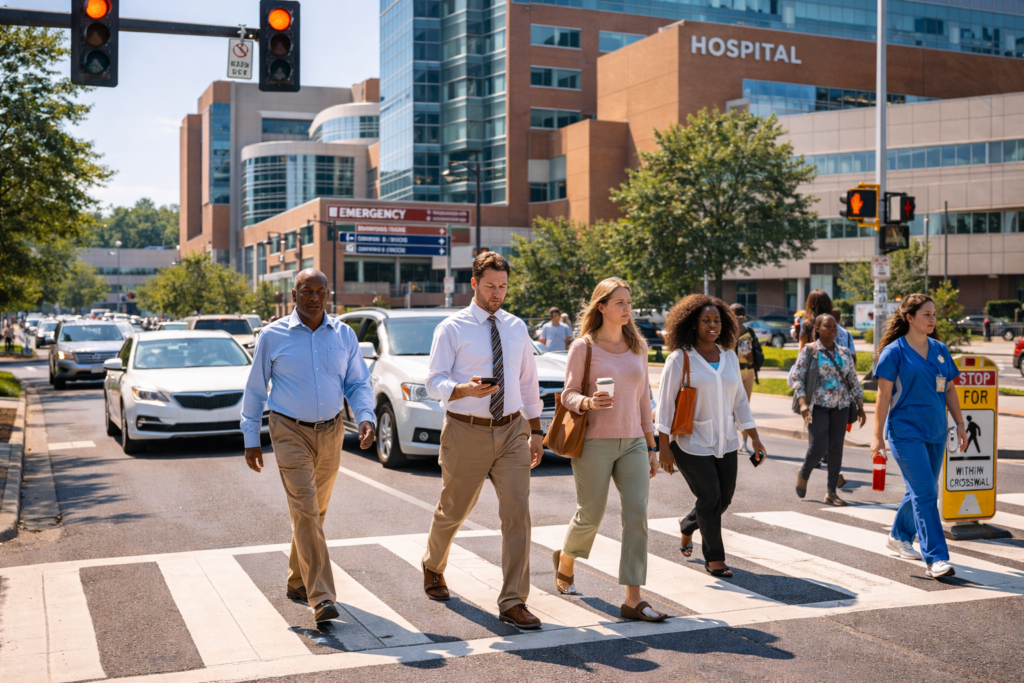
The area surrounding the Medical University of South Carolina (MUSC) and the broader Charleston Medical District is one of the most pedestrian-dense zones in the entire state. Thousands of healthcare workers, medical students, patients, visitors, and College of Charleston students navigate these streets on foot every day. Yet the road infrastructure in this area was not designed for the pedestrian volume it now carries, and the result is a persistent pattern of pedestrian accidents that cause devastating injuries and preventable deaths.
According to the National Highway Traffic Safety Administration (NHTSA), pedestrians accounted for 17% of all traffic fatalities nationwide in recent years, and South Carolina consistently ranks among the most dangerous states for pedestrians. The Medical District concentrates many of the risk factors that make pedestrian crashes so common: high foot traffic, distracted drivers navigating unfamiliar streets, parking garage exits with blind spots, and streets designed primarily for vehicle throughput rather than pedestrian safety.
The MUSC Medical District: A High-Pedestrian Zone
The Charleston Medical District spans roughly 20 blocks in the western portion of downtown Charleston, anchored by MUSC and its teaching hospital, the Ralph H. Johnson VA Medical Center, and Roper St. Francis Healthcare. Together, these institutions employ over 13,000 people and serve thousands of patients daily. Add the College of Charleston campus, which borders the medical district to the east and enrolls more than 10,000 students, and you have an area where pedestrian traffic rivals or exceeds vehicle traffic during peak hours.
The medical district generates pedestrian traffic around the clock. Unlike a typical commercial area that empties after business hours, MUSC and its affiliated hospitals operate 24/7. Shift changes at 7:00 a.m., 3:00 p.m., and 11:00 p.m. produce surges of foot traffic as hundreds of nurses, physicians, technicians, and support staff cross busy streets between parking structures and hospital buildings. These shift-change windows are among the most dangerous times for pedestrians in the district, as tired workers leaving shifts and drivers arriving for the next one converge simultaneously.
College of Charleston students add another layer of pedestrian density, particularly along Calhoun Street and the streets connecting the campus to the medical district. Students walking to class, to off-campus housing in Harleston Village, or to restaurants and shops along King Street create constant pedestrian flow through some of the district’s most dangerous intersections.
Why Pedestrian Accidents Are So Common Near MUSC
Shift Changes Create Pedestrian Surges
Hospital shift changes produce concentrated bursts of foot traffic that overwhelm crosswalks and traffic signals designed for lower volumes. During a typical 7:00 a.m. shift change, hundreds of workers cross Calhoun Street, Ashley Avenue, and Bee Street within a 30-minute window. Drivers who are accustomed to lighter pedestrian traffic at other times of day may not anticipate the volume — or the fact that pedestrians will be crossing at every intersection and even mid-block.
Parking Garage Exits and Blind Spots
MUSC and its affiliated facilities operate multiple parking garages, and the exits from these structures create some of the most hazardous pedestrian conflict points in the district. Drivers exiting garages must navigate steep ramps that limit visibility, transition from dim garage lighting to bright sunlight, and immediately enter sidewalk zones where pedestrians have the right of way. Many garage exits deposit vehicles directly onto narrow streets where pedestrians are walking along the curb or crossing to adjacent buildings. The combination of poor sight lines and the driver’s focus on merging into traffic creates a recipe for striking pedestrians who are in the driver’s blind spot.
Distracted and Unfamiliar Drivers
The medical district draws a significant number of drivers who are unfamiliar with the area — patients and visitors navigating to appointments, looking for parking, and reading directions on their phones. Distracted driving is a leading cause of car accidents generally, but in a high-pedestrian zone like the Medical District, a distracted driver is exponentially more dangerous. A driver glancing at a GPS screen or scanning for a parking garage entrance may not see the pedestrian stepping into a crosswalk.
Inadequate Pedestrian Infrastructure
Despite the enormous volume of foot traffic, many streets in the medical district lack adequate pedestrian infrastructure. Crosswalks at some intersections are faded or unmarked. Pedestrian signal timing at key crossings fails to account for the volume of foot traffic during shift changes, forcing pedestrians to wait through multiple signal cycles or cross against the light. Sidewalks in some sections are narrow, crumbling, or obstructed by construction activity related to MUSC’s ongoing expansion.
Construction and Campus Expansion
MUSC has been in a continuous state of construction and expansion for years, adding new clinical facilities, research buildings, and parking structures. Construction zones reroute pedestrians into unfamiliar paths, sometimes into traffic lanes, and create sight-line obstructions that make both drivers and pedestrians less visible to each other. Construction vehicles entering and exiting work sites add heavy, slow-moving vehicles to streets already congested with cars and pedestrians.
Calhoun Street, Ashley Avenue, and Other Dangerous Corridors
Several streets in and around the medical district are particularly dangerous for pedestrians:
- Calhoun Street — the primary east-west arterial through the medical district and the most dangerous corridor for pedestrians. Calhoun carries heavy vehicle traffic between the Crosstown (US-17) and the Charleston peninsula, and it intersects with virtually every street in the medical district. Pedestrians crossing Calhoun face four lanes of traffic, frequent turning vehicles, and signal timing that prioritizes vehicle throughput over pedestrian safety.
- Ashley Avenue — the north-south spine of the medical district, running directly past MUSC’s main campus. Ashley Avenue sees constant pedestrian crossings between hospital buildings, parking garages, and the VA Medical Center. The intersection of Ashley Avenue and Calhoun Street is one of the highest-risk pedestrian conflict points in downtown Charleston.
- Bee Street — runs along the southern edge of the MUSC campus, with parking garage entrances and exits, loading docks, and ambulance routes creating a chaotic mix of vehicle types and pedestrian traffic.
- Doughty Street and Courtenay Drive — these streets connect the medical district to the Crosstown and carry drivers who are often accelerating to highway speeds while still in a pedestrian zone.
- Coming Street — the boundary between the College of Charleston campus and the medical district, with heavy student foot traffic crossing to reach classes, dormitories, and off-campus housing in Harleston Village.
Common Pedestrian Crash Types in the Medical District
Crosswalk Crashes
The most common scenario: a pedestrian enters a marked or unmarked crosswalk with the right of way, and a turning or through-traffic vehicle strikes them. Drivers making right turns on red are a particular hazard because they often focus exclusively on oncoming traffic and fail to check the crosswalk for pedestrians approaching from the driver’s right side.
Parking Garage Exit Strikes
Vehicles exiting parking garages strike pedestrians walking on the adjacent sidewalk. The driver’s attention is focused on merging into traffic, not on the sidewalk directly in front of the garage exit. These crashes often occur at low vehicle speeds but can still cause serious injuries because the pedestrian has no warning and no time to react.
Backing Crashes in Parking Areas
Surface parking lots and on-street parallel parking areas near the medical district produce backing crashes where a driver reverses into a pedestrian walking behind the vehicle. Large SUVs and trucks have significant blind zones behind the vehicle that can completely conceal a pedestrian.
Mid-Block Crossings
When crosswalk locations are inconvenient or signal timing forces long waits, pedestrians cross mid-block — particularly healthcare workers rushing between buildings during busy shifts. Drivers do not expect pedestrians outside of crosswalks and may not have time to stop, especially on wider streets like Calhoun.
Bicycle-Pedestrian Conflicts
The medical district also sees bicycle traffic, including bike-share riders and delivery cyclists, who sometimes ride on sidewalks or against traffic. Collisions between cyclists and pedestrians can cause serious injuries, particularly to elderly patients navigating the area.
Injuries From Pedestrian Accidents Near MUSC
Pedestrians have no protection in a collision with a motor vehicle. Even at relatively low speeds common in the medical district (15-30 mph), the injuries are often severe:
- Traumatic brain injuries — a pedestrian struck by a vehicle may be thrown onto the hood, into the windshield, or onto the pavement, with the head absorbing the impact. Concussions, skull fractures, and diffuse axonal injuries are common outcomes.
- Spinal cord injuries — the violent forces involved in a vehicle-pedestrian collision can fracture vertebrae, herniate discs, or damage the spinal cord itself, potentially causing partial or complete paralysis.
- Lower extremity fractures — the vehicle’s bumper typically strikes the pedestrian at knee or thigh height, producing tibial plateau fractures, femur fractures, and knee ligament tears that may require multiple surgeries and months of rehabilitation.
- Pelvic fractures — high-energy impacts can fracture the pelvis, an injury that is life-threatening due to internal bleeding and frequently requires surgical reconstruction.
- Internal organ damage — blunt force trauma to the torso from vehicle impact can rupture the spleen, lacerate the liver, or cause kidney injuries requiring emergency surgery.
- Wrongful death — pedestrian crashes at even moderate speeds can be fatal, particularly for elderly patients and visitors who are more vulnerable to traumatic injuries.
South Carolina Pedestrian Laws
South Carolina law establishes clear rules governing the rights and responsibilities of both pedestrians and drivers. Understanding these laws is critical to determining liability after a pedestrian accident in Charleston.
Under S.C. Code Section 56-5-3130, drivers must yield the right of way to pedestrians in marked crosswalks and at intersections with no marked crosswalk. When a vehicle is stopped at a crosswalk to allow a pedestrian to cross, drivers of other vehicles approaching from behind must not pass the stopped vehicle. This statute places a clear legal duty on drivers to watch for and yield to pedestrians at crossings — a duty that is frequently violated in the medical district.
Under S.C. Code Section 56-5-3230, drivers must exercise due care to avoid colliding with any pedestrian on any roadway, must give warning by sounding the horn when necessary, and must exercise proper precaution upon observing any child or any obviously confused or incapacitated person on a roadway. This “due care” standard is particularly relevant in the medical district, where patients leaving hospitals may be disoriented from medication, recovering from procedures, or using mobility aids that limit their ability to move quickly out of a vehicle’s path.
Pedestrians also have legal obligations. South Carolina law requires pedestrians to use crosswalks where available and to obey pedestrian signals. A pedestrian who crosses mid-block when a crosswalk is available within 300 feet may bear some responsibility for a resulting collision — but this does not eliminate the driver’s independent duty of due care.
Who Is Liable for a Pedestrian Accident Near MUSC?
- The driver — a driver who fails to yield at a crosswalk, runs a red light, drives while distracted, or fails to exercise due care when exiting a parking garage bears liability for striking a pedestrian.
- MUSC or hospital entities — if a parking garage exit was designed with inadequate sight lines, if construction rerouted pedestrians into a traffic lane without adequate warnings, or if the institution failed to provide safe pedestrian pathways between its own buildings, the institutional property owner may share liability under premises liability theories.
- The City of Charleston — if dangerous road design, faded crosswalks, malfunctioning pedestrian signals, or inadequate traffic controls contributed to the crash, the city may bear responsibility. Government liability claims in South Carolina are subject to the South Carolina Tort Claims Act, which imposes specific procedural requirements and damage caps.
- Construction companies — if construction activity blocked sidewalks, created sight-line obstructions, or rerouted pedestrians without adequate safety measures, the contractor may be liable.
- The pedestrian — if the pedestrian was jaywalking, crossing against a signal, or distracted by a phone, their own negligence may reduce the amount they can recover under South Carolina’s comparative fault rules.
Comparative Fault in South Carolina and Georgia
Both South Carolina and Georgia follow modified comparative fault rules, but with a critical difference in the threshold.
In South Carolina, an injured pedestrian can recover damages as long as they are less than 51% at fault for the accident. If the pedestrian is found to be 20% at fault — for example, for crossing mid-block — their compensation is reduced by 20%, but they still recover 80% of their damages. If they are found 51% or more at fault, they recover nothing.
In Georgia, the threshold is slightly lower: an injured pedestrian can recover damages only if they are less than 50% at fault (O.C.G.A. Section 51-12-33). At exactly 50% fault, the pedestrian is barred from recovery. This distinction matters for Roden Law clients because the firm handles pedestrian accident cases across both states, and the applicable fault threshold depends on where the accident occurred.
Insurance companies routinely try to shift blame onto the pedestrian to reduce or eliminate payouts. They may argue the pedestrian was jaywalking, wearing dark clothing, distracted by a phone, or failed to look before crossing. An experienced attorney can counter these tactics with evidence from traffic cameras, witness testimony, accident reconstruction, and the driver’s own duty of care under the statutes described above.
Filing Deadlines for Pedestrian Accident Claims
South Carolina imposes a three-year statute of limitations (S.C. Code Section 15-3-530) for personal injury claims, including pedestrian accident cases. If you were struck by a vehicle in the Charleston Medical District, you have three years from the date of the accident to file a lawsuit. If the crash resulted in a wrongful death, the family has three years from the date of death to file.
For comparison, Georgia imposes a shorter two-year statute of limitations (O.C.G.A. Section 9-3-33) for personal injury and wrongful death claims.
If the City of Charleston or another government entity is a potential defendant, additional procedural requirements apply. South Carolina’s Tort Claims Act requires that certain government liability claims follow specific notice and filing procedures. Missing these deadlines can permanently bar your claim regardless of how strong your case is. Contact a Charleston pedestrian accident lawyer promptly to ensure all deadlines and procedural requirements are met.
How a Charleston Pedestrian Accident Lawyer Can Help
Pedestrian accident cases in the medical district involve complexities that go beyond a typical car accident claim. The injuries are almost always more severe because the pedestrian has no protection. The liability analysis may involve multiple parties — the driver, a hospital or institutional property owner, the city, and a construction contractor. The insurance company will aggressively try to blame the pedestrian to reduce the payout.
An experienced attorney from Roden Law in Charleston can help by:
- Investigating the crash scene — documenting crosswalk conditions, signal timing, parking garage sight lines, and construction zone configurations before evidence is altered or repaired.
- Obtaining surveillance footage — MUSC, the VA Medical Center, and surrounding businesses operate security cameras that may have captured the collision. This footage must be preserved quickly before it is overwritten.
- Identifying all liable parties — determining whether the driver, a property owner, the city, or a construction company shares responsibility, and pursuing claims against each.
- Calculating full damages — pedestrian injuries often require extensive medical treatment, rehabilitation, and long-term care. An attorney ensures that future medical costs, lost earning capacity, and pain and suffering are fully accounted for in the demand.
- Handling government liability claims — if the city’s failure to maintain safe crosswalks or signals contributed to the crash, the attorney navigates the procedural requirements of the Tort Claims Act.
- Countering comparative fault arguments — building the evidence record to refute the insurance company’s attempt to blame the pedestrian and reduce the recovery.
Frequently Asked Questions
What should I do immediately after being hit by a car near MUSC?
Call 911, get medical attention (MUSC’s emergency department is steps away), document the scene with photos if you are able, get the driver’s information and any witness contact details, and report the accident to the Charleston Police Department. Do not give a recorded statement to the driver’s insurance company before speaking with an attorney.
Can I sue MUSC if their parking garage design contributed to the accident?
Potentially, yes. If the parking garage exit had inadequate sight lines, missing mirrors, or no warning signs for pedestrians, the property owner may be liable under premises liability theories. An attorney can investigate the garage design and maintenance history to determine if a claim is viable.
What if I was crossing outside of a crosswalk when I was hit?
You may still have a claim. Under S.C. Code Section 56-5-3230, drivers have a duty to exercise due care to avoid hitting any pedestrian on any roadway. Even if you share some fault for crossing mid-block, you can still recover damages as long as your fault is less than 51% under South Carolina’s comparative fault rules.
How much is a pedestrian accident case worth?
The value depends on the severity of your injuries, the total medical expenses, lost wages, the impact on your quality of life, and the strength of the liability evidence. Pedestrian accident cases often involve traumatic brain injuries, spinal cord injuries, and other catastrophic harm that results in significant compensation when liability is established.
Do I have to pay upfront for a pedestrian accident lawyer?
No. Roden Law handles all pedestrian accident cases on a contingency fee basis, which means you pay no attorney fees unless we recover compensation for you. There are no upfront costs, no hourly bills, and no fees unless we win your case.
What is the deadline for filing a pedestrian accident claim in South Carolina?
The statute of limitations for personal injury claims in South Carolina is three years from the date of the accident (S.C. Code Section 15-3-530). However, if a government entity is involved, shorter notice requirements may apply. Contact an attorney as soon as possible to protect your rights and preserve evidence.
How long does a pedestrian accident case take to resolve?
Timelines vary depending on the severity of injuries, the complexity of liability, and whether the case settles or goes to trial. Most cases resolve within 12 to 24 months, but cases involving catastrophic injuries or multiple defendants may take longer. Your attorney will advise you on realistic timelines based on the specific facts of your case.
If you or a loved one was injured in a pedestrian accident near MUSC or anywhere in the Charleston Medical District, Roden Law can help. We handle pedestrian accident cases on a contingency fee basis — you pay nothing unless we win. Call our Charleston office at (843) 790-8999 or toll-free at 1-844-RESULTS for a free consultation.
Frequently Asked Questions
The Medical District has heavy pedestrian traffic from hospital workers during shift changes, College of Charleston students, patients and visitors navigating between buildings, and parking garage exits onto busy streets. The mix of distracted drivers and high pedestrian volume creates constant conflict.
Yes. Drivers have a duty to exercise due care to avoid hitting any pedestrian regardless of location (S.C. Code section 56-5-3230). Under comparative fault, you can recover if your fault is less than 51 percent.
Potentially the driver, the hospital for parking garage design or traffic flow, the City of Charleston for crosswalk and signal deficiencies, or construction companies for work zone hazards that force pedestrians into traffic.
Three years in SC (S.C. Code section 15-3-530). Two years in Georgia.
TBI, spinal cord injuries, lower extremity fractures, pelvic fractures, internal organ damage, and wrongful death. Pedestrians have no crash protection.
Drivers must yield to pedestrians in crosswalks (S.C. Code section 56-5-3130) and exercise due care to avoid hitting any pedestrian (S.C. Code section 56-5-3230).
About the Author