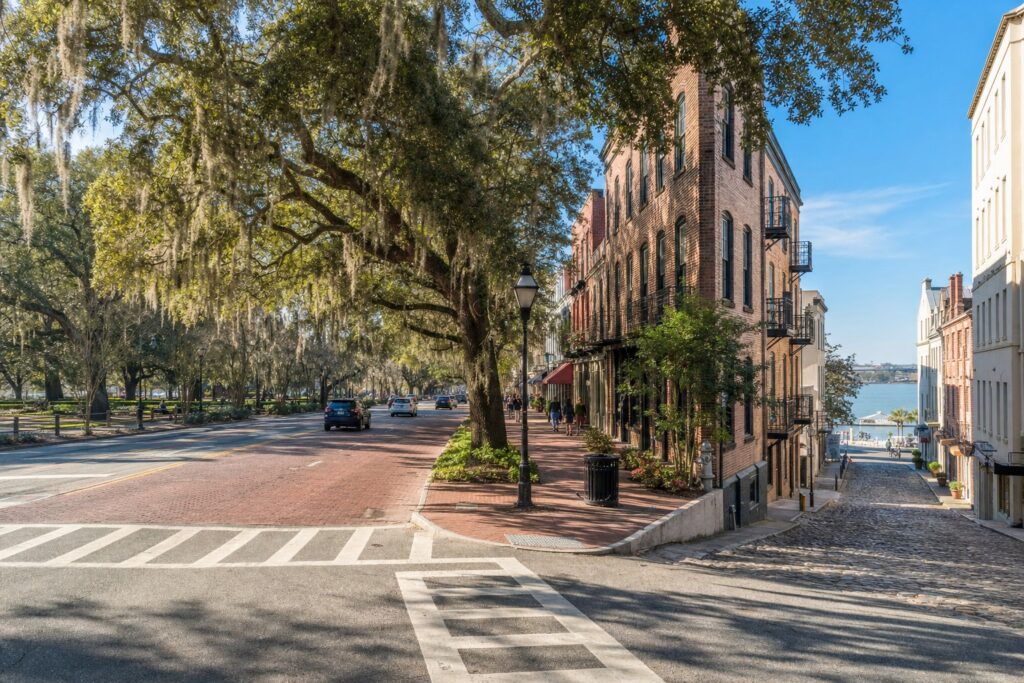
If you were hit by a car while walking downtown, an East Bay Street Savannah pedestrian accident lawyer can help you hold the driver accountable and recover for your medical bills, lost income, and pain — and in Georgia you generally have 2 years from the date of injury to file (O.C.G.A. § 9-3-33). East Bay Street is one of the densest pedestrian corridors in the city: a four-lane arterial running past Emmet Park, the River Street ramps, and blocks of hotels and bars where visitors cross mid-block while drivers watch for one-way traffic instead of people on foot. This guide walks you through your rights, the deadlines that can quietly kill a claim, and the steps that protect your case.
Key Takeaways
- Georgia gives you 2 years from the date of injury to file a pedestrian injury claim (O.C.G.A. § 9-3-33) — but a claim against the City of Savannah requires written ante litem notice within 6 months (O.C.G.A. § 36-33-5).
- Drivers must stop for pedestrians in marked crosswalks under O.C.G.A. § 40-6-91, and most Historic District intersections around the squares have marked crossings.
- Partial fault does not bar you. Under Georgia's modified comparative negligence rule, you can recover as long as you are less than 50% at fault (O.C.G.A. § 51-12-33).
- If the driver flees, your own uninsured motorist coverage (O.C.G.A. § 33-7-11) is often the primary way to recover after a hit-and-run (O.C.G.A. § 40-6-270).
- The Truman Parkway / East President Street interchange funnels 55 mph commuter traffic straight into slow, pedestrian-packed downtown blocks — a top crash setup on the east side.
- Most Savannah pedestrian injury suits are filed in the State Court of Chatham County; smaller claims may go to Magistrate Court and serious cases to Superior Court.
- You pay nothing upfront. Roden Law works on contingency — no fees unless we win.
Why East Bay Street Is So Dangerous for People on Foot
East Bay Street is dangerous for pedestrians because it is a four-lane arterial carrying fast through-traffic directly alongside one of the most walked corridors in Savannah. On one side you have Emmet Park's oaks and the steps down toward River Street; on the other, a steady stream of drivers who are watching for the Historic District's one-way circulation instead of the person stepping off the curb. That mismatch — arterial speed next to constant foot traffic — is exactly where people get hit.
According to the National Highway Traffic Safety Administration, pedestrian fatalities have climbed to their highest levels in decades nationwide, and people on foot are the most vulnerable road users because they have no protection in a collision. According to the Governors Highway Safety Association, a large majority of pedestrian deaths now happen after dark — which matters on East Bay Street, where ghost tours, pub crawls, and late-night bar crowds keep the sidewalks full long after sunset. According to the Georgia Department of Transportation, pedestrian crashes in the state cluster on higher-speed arterial roads and at intersections — the exact profile of East Bay Street and the square-grid crossings around it.
The eastern Historic District stacks several hazards into a few blocks:
- The square grid. Drivers circle Washington Square, Greene Square, Warren Square, Crawford Square, and Columbia Square while tourists step off curbs mid-block, watching the scenery instead of traffic.
- The Truman Parkway hand-off. Harry Truman Parkway ramps meet East President Street at the eastern edge of downtown, dumping 55 mph commuter traffic into pedestrian-dense blocks with almost no speed transition.
- The bar corridor after dark. Late-night impaired driving along East Bay Street is a recurring factor in nighttime crashes near the riverfront.
- Mid-lane rideshare stops. Uber and Lyft pickups routinely stop in travel lanes on East Bay Street, forcing passengers and other walkers into moving traffic.
- Event surges. St. Patrick's Day, riverfront festivals, and SCAD event weekends flood the squares and East Bay Street with unfamiliar drivers on the one-way grid.
Eric Roden, Roden Law's founding partner, points out that the most winnable Historic District pedestrian cases often turn on the small physical details of the corridor — a faded crosswalk line, a blocked sightline behind a trolley, a rideshare stopped where it never should have been — which is why documenting the exact spot on East Bay Street where you were hit matters as much as the police report itself.
Georgia Crosswalk Law and Who Has the Right of Way
In a marked crosswalk, the driver almost always owes you the duty to stop. Georgia law requires drivers to stop and remain stopped for a pedestrian crossing in a marked crosswalk (O.C.G.A. § 40-6-91), and most intersections around the squares — along East Bay Street, East Oglethorpe Avenue, and East Broad Street — have marked crossings. When a driver rolls a crosswalk, turns across it without looking, or accelerates out of a one-way street into a person who already has the right of way, that violation is powerful evidence of negligence.
Right of way is not automatic everywhere, though. Mid-block, outside a marked crosswalk, pedestrians generally must yield to vehicles — which is why so many tourist crashes around Washington Square and Columbia Square become fault disputes. That does not mean you lose. It means the facts of the specific crossing decide the case, and a careful review of the scene, the signals, and witness accounts often shifts fault back onto the driver who was speeding or not paying attention. If your crash happened in a crossing, our breakdown of crosswalk accident claims explains how these cases are built, and our guide to intersection pedestrian accidents covers the square-grid crossings specifically.
The Deadlines That Can Quietly End Your Claim
You generally have two years from the date of injury to file a pedestrian injury lawsuit in Georgia (O.C.G.A. § 9-3-33). Miss that window and the court will almost certainly throw the case out, no matter how badly you were hurt. Two years feels like plenty of time until months disappear into surgeries, physical therapy, and insurance calls — so the deadline is a reason to talk to a lawyer early, not later.
One deadline catches people off guard: if a government vehicle or a dangerous condition on a city street contributed to your crash, a claim against the City of Savannah requires written ante litem notice within 6 months (O.C.G.A. § 36-33-5). That is a fraction of the standard limitations period, and getting the notice wrong can bar the claim entirely.
| Deadline | Time limit | Statute |
|---|---|---|
| Personal-injury lawsuit (against a driver) | 2 years from injury | O.C.G.A. § 9-3-33 |
| Ante litem notice to the City of Savannah | 6 months from injury | O.C.G.A. § 36-33-5 |
| Preserving evidence (video, witnesses) | No statute — but often days | Practical deadline |
That last row is not a statute, but it is just as real. Hotel and business cameras along East Bay Street often overwrite footage within days, and the tourists who witnessed your crash go home. An experienced pedestrian accident practice overview shows why moving fast on evidence frequently decides the outcome.
How Fault Is Decided — and Why Partial Blame Isn't the End
Being partly at fault does not end your claim in Georgia. The state follows modified comparative negligence: you can still recover damages as long as you are less than 50% at fault, though your award is reduced by your own percentage of fault (O.C.G.A. § 51-12-33). If you were 20% responsible and your damages are $100,000, you recover $80,000.
This rule matters for East Bay Street crashes, because insurers reflexively blame the pedestrian — "you crossed mid-block," "you were on your phone," "you'd been drinking." Even if some of that is true, it does not automatically bar you. According to the Centers for Disease Control and Prevention, alcohol is involved for the driver or the pedestrian in nearly half of the crashes that kill a pedestrian — which is why insurers lean on it, and why the driver's own speed, inattention, or crosswalk violation has to be weighed against yours. Pushing your share of fault below the line is where a lawyer earns the recovery, and our Savannah car accident lawyers handle the striking-vehicle side in tandem.
When the Driver Flees the Scene
If the driver who hit you took off, you may still have a clear path to compensation. Leaving the scene of an injury crash is a crime under Georgia's hit-and-run law (O.C.G.A. § 40-6-270), and when the driver is never identified, your own uninsured motorist (UM) coverage often becomes the primary source of recovery (O.C.G.A. § 33-7-11). Many people do not realize their auto policy's UM coverage can pay even when they were on foot, not behind the wheel.
Late-night hit-and-runs cluster on East Broad Street and Wheaton Street, where the bar traffic thins out and drivers gamble that no one saw them. Do not assume a case is hopeless because the car is gone — camera canvassing and rideshare records frequently identify the vehicle. We cover this scenario in depth for walkers in our page on hit-and-run pedestrian accidents, and the UM-coverage mechanics in our overview of hit-and-run accident claims. When impaired driving is the cause, our resource on drunk-driver pedestrian accidents explains the added avenues — including potential dram-shop exposure — that can widen your recovery.
What to Do After You're Hit on East Bay Street
The single most important step is to get medical care immediately, even if you feel "okay." Adrenaline masks serious injuries, and a gap in treatment is the first thing an insurer uses against you. Memorial Health University Medical Center — the region's Level I trauma center — is roughly ten minutes away via the Truman Parkway.
Then, if you are physically able:
- Call 911 and make sure a Savannah-Chatham police report is created.
- Photograph everything — the crosswalk, skid marks, the vehicle, the intersection, and where you landed relative to the curb.
- Get names and numbers from tourists and bystanders before they scatter; on East Bay Street, most witnesses are visitors who leave town.
- Do not give a recorded statement to the driver's insurer before speaking with a lawyer.
- Save your shoes and clothing exactly as they are — they can corroborate the point of impact.
Serious pedestrian collisions can cause life-altering harm. Our coverage of Eastern Wharf pedestrian and bike accidents and Savannah's most dangerous intersections shows how location-specific these claims are, and in the gravest cases families may need our Savannah wrongful death lawyers.
Talk to a Savannah Pedestrian Injury Lawyer — Free
If you or a loved one was hit walking on East Bay Street or anywhere in the Historic District, an East Bay Street Savannah pedestrian accident lawyer at Roden Law is ready to review your case at no cost. With $300M+ recovered, a 4.9-star average across 500+ reviews, and 62 years of combined experience, our team knows how these downtown cases are won. If you were also using a bike in the corridor, our Savannah bicycle accident lawyers cover the Price Street bike lane specifically.
Roden Law — Savannah office: 333 Commercial Dr., Savannah, GA 31406 · (912) 303-5850
📞 Call 1-844-RESULTS — Free Case Review, No Fees Unless We Win.
About the Author
Eric Roden is the founding partner of Roden Law and is admitted to practice in Georgia and South Carolina. He leads the firm's personal-injury practice from its Savannah office at 333 Commercial Dr., where the team represents pedestrians and crash victims across Chatham County and the Georgia coast. This article is legal information, not legal advice; for guidance on your specific situation, contact Roden Law for a free consultation.
Frequently Asked Questions
About the Author