Key Takeaways
Truck accident reconstruction uses physics, engineering, and electronic data analysis to scientifically prove negligence in commercial vehicle crashes. Critical evidence includes event data recorders, ELD logs, maintenance records, and cargo documentation. Georgia allows 2 years to file (O.C.G.A. § 9-3-33) with modified comparative fault under 50% (O.C.G.A. § 51-12-33); South Carolina allows 3 years (S.C. Code § 15-3-530) with fault under 51%. Prompt spoliation letters are essential to preserve electronic evidence.
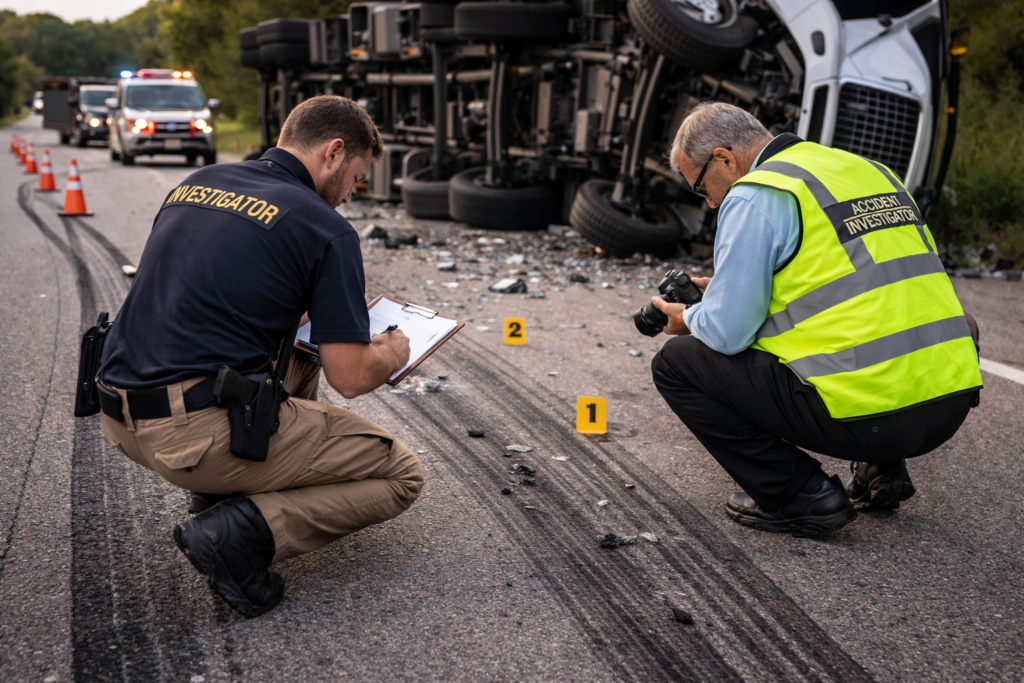
Truck accidents produce catastrophic injuries and complex liability questions. When an 80,000-pound commercial vehicle collides with a passenger car, determining exactly what happened — and who is responsible — requires far more than witness statements and a police report. Truck accident reconstruction uses physics, engineering, and digital forensics to scientifically recreate the collision sequence, providing critical evidence that can make or break your claim in Georgia or South Carolina. Understanding how this process works from the National Highway Traffic Safety Administration’s crash investigation standards helps accident victims appreciate why thorough investigation is essential to securing fair compensation.
What Is Truck Accident Reconstruction?
Truck accident reconstruction is a specialized forensic discipline that combines physics, engineering, and data analysis to determine how and why a collision occurred. Trained reconstruction specialists — typically holding certifications from the Accreditation Commission for Traffic Accident Reconstruction (ACTAR) — examine physical evidence, vehicle data, road conditions, and environmental factors to build a scientific model of the accident sequence.
Unlike a standard accident investigation, which focuses on documenting the scene, reconstruction goes further by answering questions such as:
- How fast were the vehicles traveling at the time of impact?
- Did the truck driver apply the brakes, and if so, when?
- Was the truck driver’s view obstructed, and could the collision have been avoided?
- Did a mechanical failure — such as brake malfunction or tire blowout — contribute to the crash?
- Was the truck’s cargo properly loaded and secured?
- Did the truck driver violate hours-of-service regulations or other federal trucking rules?
The answers to these questions establish the foundation for proving negligence in motor vehicle accident claims and identifying all liable parties.
How the Reconstruction Process Works
A comprehensive truck accident reconstruction follows a systematic methodology that typically unfolds in several phases:
Scene Documentation and Evidence Collection
Reconstruction begins at the accident scene, where specialists document skid marks, gouge marks, debris fields, point of impact indicators, and road surface conditions. Modern reconstructionists use 3D laser scanning, drone photography, and total station surveying to create precise digital models of the scene. This evidence degrades rapidly — skid marks fade, debris is cleared, and road surfaces are repaired — making prompt investigation critical.
Vehicle Inspection
Both vehicles undergo detailed inspection. For commercial trucks, specialists examine brake systems (including adjustment and wear), steering components, tires (tread depth, inflation, age), lighting systems, mirrors, and coupling devices. Defective components may point to product liability claims against manufacturers or maintenance negligence claims against the trucking company.
Electronic Data Retrieval
Modern commercial trucks contain multiple electronic data sources that provide objective evidence of pre-crash conditions. The truck’s Event Data Recorder (EDR or “black box”) captures speed, braking, throttle position, and other parameters in the seconds before and during a collision. Electronic Logging Devices (ELDs) record hours of service, revealing potential driver fatigue violations. GPS tracking data shows the truck’s route, stops, and speed history. Engine Control Module (ECM) data reveals maintenance alerts and mechanical issues.
Physics-Based Analysis
Using the collected evidence, reconstructionists apply the laws of physics — conservation of momentum, energy dissipation, kinematics, and friction dynamics — to calculate vehicle speeds, impact forces, closing rates, and post-collision trajectories. Specialized software programs model collision scenarios and generate animations that illustrate the accident sequence for judges and juries.
Critical Evidence Used in Truck Accident Reconstruction
Successful reconstruction depends on preserving and analyzing multiple evidence sources. A skilled truck accident attorney knows what evidence to demand before it disappears:
| Evidence Type | What It Reveals | Preservation Window |
|---|---|---|
| Event Data Recorder (EDR) | Speed, braking, throttle, steering inputs | May be overwritten in days |
| Electronic Logging Device (ELD) | Hours of service, rest periods, driving time | 6 months (federal requirement) |
| GPS/telematics data | Route, speed, stops, hard braking events | 30-90 days typically |
| Dashcam/security footage | Pre-crash driver behavior, road conditions | Overwritten in 24-72 hours |
| Maintenance records | Brake inspections, tire changes, repair history | Must be retained 1 year (FMCSA) |
| Driver qualification file | CDL status, medical certificate, training, violations | Duration of employment + 3 years |
| Cargo/load records | Weight, distribution, securement methods | Varies by carrier |
| Drug/alcohol test results | Post-accident impairment testing | Must be retained 5 years (FMCSA) |
Sending a spoliation letter — a formal demand to preserve evidence — immediately after the accident is one of the most important steps your attorney can take. Without this preservation demand, trucking companies may destroy or overwrite critical evidence during routine business operations.
Proving Negligence Through Reconstruction
Negligence in truck accident cases can take many forms, and reconstruction evidence directly supports each element of a negligence claim:
Duty of Care
Commercial truck drivers and trucking companies owe a heightened duty of care due to the size and danger of their vehicles. Federal Motor Carrier Safety Administration (FMCSA) regulations establish specific standards for driver conduct, vehicle maintenance, hours of service, and cargo securement. Reconstruction evidence showing violations of these standards establishes a clear breach of duty.
Breach of Duty
Common forms of negligence revealed through reconstruction include:
- Speeding: EDR data and physics calculations show the truck was traveling above the speed limit or too fast for conditions
- Driver fatigue: ELD records reveal hours-of-service violations indicating the driver was too fatigued to operate safely
- Distracted driving: Cell phone records and dashcam footage show the driver was not focused on the road
- Improper maintenance: Brake inspection records reveal failed or neglected maintenance leading to brake failure
- Overloaded cargo: Weight records show the truck exceeded legal weight limits or cargo was improperly secured
- Following too closely: Speed and distance calculations prove the truck did not maintain a safe following distance
Causation and Damages
Reconstruction connects the breach of duty to the injuries by demonstrating that the negligent conduct directly caused the collision and resulting harm. Impact force calculations help explain the severity of injuries, supporting claims for damages in traumatic brain injury, spinal cord injury, and wrongful death cases.
Truck Accident Liability Rules in Georgia
Georgia’s legal framework for truck accident claims includes several important rules that reconstruction evidence helps navigate:
- Modified comparative fault (O.C.G.A. § 51-12-33): Georgia allows recovery only if the injured party is less than 50% at fault. Reconstruction evidence establishing the truck driver’s greater share of fault is essential when the defense argues comparative negligence.
- Statute of limitations (O.C.G.A. § 9-3-33): Injured parties have 2 years from the date of the accident to file a personal injury lawsuit. Wrongful death claims must be filed within 2 years of the date of death (O.C.G.A. § 9-3-33).
- Respondeat superior: Georgia holds trucking companies vicariously liable for the negligent acts of their employee drivers under the doctrine of respondeat superior. Reconstruction evidence proving the driver was acting within the scope of employment at the time of the crash supports claims against the carrier.
- Punitive damages (O.C.G.A. § 51-12-5.1): When reconstruction reveals egregious conduct such as falsified logbooks or known mechanical defects, punitive damages may be available, capped at $250,000 in most cases.
Truck Accident Liability Rules in South Carolina
South Carolina applies a slightly different legal framework to truck accident cases:
- Modified comparative fault: South Carolina allows injured parties to recover damages if they are less than 51% at fault — providing marginally more latitude than Georgia’s 50% threshold. Reconstruction evidence quantifying each party’s fault percentage is critical.
- Statute of limitations (S.C. Code § 15-3-530): South Carolina provides 3 years to file a personal injury claim, giving more time to complete reconstruction analysis and build a comprehensive case.
- Negligent entrustment: South Carolina recognizes negligent entrustment claims against trucking companies that allow unqualified or dangerous drivers to operate their vehicles. Driver qualification file analysis often supports these claims.
- Punitive damages (S.C. Code § 15-32-530): South Carolina caps punitive damages at three times compensatory damages or $739,245, the 2026 inflation-indexed figure, whichever is greater. A clear and convincing evidence standard applies.
Common Truck Accident Scenarios Requiring Reconstruction
Certain types of truck accidents almost always benefit from professional reconstruction analysis:
- Jackknife accidents: When a truck’s trailer swings out at an angle, reconstruction determines whether the cause was excessive braking, wet roads, improper cargo loading, or driver error.
- Override/underride collisions: Passenger vehicles can slide beneath truck trailers in catastrophic collisions. Reconstruction analyzes rear and side underride guard compliance with federal standards.
- Rollover crashes: Speed, road curvature, cargo distribution, and center-of-gravity calculations determine whether the rollover resulted from driver negligence or mechanical failure.
- Intersection collisions: Traffic signal timing, sight distance analysis, and speed calculations determine right-of-way and fault at intersections.
- Rear-end collisions: Following distance, reaction time, and braking distance calculations prove whether the truck driver had sufficient time and distance to stop.
- Construction zone accidents: Lane width, signage adequacy, and speed reduction compliance are critical factors in work zone crashes.
- Multi-vehicle pileups: Reconstruction is essential to sorting out fault among multiple parties in chain-reaction collisions, particularly on highways and interstates common in Georgia and South Carolina.
How Reconstruction Experts Strengthen Your Case
A qualified accident reconstructionist serves as an expert witness who translates complex scientific analysis into clear, persuasive testimony. Their role includes:
- Preparing detailed reports documenting their methodology, findings, and conclusions
- Creating visual exhibits including scaled diagrams, 3D animations, and computer simulations that help juries visualize the accident
- Providing deposition testimony that establishes the scientific basis for negligence claims
- Rebutting defense experts who may attempt to shift blame to the injured party
- Withstanding cross-examination through adherence to accepted scientific methodology and peer-reviewed standards
In both Georgia and South Carolina courts, expert testimony must meet reliability standards — Georgia follows the Daubert standard (O.C.G.A. § 24-7-702), and South Carolina applies the Jones/Council standard. A well-qualified reconstructionist with ACTAR certification and documented methodology will satisfy these requirements.
Why You Need an Attorney for Truck Accident Claims
Truck accident cases involve multiple potential defendants — the driver, the trucking company, cargo loaders, maintenance providers, and vehicle or parts manufacturers. Reconstruction evidence helps identify all responsible parties and maximize your recovery. An experienced attorney coordinates with reconstruction specialists from the outset, ensuring evidence is preserved through spoliation letters and independent investigation begins before critical data is lost.
At Roden Law, our truck accident lawyers serve clients across Georgia and South Carolina. We work with certified accident reconstructionists and handle every aspect of your claim on a contingency fee basis — you pay nothing unless we recover compensation for you. Contact Roden Law for a free consultation or call 1-844-RESULTS.
Frequently Asked Questions
About the Author