Last reviewed: May 15, 2026
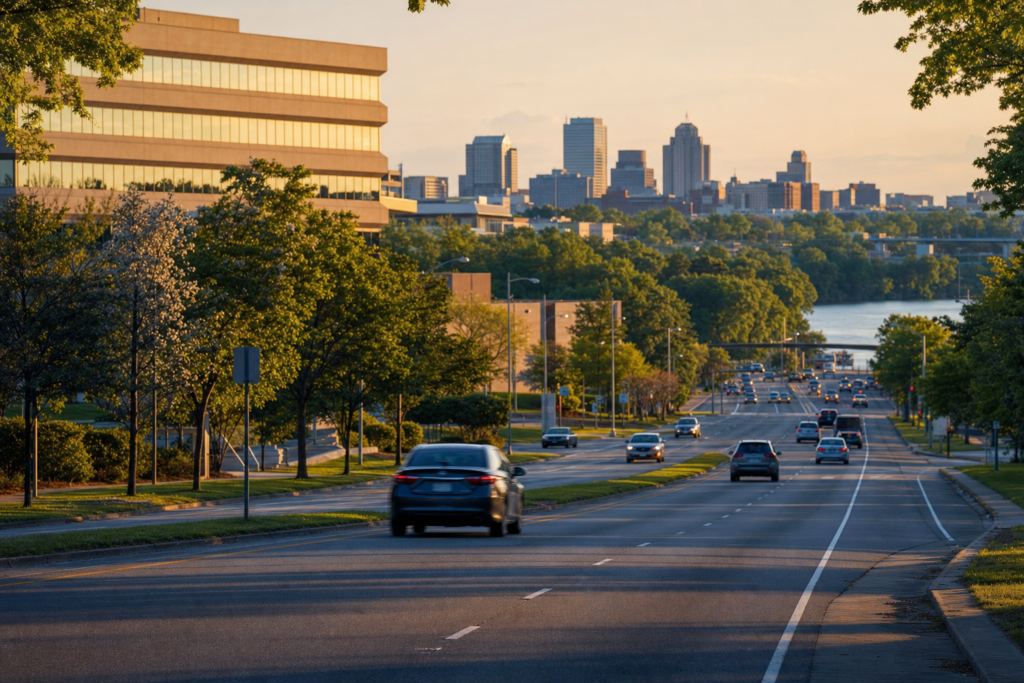
A Sunset Boulevard car accident is a crash on US-378 — the four-lane, 45-mph arterial cutting through West Columbia and Cayce past Lexington Medical Center. These crashes sit in Lexington County, not Richland, which changes where your case files, who handles your records, and which civil rules govern your claim. This guide walks you through the corridor, the law, and your next move.
If you were hit on Sunset Boulevard near the Lexington Medical Center hospital district, you are probably reading this from a hospital bed, a parking lot, or your couch the day after — confused about who pays the bills, anxious about the police report, and unsure whether you even need a car accident lawyer. You do not have to figure this out alone, and you do not pay anything to ask. Roden Law’s Columbia office handles these cases on a contingency basis — no fees unless we win.
Key Takeaways
- Sunset Boulevard crashes file in Lexington County, not Richland. The cluster around Lexington Medical Center sits squarely inside Lexington County, so most cases proceed in the Lexington County Court of Common Pleas (11th Judicial Circuit) — not the Richland County 5th Circuit in downtown Columbia.
- You have 3 years to sue under S.C. Code § 15-3-530 — but only 2 years if your defendant is a state or local government entity under the South Carolina Tort Claims Act, S.C. Code § 15-78-110.
- South Carolina is a 51% modified-comparative-fault state under Nelson v. Concrete Supply Co. — if you are more than 50% at fault, you recover nothing.
- UIM coverage can be stacked across multiple policies under S.C. Code § 38-77-160 — critical when Lexington Medical Center bills outrun the at-fault driver’s limits.
- DUI convictions carry over into civil claims. A criminal conviction under S.C. Code § 56-5-2930 is persuasive evidence of negligence and can support a dram-shop case.
- Ambulance and emergency-vehicle right-of-way disputes turn on S.C. Code § 56-5-760 — and may involve a government defendant, which compresses your filing deadline.
What Makes Sunset Boulevard (US-378) So Crash-Prone
Sunset Boulevard is a 4-lane, 45-mph primary arterial that runs straight through the heart of West Columbia and Cayce. It is the dominant east-west commuter route between downtown Columbia and Lexington County, and according to the SCDOT 2024 Traffic Count Book, US-378 corridors through the Midlands carry tens of thousands of vehicles per day with peak-period AADT volumes well above the statewide arterial average. That volume, combined with frequent signalized intersections, hospital driveways, and school-zone speed transitions, produces a textbook recipe for serious crashes.
According to the South Carolina Department of Public Safety’s 2023 Traffic Collision Fact Book, Lexington County recorded more than 13,000 reportable traffic crashes in 2023 alone — placing it among the state’s top five counties for collision volume. Roughly one in three of those crashes occurred on a state-maintained primary route like US-378.
A few specific risk factors converge on this stretch:
- The hospital corridor. Lexington Medical Center is one of the largest hospitals in the Midlands, with ambulances, patient-transport vans, shift-change traffic, and visitors all turning on and off Sunset Boulevard around the clock. Emergency-vehicle right-of-way disputes are common — and legally complicated, because they implicate S.C. Code § 56-5-760.
- The school zones. Glenforest School and East Point Academy Elementary Campus both sit within a mile of the cluster. School-zone speed drops from 45 mph to as low as 25 mph during arrival and dismissal create dangerous speed differentials between commuters who don’t slow down and parents creeping into the bus loop.
- The river-bridge funnel. Cross-river commuter traffic from downtown Columbia (Richland County) pours onto Sunset Boulevard via the Saluda and Congaree River bridges at rush hour. USC football weekends and downtown event traffic make it worse.
- Late-night DUI risk. Sunset Boulevard’s mix of restaurants, bars, and 45-mph open lanes makes it a recurring location for impaired-driver crashes.
The result is a corridor where rear-end collisions at signalized intersections, left-turn-across-path crashes at driveways, pedestrian strikes near school crosswalks, hospital-corridor right-of-way disputes, and late-night DUI wrecks all happen at meaningful frequency.
The Lexington vs. Richland Venue Distinction — and Why It Matters
This is the single most important thing most Columbia-area injury victims don’t know: the Sunset Boulevard / Lexington Medical Center cluster is in Lexington County, not Richland.
It is a five-minute drive across the Congaree River from downtown Columbia, but a five-minute drive can change your entire civil-procedure landscape. Where you file determines which courthouse you walk into, which clerk handles your filings, which jury pool decides your case, and — in some cases — how quickly your case actually moves.
| Issue | Lexington County (Sunset Blvd / LMC) | Richland County (downtown Columbia) |
|---|---|---|
| Court of Common Pleas | 11th Judicial Circuit, Lexington | 5th Judicial Circuit, Columbia |
| Magistrate’s Court (small claims) | Lexington County Magistrate’s Court | Richland County Magistrate’s Court |
| Federal court option | U.S. District Court for the District of South Carolina, Columbia Division | Same — both counties fall under the Columbia Division |
| Typical jury pool | Lexington County residents | Richland County residents |
| Where most Sunset Blvd / LMC crashes file | Yes | No |
If your crash occurred on the West Columbia or Cayce side of the river, near Lexington Medical Center, your case almost certainly belongs in Lexington County Court of Common Pleas. Smaller claims under the magistrate-court jurisdictional limit may go to Lexington County Magistrate’s Court. Cases with complete diversity of citizenship and over $75,000 in controversy can be removed to the U.S. District Court for the District of South Carolina, Columbia Division — which actually serves both counties.
Filing in the wrong venue won’t necessarily kill your case, but it can cause expensive delay, motions to transfer, and a worse procedural posture going into discovery. This is one of several reasons working with Columbia-area counsel who knows the difference matters — and why our Columbia car accident lawyers treat venue as a threshold decision, not an afterthought.
South Carolina Law That Will Drive Your Sunset Boulevard Claim
These are the SC statutes that will shape your case from day one. None of them are Georgia law — South Carolina has its own framework, and it differs in important ways from neighboring states.
The 3-year deadline (with a 2-year trap). Under S.C. Code § 15-3-530, you generally have three years from the date of injury to file a personal-injury lawsuit in South Carolina. But if your defendant is a state or local government entity — for example, a county-employed EMS driver, a city employee, or a state trooper — the South Carolina Tort Claims Act, S.C. Code § 15-78-110, requires filing within two years. Hospital-corridor crashes near Lexington Medical Center are exactly the kind of cases where a government defendant can show up unexpectedly. For a deeper dive, see South Carolina’s 3-year statute of limitations.
Modified comparative fault — 51% bar. South Carolina follows a 51% modified-comparative-negligence rule under Nelson v. Concrete Supply Co.. If a jury finds you 50% or less at fault, you can still recover — but your damages are reduced by your share of fault. If you are 51% or more at fault, you recover nothing. The defense will fight aggressively to push your fault percentage upward. According to the U.S. Census Bureau’s American Community Survey, more than 90% of South Carolina workers commute by car — meaning crash-fault disputes are not edge cases here, they are routine, and South Carolina’s 51% bar is among the more defense-friendly variants in use nationally.
Uninsured / underinsured motorist stacking. S.C. Code § 38-77-160 permits stacking of UIM coverage across multiple eligible policies. This matters enormously in hospital-corridor crashes, where Lexington Medical Center bills alone can blow through a single at-fault driver’s minimum policy limits. If you have multiple vehicles on your policy — or live in a household with multiple insured vehicles — stacking can unlock several layers of coverage you may not know you have.
DUI and dram-shop. S.C. Code § 56-5-2930 governs DUI in South Carolina. A criminal conviction under this section is persuasive evidence in a civil negligence claim, and can support a dram-shop action against the bar or restaurant that overserved the impaired driver. Late-night Sunset Boulevard wrecks frequently involve this fact pattern.
Emergency-vehicle right-of-way. S.C. Code § 56-5-760 sets the rules of the road for emergency vehicles. When an ambulance leaves Lexington Medical Center with lights and sirens and is involved in a crash, this statute (and the Tort Claims Act if the responder is government-employed) governs liability — and the analysis is genuinely technical.
Wrongful death. If you lost a family member in a Sunset Boulevard crash, S.C. Code § 15-51-10 et seq. governs wrongful-death actions in South Carolina. The claim must be brought by the deceased person’s personal representative. Our Columbia wrongful death lawyers handle these cases with the sensitivity they deserve.
What You Should Actually Do After a Sunset Boulevard Crash
According to the National Highway Traffic Safety Administration’s most recent Traffic Safety Facts annual report, more than 6 million police-reported motor-vehicle crashes occur in the United States each year — and the steps a victim takes in the first 72 hours often determine the outcome of any later claim.
The short version: get safe, get medical care, get documentation. The longer version is in our complete guide on what to do after a Columbia car accident. A few specifics for this corridor:
- Lexington Medical Center is right there. If you have any head, neck, back, or chest symptoms, go. Soft-tissue injuries and concussions routinely surface 24 to 72 hours later, and a contemporaneous ER record is the most powerful piece of evidence in a soft-tissue case.
- Get the SCDPS crash report. You can request it through SCDPS or the responding agency. For a Sunset Boulevard wreck, the responding agency is typically the West Columbia Police Department, Cayce Department of Public Safety, or the Lexington County Sheriff’s Office depending on the exact mile-marker.
- Don’t give a recorded statement to the other driver’s insurer. Talk to a lawyer first. The first thing they ask about is your fault — see the 51% bar above.
- Document the corridor. Photos of the intersection, the school-zone signage if relevant, the hospital driveway, skid marks, and your vehicle’s resting position are evidence that disappears within 24 hours.
Truck and commercial-vehicle crashes on this corridor have additional layers — driver logs, ECM data, FMCSA compliance records — that require fast preservation letters. The procedural playbook for those is in our Columbia truck-accident step-by-step guide, and our Columbia truck accident lawyers take the lead on commercial cases.
What Graeham C. Gillin Sees in These Cases
Graeham C. Gillin, a partner and Chief Operating Officer at Roden Law, has built much of his career around catastrophic-injury cases in coastal and Midlands South Carolina. He has emphasized that the Sunset Boulevard / Lexington Medical Center corridor sees a recurring pattern of mid-speed rear-end and left-turn crashes that look minor on the police report but produce serious soft-tissue and traumatic-brain-injury claims weeks later — particularly when the impact happens at 35 to 45 mph at a signalized intersection. In his experience, the two factors that most often decide these cases are how quickly the client gets evaluated at Lexington Medical Center and whether the lawyer immediately preserves the corridor evidence — signal-timing logs, nearby business camera footage, and the SCDPS report. He notes that the venue question — Lexington County versus Richland — is also one of the most consistently misunderstood issues he sees clients arrive with, including clients who have already spoken with another firm. The right county, the right court, the right jury pool, and the right preservation steps make the difference between a settlement that covers your bills and one that leaves you short.
If your injuries are catastrophic — brain injury, spinal cord injury, or loss of a family member — additional teams get involved early. Our Columbia brain injury lawyers and Columbia spinal cord injury lawyers coordinate medical experts, life-care planners, and economists from the start.
Other Common Sunset Boulevard Scenarios
Sunset Boulevard is not just a car-on-car corridor. Because of the school zones at Glenforest School and East Point Academy Elementary Campus, our Columbia pedestrian accident lawyers and Columbia bicycle accident lawyers regularly handle school-zone crosswalk and shoulder-strike cases on this stretch. Motorcycle crashes at signalized intersections — typically when a driver fails to yield to a left-turning rider — are also common, and our Columbia motorcycle accident lawyers handle those alongside the car-crash team.
For broader context on Columbia-area crash patterns, see Columbia’s most dangerous intersections and the firm-wide pillar at South Carolina personal injury lawyers.
Frequently Asked Questions
Q: Does my Sunset Boulevard crash file in Lexington County or Richland County?
A: Almost certainly Lexington County. The Sunset Boulevard / Lexington Medical Center corridor sits inside Lexington County, so most personal-injury cases proceed in the Lexington County Court of Common Pleas (11th Judicial Circuit) rather than the Richland County 5th Circuit in downtown Columbia. Federal cases under diversity jurisdiction file in the U.S. District Court, Columbia Division.
Q: How long do I have to file a lawsuit after a Sunset Boulevard car accident?
A: In most cases, three years from the date of injury under S.C. Code § 15-3-530. But if your defendant is a state or local government entity — for example, a county-employed EMS driver — the South Carolina Tort Claims Act (S.C. Code § 15-78-110) shortens that to two years. Don’t assume you have three years until a lawyer confirms it.
Q: What if I was partly at fault for the Sunset Boulevard crash?
A: You can still recover damages in South Carolina if you were 50% or less at fault, under Nelson v. Concrete Supply Co.. Your recovery is reduced by your fault percentage. If a jury finds you 51% or more at fault, however, you recover nothing — which is why aggressive fault-shifting is the defense playbook in nearly every contested claim.
Q: The other driver had only state-minimum insurance and my Lexington Medical Center bills are huge. What now?
A: Look hard at uninsured / underinsured motorist coverage. S.C. Code § 38-77-160 allows stacking of UIM coverage across multiple eligible policies, which can multiply the coverage available to you. Many crash victims have stackable coverage they don’t realize they have until a lawyer reviews every household policy.
Q: An ambulance from Lexington Medical Center caused my crash. Can I sue?
A: Possibly, but it gets technical fast. S.C. Code § 56-5-760 governs emergency-vehicle operations, and if the ambulance driver works for a government entity, the South Carolina Tort Claims Act (S.C. Code § 15-78-110) applies — meaning a two-year filing deadline instead of three, and potential damage caps. Get a lawyer involved before that 2-year window starts running.
Q: Do I need a lawyer for a Sunset Boulevard car accident, or can I handle it myself?
A: You can technically handle it yourself, but most serious-injury claims involve venue questions (Lexington vs. Richland), comparative-fault disputes, UIM stacking analysis, and medical-bill negotiation that benefits enormously from experienced counsel. Roden Law charges no upfront fees and no legal fees unless we win — so the cost of getting evaluated is zero.
About the Author
Graeham C. Gillin is a partner and Chief Operating Officer at Roden Law and leads the firm’s catastrophic-injury practice across South Carolina and Georgia. Graeham is licensed by the South Carolina Bar.S. District Court for the District of South Carolina, Columbia Division.
Hurt on Sunset Boulevard or anywhere along the Lexington Medical Center corridor? Call Roden Law’s Columbia office at (803) 219-2816 or 1-844-RESULTS for a free, no-obligation case review. No fees unless we win.
About the Author