
Key Takeaways
Georgia law requires drivers to stop and remain stopped for pedestrians in marked and unmarked crosswalks (O.C.G.A. § 40-6-91), while pedestrians must obey walk signals and, when crossing outside a crosswalk, yield to traffic (O.C.G.A. § 40-6-92). Under Georgia's modified comparative fault rule (O.C.G.A. § 51-12-33), an injured pedestrian can recover damages as long as they are less than 50% at fault. Right-of-way violations such as failing to yield, speeding, or distracted driving are proven through surveillance footage, witness testimony, and accident reconstruction. Georgia's two-year statute of limitations (O.C.G.A. § 9-3-33) applies to pedestrian injury claims, and claims against a city, county or state driver require written notice far sooner.
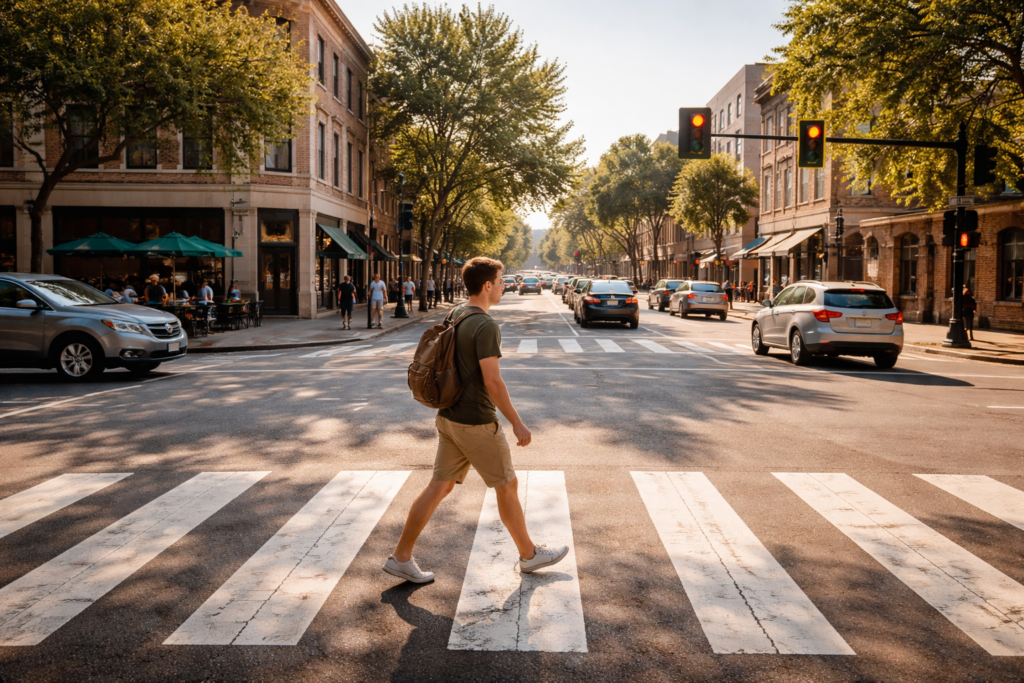
Georgia’s pedestrian right-of-way laws exist to protect walkers, joggers, and anyone on foot from being struck by motor vehicles. But despite these protections, right-of-way rules are frequently misunderstood by both drivers and pedestrians — and Georgia recorded 286 pedestrian deaths and 2,653 pedestrian injuries in 2024, according to the Georgia Governor’s Office of Highway Safety. If you were hit by a vehicle while lawfully crossing a Georgia road, understanding how these statutes work is critical to recovering compensation for your injuries.
Georgia’s Official Code — specifically Title 40, Chapter 6 — lays out detailed rules governing when drivers must yield to pedestrians, when pedestrians have the right of way, and when pedestrians themselves must yield to traffic. These laws apply in cities like Savannah, Pooler, Statesboro, Hinesville, and throughout the state. Knowing these rules can make or break your pedestrian accident claim.
What Is Pedestrian Right of Way in Georgia?
Pedestrian right of way refers to the legal priority a person on foot has when crossing a roadway. When a pedestrian has the right of way, drivers are legally required to stop or yield — meaning the driver must allow the pedestrian to cross safely before proceeding. Failing to yield when the law requires it constitutes negligence and can form the basis of a personal injury claim.
In Georgia, right-of-way rules are not one-sided. Both drivers and pedestrians have specific legal obligations. The law creates a framework of shared responsibility, but when a driver violates a pedestrian’s right of way and causes a collision, the driver is typically liable for the resulting injuries. Georgia courts treat a statutory right-of-way violation as negligence per se — the violation itself establishes the driver’s negligence, though the injured person must still show it caused the injuries (O.C.G.A. § 51-1-6).
Georgia Pedestrian Right-of-Way Statutes
Georgia’s pedestrian right-of-way framework is built on several interconnected statutes within the Official Code of Georgia Annotated (O.C.G.A.). Each addresses a different scenario:
O.C.G.A. § 40-6-91 — Right of Way in Crosswalks
This is the most important pedestrian right-of-way statute in Georgia. It requires drivers to “stop and remain stopped to allow a pedestrian to cross the roadway within a crosswalk when the pedestrian is upon the half of the roadway upon which the vehicle is traveling, or when the pedestrian is approaching and is within one lane of the half of the roadway on which the vehicle is traveling or onto which it is turning.”
Key points from this statute:
- The duty applies at both marked and unmarked crosswalks
- The driver must not just slow down but must stop and remain stopped
- The trigger is the pedestrian being on the driver’s half of the road, or within one lane of it — including the half the driver is turning onto
- A driver coming up behind a vehicle stopped at a crosswalk may not pass it (subsection (d))
O.C.G.A. § 40-6-92 — Crossing at Other Than Crosswalks
When a pedestrian crosses a road at a location other than a marked crosswalk or an unmarked crosswalk at an intersection, the pedestrian must yield the right of way to vehicles unless the pedestrian has already, and under safe conditions, entered the roadway. However, this does not give drivers license to ignore pedestrians — drivers must still exercise due care to avoid hitting any person on the roadway regardless of who has the technical right of way.
O.C.G.A. § 40-6-93 — Drivers to Exercise Due Care
This statute imposes a universal duty: notwithstanding the other rules of the road, “every driver of a vehicle shall exercise due care to avoid colliding with any pedestrian upon any roadway” — and must sound the horn when necessary and take proper precautions around any child or any obviously confused, incapacitated, or intoxicated person. This means that even when a pedestrian is jaywalking or crossing against a signal, the driver has a legal obligation to take reasonable steps to avoid a collision. A driver who sees a pedestrian in the road and makes no effort to slow down or stop can be held liable regardless of who technically had the right of way.
O.C.G.A. § 40-6-22 — Pedestrian-Control Signals
At intersections with pedestrian signals (“Walk” / “Don’t Walk”), pedestrians must obey these signals. A pedestrian who enters the roadway on a “Don’t Walk” signal does not have the right of way. However, if a pedestrian begins crossing during a “Walk” signal and the signal changes mid-crossing, the pedestrian may finish crossing to the sidewalk or a safety island (O.C.G.A. § 40-6-22), and a driver getting a green light must stop and remain stopped for a pedestrian still lawfully in the crosswalk (O.C.G.A. § 40-6-21).
Marked vs. Unmarked Crosswalks Under Georgia Law
One of the most misunderstood aspects of Georgia pedestrian law is the concept of unmarked crosswalks. Many drivers — and even some pedestrians — believe that crosswalks only exist where painted lines are visible on the road. This is wrong.
Under Georgia law, an unmarked crosswalk exists at an intersection wherever the sidewalks on opposite sides of the road would connect across it, even when no paint or markings are present. O.C.G.A. § 40-1-1(10) defines a crosswalk as:
“That part of a roadway at an intersection included within the connections of the lateral lines of the sidewalks on opposite sides of the highway measured from the curbs or in the absence of curbs, from the edges of the traversable roadway.”
This means that at any intersection with sidewalks, there is a legal crosswalk — marked or not, though the Georgia Court of Appeals held a T intersection did not qualify (McKenzie v. Detenber, 1997). Drivers must stop and remain stopped for pedestrians in unmarked crosswalks just as they would in marked ones. This rule is particularly relevant in Georgia’s older downtown areas, such as Savannah’s historic district and crosswalk intersections throughout the state where faded or absent markings are common.
| Feature | Marked Crosswalk | Unmarked Crosswalk |
|---|---|---|
| Visual Indicator | Painted lines on roadway | No paint — implied at intersections with sidewalks |
| Legal Status in Georgia | Full right of way (O.C.G.A. § 40-6-91) | Full right of way (O.C.G.A. § 40-6-91) |
| Driver’s Duty | Stop and remain stopped | Stop and remain stopped |
| Common Locations | School zones, busy intersections, downtown areas | Residential intersections, older neighborhoods |
| Insurance Disputes | Rarely disputed | Frequently disputed by insurers |
Driver Duties to Pedestrians in Georgia
Georgia law imposes several specific obligations on drivers when pedestrians are present or potentially present:
- Stop and remain stopped for pedestrians in any crosswalk (marked or unmarked) when the pedestrian is on the driver’s half of the roadway or approaching within one lane (O.C.G.A. § 40-6-91)
- Do not pass a stopped vehicle at a crosswalk — if a vehicle ahead has stopped to let a pedestrian cross, you may not overtake and pass it (O.C.G.A. § 40-6-91(d))
- Exercise due care to avoid colliding with any pedestrian, regardless of who has the right of way (O.C.G.A. § 40-6-93)
- Give audible warning when necessary by sounding the horn to alert a pedestrian of danger
- Reduce speed in school zones, residential areas, and other areas where pedestrians are likely
- Stop when turning — drivers turning left or right must stop and remain stopped for pedestrians lawfully in the crosswalk they are turning across (O.C.G.A. §§ 40-6-21, 40-6-91)
When a driver fails to follow any of these rules and strikes a pedestrian, the violation can serve as evidence of negligence in a car accident or pedestrian accident claim.
Pedestrian Duties Under Georgia Law
Pedestrians also have legal obligations in Georgia. Failing to follow these rules can reduce or eliminate a pedestrian’s ability to recover compensation after an accident:
- Obey pedestrian signals — do not enter the roadway against a “Don’t Walk” signal (O.C.G.A. § 40-6-22)
- Use marked crosswalks between signals — between adjacent intersections where traffic signals are operating, pedestrians may cross only in a marked crosswalk (O.C.G.A. § 40-6-92(c))
- Yield to vehicles when outside a crosswalk — pedestrians crossing at locations other than crosswalks must yield to traffic (O.C.G.A. § 40-6-92(a)) unless they have already entered the roadway under safe conditions
- Use the sidewalk if there is one; if not, use the shoulder; and if there is neither, walk as close to the edge as practicable — on a two-lane road, on the left side, facing traffic (O.C.G.A. § 40-6-96)
- Do not suddenly leave a curb and walk or run into the path of a vehicle so close that the driver cannot yield (O.C.G.A. § 40-6-91(b))
It is important to understand that even when a pedestrian violates one of these rules, the driver’s duty of due care under O.C.G.A. § 40-6-93 does not disappear. Both parties can share fault, which is where Georgia’s comparative fault rules become critical.
How Georgia’s Comparative Fault Rule Affects Pedestrian Claims
Georgia follows a modified comparative fault system under O.C.G.A. § 51-12-33. Under this rule, an injured pedestrian can recover compensation as long as they are less than 50% at fault for the accident. If the pedestrian is found to be 50% or more at fault, they recover nothing.
When comparative fault applies, the pedestrian’s damages are reduced by their percentage of fault. For example:
- A pedestrian suffers $200,000 in damages
- The jury finds the pedestrian was 20% at fault for crossing against the signal
- The pedestrian recovers $160,000 (reduced by 20%)
Insurance companies frequently try to assign fault to pedestrians to reduce payouts. Common arguments include claiming the pedestrian was jaywalking, not paying attention, wearing dark clothing at night, or was intoxicated. An experienced pedestrian accident lawyer can counter these arguments with evidence that the driver’s right-of-way violation was the primary cause of the collision.
Common Right-of-Way Violations That Cause Pedestrian Accidents
In our experience handling pedestrian accident cases across Georgia, the most common driver right-of-way violations include:
Failure to Stop at Crosswalks
The most frequent violation. Drivers either fail to see the pedestrian or misjudge the distance, rolling through a crosswalk while a person is crossing. This is especially common at unmarked crosswalks where drivers do not expect pedestrian traffic.
Right-Turn-on-Red Violations
Drivers turning right on red often focus exclusively on oncoming traffic and fail to check the crosswalk. A pedestrian crossing with a “Walk” signal can be struck by a driver who never looked their direction.
Left-Turn Failures
Drivers making left turns at intersections are focused on finding a gap in oncoming traffic and frequently fail to check for pedestrians in the crosswalk they are turning into. Left-turning drivers are a frequent cause of crosswalk accidents.
Passing a Stopped Vehicle at a Crosswalk
When one vehicle stops for a pedestrian, drivers coming up from behind in adjacent lanes sometimes pass the stopped vehicle — directly into the pedestrian’s path. O.C.G.A. § 40-6-91(d) bars a driver approaching from the rear from overtaking and passing the stopped vehicle, but violations are common on multi-lane roads.
Distracted Driving
Texting, phone use, eating, and other distractions prevent drivers from seeing pedestrians who have the right of way. Distracted driving accidents involving pedestrians often result in severe injuries because the driver makes no attempt to brake.
Speeding Through Pedestrian Areas
Excessive speed reduces a driver’s ability to stop for pedestrians and dramatically increases the severity of injuries. A pedestrian’s risk of death reaches 10% at an impact speed of 23 mph, 50% at 42 mph and 90% at 58 mph, according to the AAA Foundation for Traffic Safety.
How to Prove a Right-of-Way Violation in a Georgia Pedestrian Case
To recover compensation after a pedestrian accident in Georgia, you must prove that the driver violated your right of way and that this violation caused your injuries. Key evidence includes:
- Traffic camera or surveillance footage showing the driver failing to stop at the crosswalk
- Witness testimony from bystanders who saw the driver run the crosswalk or fail to yield
- Police accident report — the officer’s findings and witness statements help establish what happened; a citation is not itself evidence of negligence at trial, but a guilty plea to it can be used as an admission
- Crash reconstruction by an expert who can analyze vehicle speed, braking distance, and the pedestrian’s position
- Signal timing data from the traffic authority showing which signal was displayed at the time of the crash
- Medical records documenting injuries consistent with the mechanism of the collision
- Cell phone records showing the driver was texting or on the phone at the time of impact
Georgia’s statute of limitations for personal injury claims is 2 years from the date of the accident (O.C.G.A. § 9-3-33). Filing after this deadline bars your claim entirely, and claims against a city, county or state driver require written notice far sooner, so it is critical to act quickly to preserve evidence and protect your rights.
Damages Available in Georgia Pedestrian Accident Cases
Pedestrian accidents frequently cause catastrophic injuries because the human body has no protection against a multi-thousand-pound vehicle. Common injuries include traumatic brain injuries, spinal cord injuries, broken bones, internal organ damage, and road rash or burn injuries. Georgia law allows injured pedestrians to recover:
- Medical expenses — emergency care, surgery, hospitalization, rehabilitation, future medical needs
- Lost wages — income lost during recovery and diminished future earning capacity
- Pain and suffering — physical pain, emotional distress, loss of enjoyment of life
- Disfigurement — scarring and permanent physical changes
- Loss of consortium — your spouse’s claim for the loss of companionship and services
- Punitive damages — where clear and convincing evidence shows willful misconduct, wantonness or conscious indifference to consequences, such as drunk driving; negligence, even gross negligence, is not enough (Colonial Pipeline Co. v. Brown, 1988). They are capped at $250,000 in most cases but uncapped against an impaired driver or one who intended harm (O.C.G.A. § 51-12-5.1)
In cases where a pedestrian is killed, the surviving spouse or children — or the parents, if neither survives — may bring a wrongful death claim to recover the full value of the decedent’s life (O.C.G.A. §§ 51-4-1, 51-4-2; parents’ claims under O.C.G.A. § 19-7-1).
How a Georgia Pedestrian Accident Lawyer Can Help
Pedestrian accident cases involving right-of-way disputes require an attorney who understands Georgia’s specific statutes and how insurance companies exploit ambiguity in these laws. At Roden Law, our attorneys handle pedestrian accident cases throughout Georgia — from Savannah and the coastal communities to all corners of the state.
A pedestrian accident lawyer can:
- Investigate the accident scene and preserve critical evidence before it disappears
- Obtain traffic camera footage and signal timing data
- Establish whether the crosswalk was marked or unmarked and prove the driver’s duty to yield
- Retain crash reconstruction experts and medical specialists
- Counter the insurance company’s attempts to blame the pedestrian
- Negotiate a full settlement or take the case to trial if necessary
We handle all pedestrian accident cases on a contingency fee basis — no fees or costs unless we recover compensation for you. If you or a loved one was struck by a vehicle in Georgia, contact Roden Law today for a free case review or call 1-844-RESULTS.
Frequently Asked Questions
About the Author

Want more from Roden Law in your Google results?