
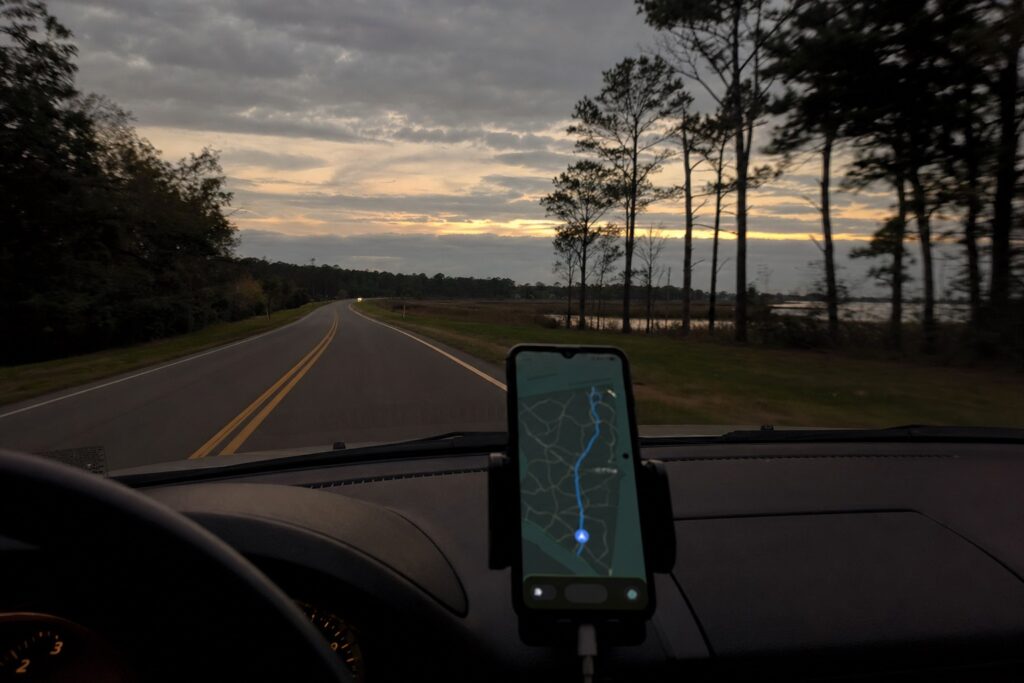
If you or a loved one was hurt in an Uber or Lyft crash on the Ocean Highway, you need an experienced Eulonia US-17 Ocean Highway rideshare accident lawyer who understands both Georgia injury law and the way rideshare insurance actually works. A rideshare wreck on a dark, undivided stretch of US-17 / GA-25 through northern McIntosh County can leave you with serious injuries, mounting medical bills, and a confusing tangle of insurance companies — the driver's personal policy, Uber or Lyft's commercial coverage, and possibly your own. This guide explains, in plain language, who pays, how Georgia law protects you, and the deadlines you cannot afford to miss.
Key Takeaways
- The deadline: In Georgia you generally have 2 years from the crash date to file a rideshare injury claim (O.C.G.A. § 9-3-33) — and shorter if a government vehicle or road is involved.
- Uber and Lyft carry up to $1 million in liability coverage when the app is in "trip in progress" or "en route to pickup" status, on top of the driver's own policy.
- Coverage depends on the app status at the moment of the crash — offline, available, en route, or on a trip — so preserving trip records is critical.
- You can still recover even if partly at fault under Georgia's modified comparative negligence rule, as long as you are less than 50% responsible (O.C.G.A. § 51-12-33).
- Hit-and-run on dark US-17 stretches may force your claim onto your own uninsured-motorist (UM) coverage, which can stack with the rideshare policy.
- McIntosh County crash claims are filed in the State Court or Superior Court of McIntosh County in Darien.
- Roden Law charges no upfront fees — you pay nothing unless we win your case.
Why US-17 (Ocean Highway) Through Eulonia Is a High-Risk Rideshare Corridor
US-17 through Eulonia is dangerous for rideshare passengers because it is an undivided, lightly lit, two-lane highway where local traffic, coastal-bound tourists, and freight all share the same narrow roadway at high speed. Eulonia sits in northern McIntosh County along the Ocean Highway (US-17 / GA-25), a services-light community where Uber and Lyft trips to and from Darien, Shellman Bluff, Crescent, Valona, and the South Newport area all funnel onto one surface artery.
Several features make this corridor especially hazardous for rideshare riders. Long rural stretches have limited overhead lighting, raising the risk of high-speed and hit-and-run crashes after dark. Because US-17 functions as a surface alternative to I-95 — connected near I-95 Exit 67 (GA-251) — diverted traffic and 18-wheelers regularly share lanes with passenger and rideshare cars. And out-of-area drivers heading to coastal destinations are often unfamiliar with the corridor's curves and turn movements.
According to the Federal Highway Administration, rural two-lane roads account for a disproportionate share of fatal crashes relative to their traffic volume, largely due to head-on and roadway-departure collisions. According to the National Highway Traffic Safety Administration, roughly half of all traffic fatalities occur in dark or low-light conditions — exactly the conditions a rider faces on US-17 at night. According to the Georgia Department of Transportation, US-17 carries substantial through-traffic across coastal Georgia, mixing local, tourist, and freight movement on the same corridor.
How Rideshare Insurance Works After an Uber or Lyft Crash in Georgia
Uber and Lyft coverage in Georgia is tied directly to the driver's app status at the moment of the crash, and it can provide up to $1 million in liability protection during an active trip. This is the single most important thing to understand after a rideshare wreck on US-17, because it determines which insurance pays and how much is available.
App offline. When the driver is not logged into the app, only the driver's personal auto policy applies. The rideshare company's coverage does not attach.
App on, waiting for a ride request. Uber and Lyft provide contingent liability coverage at this stage — typically $50,000 per person / $100,000 per accident for bodily injury — but it is limited.
En route to a pickup or on an active trip. This is where the protection jumps. When the driver has accepted your ride or you are in the vehicle, Uber and Lyft each maintain a $1 million third-party liability policy, plus uninsured/underinsured motorist coverage in many situations. As a passenger, you are almost always covered during this phase.
Eric Roden, Roden Law's founding partner, emphasizes that the difference between these phases can be worth hundreds of thousands of dollars to an injured passenger, which is why preserving the trip receipt, the app screen, and the driver's status at impact matters so much in a McIntosh County rideshare case. Our Rideshare and Uber accident lawyers build the timeline early so the right policy is on the hook.
| App status at the moment of the crash | Whose coverage applies | Typical liability limit |
|---|---|---|
| Driver offline (not logged in) | Driver's personal auto policy only | Personal policy limits |
| App on, awaiting a request | Rideshare contingent coverage | ~$50K/$100K bodily injury |
| En route to pickup | Rideshare commercial policy | Up to $1 million |
| Passenger on an active trip | Rideshare commercial policy | Up to $1 million |
Who Is Liable After a Rideshare Crash on US-17 Near Eulonia?
Liability after an Eulonia rideshare crash depends on who caused the wreck, and more than one party is often responsible. The at-fault party might be your own rideshare driver, another motorist who struck the vehicle, a freight truck using US-17 as an I-95 alternative, or — on dark rural stretches — a hit-and-run driver who flees the scene.
If another driver caused the crash, their liability insurance is the first source of recovery, with the rideshare policy potentially adding coverage on top. If your Uber or Lyft driver was at fault during an active trip, the $1 million commercial policy generally applies. When a commercial truck is involved, federal FMCSA rules and multiple potentially liable parties — the driver, the motor carrier, the broker, and the cargo loader — can come into play; our 18-wheeler and semi-truck accident lawyers handle that layer of investigation.
Even if you bear some blame, Georgia law still lets you recover. According to the Insurance Information Institute, Georgia is a modified comparative negligence state, meaning an injured person's recovery is reduced by their share of fault and barred only if they are 50% or more responsible. As a rideshare passenger, you are rarely at fault at all — but this rule matters when insurers try to shift blame to lower a payout.
When the Other Driver Flees: Hit-and-Run and UM/UIM Stacking
When a hit-and-run driver flees a crash on US-17 and is never identified, your own uninsured-motorist (UM) coverage becomes the primary path to recovery. Poorly lit, sparsely traveled stretches of the Ocean Highway near Eulonia are exactly where fleeing-driver crashes happen, and Georgia treats an unidentified hit-and-run driver as an uninsured motorist for coverage purposes.
In Georgia, UM and underinsured-motorist (UIM) coverage can often stack — meaning the rideshare company's UM/UIM policy and your personal UM/UIM coverage may both apply, increasing the total compensation available. The interplay between Uber or Lyft's UM coverage and your own policy is technical, and insurers do not volunteer the most favorable reading. Our team works through it the way we explain in our guide to uninsured and underinsured motorist coverage in Georgia, and our hit-and-run accident lawyers pursue every layer of coverage. If you want the local picture, see our McIntosh County drunk-driver crash guide for US-17 in Darien and our overview of dangerous roads near Darien and Brunswick (I-95 and US-17).
What to Do After a Rideshare Crash on the Ocean Highway
The most important steps after an Eulonia rideshare crash are to get medical care, document everything, and preserve your trip record before evidence disappears. On a remote corridor like US-17, EMS response and transport distances are longer, so do not downplay your injuries.
- Call 911 and get checked out. Serious McIntosh County crash injuries are often transported to Southeast Georgia Health System's Brunswick Campus or to Memorial Health University Medical Center in Savannah, the regional Level I trauma center.
- Screenshot the trip. Save the Uber or Lyft receipt, the driver's name, and the app status — this fixes which policy applies.
- Photograph the scene. Capture vehicle positions, lighting conditions, and road markings on US-17 while they are fresh.
- Get a police report. A documented report is critical, especially in a hit-and-run.
- Don't give a recorded statement to any insurer before speaking with a lawyer.
According to the Centers for Disease Control and Prevention, the symptoms of serious injuries such as concussions and internal trauma can be delayed for hours or days, which is why prompt medical evaluation protects both your health and your claim.
Filing Deadlines and Where McIntosh County Cases Are Heard
In Georgia, you generally have 2 years from the date of the crash to file a personal-injury lawsuit (O.C.G.A. § 9-3-33), and missing that deadline usually ends your claim permanently. If a county, city, or government vehicle or roadway is involved, a much shorter ante litem notice deadline applies, so you should never wait. You can read more in our explainer on the Georgia statute of limitations for injury claims.
Rideshare injury claims arising from a crash near Eulonia are filed in McIntosh County — most personal-injury cases go to the State Court of McIntosh County in Darien, while higher-value and wrongful-death claims are heard in the Superior Court of McIntosh County (Atlantic Judicial Circuit), also in Darien. For local support, our car accident lawyers in Darien, GA and our Georgia car accident lawyers team know these courts and this corridor. If a truck or motorcycle was involved, see our Darien I-95 truck accident guide, our breakdown of US-17 / GA-25 truck crashes through Broadfield, our motorcycle accident lawyers page, and our coastal Georgia motorcycle crash guide for Brunswick and Darien.
About the Author
This guide was reviewed by Eric Roden, founding partner of Roden Law. Eric is admitted to practice in Georgia and leads a team that has recovered more than $300 million for injured clients across coastal Georgia, including McIntosh County crash victims on the US-17 corridor. If you were hurt in an Uber or Lyft on the Ocean Highway, call 1-844-RESULTS or our Darien office at (912) 303-5850 for a Free Case Review — No Fees Unless We Win.
Frequently Asked Questions
About the Author