
Last reviewed: 2026-05-18 — Graeham C. Gillin, partner and Chief Operating Officer at Roden Law.
A drunk-driver crash on South Kings Highway is a collision on US-17 Business through Surfside Beach in which an impaired motorist — typically a tourist, rideshare driver, or local heading home from a Grand Strand bar — strikes another vehicle, pedestrian, motorcyclist, or golf cart. In South Carolina, that crash creates a civil claim against the driver, their insurer, often the bar or restaurant that over-served them, and your own uninsured/underinsured-motorist coverage when the at-fault driver flees or can’t pay. You have three years from the crash date to file under S.C. Code Ann. § 15-3-530, and that clock does not stop because the driver was a Memorial Day visitor from Ohio.
Key Takeaways
- Deadline: SC personal-injury claims must be filed within 3 years under S.C. Code Ann. § 15-3-530; wrongful-death under § 15-51-10.
- Fault rule: 51% modified comparative negligence — you recover if you’re 50% or less at fault (Nelson v. Concrete Supply Co., 303 S.C. 243 (1991)).
- Hit-and-run: Leaving an injury crash is a felony under S.C. Code Ann. § 56-5-1210 — and triggers your own UM coverage even when the driver is never found.
- Stacked coverage: SC allows UM (§ 38-77-150) and UIM (§ 38-77-160) stacking across household vehicles — often the only money in a hit-and-run or out-of-state-rental case.
- Felony DUI: Causing great bodily injury or death is felony DUI under S.C. Code Ann. § 56-5-2945; criminal restitution runs parallel to your civil case.
- Local venue: Civil suits are filed in the Horry County Court of Common Pleas (15th Judicial Circuit) in Conway; claims of $7,500 or less go to magistrate’s court.
- Closest ER: South Strand Medical Center (Murrells Inlet area), 2.9 miles north of N Lake Drive on US-17 — get evaluated even if you “feel fine.”
Why South Kings Highway (US-17 Business) Is the South Strand’s DUI Pressure Point
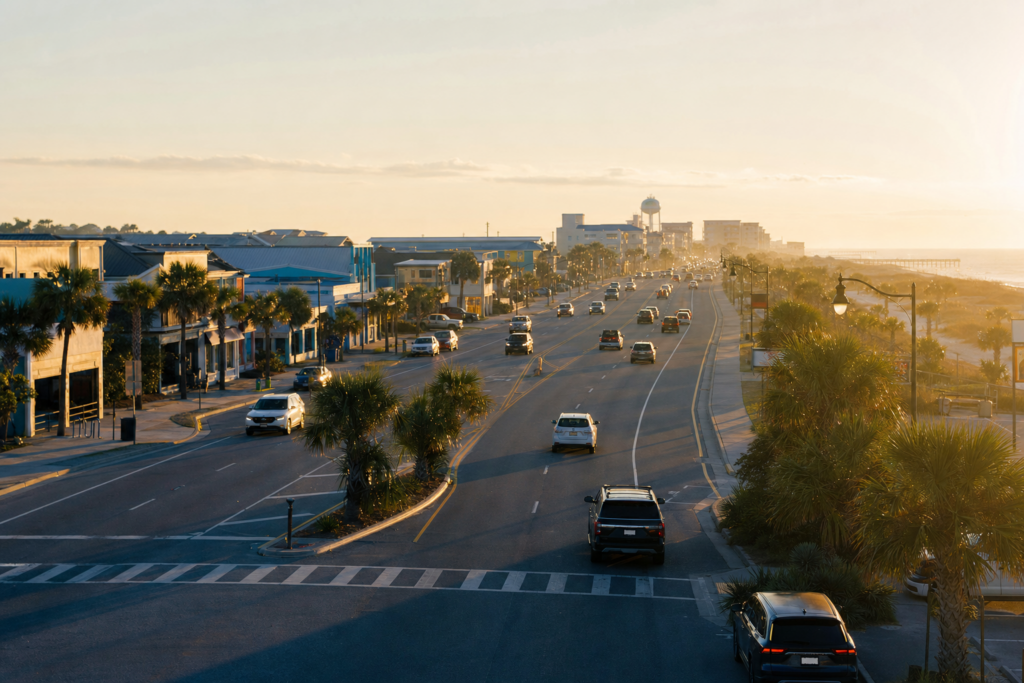
South Kings Highway carries US-17 Business through the heart of Surfside Beach — posted at 45 mph, lined with hotels and beach-access drives, and the artery every visitor in the 29575 uses to get from a Grand Strand bar back to wherever they’re sleeping. A few miles north, the Dick Pond Road (SC-544) junction layers Conway and Socastee commuter traffic onto the tourist load. By late evening on a summer Saturday, the same lanes carry rental SUVs, rideshare sedans, Bike Week motorcycles, and golf carts crossing from residential streets like N Lake Drive — and nothing about that mix forgives a 0.08% BAC.
What the data says about coastal-SC drunk driving
- According to the SC Department of Public Safety‘s annual Traffic Collision Fact Book, alcohol is a factor in roughly 23–28% of SC traffic fatalities in any given year — a share that has barely moved in a decade.
- According to the NHTSA, drivers with a BAC of 0.08 or higher were involved in 13,524 traffic fatalities nationwide in 2022 — about 32% of all U.S. traffic deaths.
- According to MADD — South Carolina, MADD has identified SC as one of the worst-performing states for drunk-driving fatalities per capita and has lobbied for stronger ignition-interlock laws.
- According to Horry County’s published court schedules, the 15th Judicial Circuit in Conway runs dedicated DUI dockets to clear seasonal volume — a structural sign of the South Strand’s impaired-driving caseload.
The First 72 Hours — What to Do Before You Talk to a Lawyer
Roden Law works on contingency — no fees unless we win — so there’s no cost reason to wait. But there are evidence reasons to move quickly.
- Get treated. South Strand Medical Center on the Murrells Inlet side of US-17 is the closest ER; serious trauma is often transferred to Grand Strand Medical Center (Level II) or MUSC in Charleston. The ER record is the foundation of your damages claim — gaps in care become an insurance-defense argument.
- Get the police report. Surfside Beach Police, Horry County Sheriff, or SC Highway Patrol works the crash depending on jurisdiction. The narrative, diagram, and any DUI arrest noted on the report are gold. If the driver fled, S.C. Code Ann. § 56-5-1210 makes that a felony, and the hit-and-run report is what unlocks your own UM coverage.
- Preserve evidence. Photograph the cars, lane, skid marks, and signage. If you came from a bar or restaurant, save the receipt — that timestamp can anchor a dram-shop / over-service claim.
- Don’t give a recorded statement to the at-fault carrier. Tell them you’re injured, you’re getting treated, and you’ll provide a statement through counsel.
- Call a lawyer who knows Horry County. Roden Law’s Myrtle Beach office at 631 Bellamy Ave. Suite C-B, Murrells Inlet, SC 29576 handles US-17 Business and SC-544 crashes routinely.
South Carolina changed these rules for claims arising after 1 January 2026. The 2025 Act narrowed the alcohol exception in S.C. Code § 15-38-15 and created § 61-2-147, under which an establishment can be jointly and severally liable for fifty percent of a plaintiff’s actual damages where a verdict is returned against both it and a driver charged with DUI — what South Carolina’s 2026 liquor liability law changed.
How South Carolina Law Actually Works in a DUI Crash
Statute of limitations
Under S.C. Code Ann. § 15-3-530, you have three years from the crash date to file a personal-injury lawsuit. Wrongful-death claims under S.C. Code Ann. § 15-51-10 follow the same three-year period from the date of death. See South Carolina’s three-year personal-injury statute of limitations for edge cases.
Comparative fault
South Carolina follows modified comparative negligence with a 51% bar, set in Nelson v. Concrete Supply Co., 303 S.C. 243 (1991). You recover if your share of fault is 50% or less, reduced by your percentage; at 51%+ you take nothing. This is why the drunk driver’s insurer will still argue you were speeding or distracted — they’re not denying the BAC, they’re trying to push you across the 51% line. Read more on South Carolina’s 51% modified comparative-fault rule.
Criminal DUI runs parallel to your civil case
SC’s DUI statute (§ 56-5-2930) and its DUAC companion (§ 56-5-2933) cover the standard misdemeanor. If the drunk driver caused great bodily injury or death, prosecutors can charge felony DUI under § 56-5-2945 — with mandatory prison time and court-ordered restitution. The civil claim is separate, but the criminal record (BAC, breath, dashcam, body cam) becomes some of your strongest evidence.
Hit-and-run on US-17 Business
If the driver flees an injury crash — a recurring pattern with intoxicated and out-of-state drivers — it’s a felony under § 56-5-1210, and it triggers your own UM coverage under § 38-77-150. See hit-and-run accident claims for how that pathway works.
Four Civil Pathways That Actually Pay in a Grand Strand DUI Crash
Most clients arrive thinking the only money is the drunk driver’s auto policy. Often it isn’t. Four pathways we work in parallel:
| Civil Pathway | Statute / Source | When It Pays | Practical Notes |
|---|---|---|---|
| At-fault driver’s auto liability | SC minimum: 25/50/25 | Driver has insurance and stays at the scene | Most common source — but SC minimums are routinely insufficient |
| Your UM / UIM (stacked) | § 38-77-150 (UM) / § 38-77-160 (UIM) | Driver fled, was uninsured, or under-insured; stack UIM across household vehicles | Critical for hit-and-runs and rentals; often the largest single payor |
| Bar / restaurant (over-service) | SC common-law negligence (no separate dram-shop statute) | Driver came from a bar that kept serving past visible intoxication | Preserve receipts, POS data, and witnesses |
| Felony-DUI restitution | § 56-5-2945 | Driver is convicted of felony DUI causing great bodily injury or death | Criminal restitution does not reduce your civil judgment |
Graeham C. Gillin, partner and Chief Operating Officer at Roden Law, puts it this way: the drunk driver’s auto policy is almost never the ceiling on a Grand Strand DUI crash. The bigger numbers usually sit in stacked UM/UIM coverage the client didn’t know they had, and in the bar that kept pouring after visible intoxication — both require fast evidence work in the first weeks.
Special Fact Patterns We See on US-17 Business
- Out-of-state rentals. A drunk driver in a Hertz or Turo rental creates a three-way coverage fight: the rental company’s policy, the renter’s personal auto policy, and your UM/UIM.
- Rideshare crashes. If you were in an Uber or Lyft, or struck by one, the rideshare company’s $1M third-party policy kicks in when the driver is in Period 2 (en route to pickup) or Period 3 (carrying a passenger). See rideshare and Uber accident claims.
- Bike Week and Bikefest motorcycle hits. Drunk drivers and motorcycles on US-17 Business during early-May Bike Week and Memorial Day Atlantic Beach Bikefest produce a disproportionate share of catastrophic Horry County crashes — talk to Myrtle Beach motorcycle accident lawyers before the helmet-camera footage walks.
- Pedestrians and golf carts. Walkers crossing to the beach and golf carts entering 45 mph traffic from N Lake Drive get hit by DUI drivers more often than official statistics suggest. See Myrtle Beach pedestrian accident lawyers.
- Commercial-vehicle DUIs. When the drunk driver was operating a delivery van or work truck, the employer’s commercial policy is in play — that’s a Myrtle Beach truck accident lawyers call.
- Fatal crashes. If your loved one was killed, see Myrtle Beach wrongful death lawyers — the case is brought by the estate, and the three-year clock under § 15-51-10 still applies.
For local context, read the most dangerous roads and intersections in Myrtle Beach and our analysis of summer DUI crashes in coastal South Carolina. For basics, see protecting your rights after a Myrtle Beach car accident, Myrtle Beach car accident lawyers, and the pillar on drunk-driver crash claims.
Frequently Asked Questions
Q: How long do I have to file a lawsuit after a drunk-driver crash in Surfside Beach?
A: In South Carolina, you have three years from the crash date to file a personal-injury lawsuit under S.C. Code Ann. § 15-3-530. Wrongful-death claims under S.C. Code Ann. § 15-51-10 also follow a three-year deadline from the date of death. Miss the date and the court will dismiss your case regardless of how clear the drunk driver’s fault was. Narrow exceptions (minors, incapacitated plaintiffs, government defendants) can shift the timing.
Q: The drunk driver fled the scene of my crash on US-17 Business. Can I still recover?
A: Yes. Leaving an injury crash is a felony under S.C. Code Ann. § 56-5-1210, and the hit-and-run police report is what triggers your own uninsured-motorist (UM) coverage under S.C. Code Ann. § 38-77-150. Report the crash, cooperate with the investigation, and your UM carrier steps in as if it were the at-fault driver’s insurer — subject to your limits, which are often stackable across household vehicles.
Q: The drunk driver was a tourist from out of state in a rental car. Who pays?
A: Usually a layered combination. The driver’s personal auto policy from their home state typically provides primary coverage and follows them into South Carolina; the rental company’s policy may sit excess; and your own UM/UIM under S.C. Code Ann. §§ 38-77-150 and 38-77-160 fills the gap when those limits run out. Service on out-of-state defendants runs through the SC Director of Motor Vehicles under the non-resident motorist statute.
Q: I had a couple of drinks too. Can I still sue the drunk driver who hit me?
A: Probably yes, as long as you were 50% or less at fault. South Carolina follows modified comparative negligence with a 51% bar under Nelson v. Concrete Supply Co., 303 S.C. 243 (1991). If a jury finds you 20% at fault and the drunk driver 80%, your damages drop by 20%. At 51% or higher you recover nothing — which is why the defense will push your share of fault as high as it will go.
Q: Can I sue the bar or restaurant that over-served the drunk driver?
A: Sometimes. South Carolina has no separate dram-shop statute, but bars and restaurants can be held civilly liable under common-law negligence for knowingly serving alcohol to a visibly intoxicated patron who then injures someone. These cases live or die on evidence — receipts, POS time stamps, surveillance video, witnesses to visible intoxication — and that evidence disappears fast without preservation letters in the first weeks.
Q: How much does it cost to hire Roden Law for a Surfside Beach drunk-driver case?
A: Nothing up front. Roden Law handles drunk-driver cases on a contingency fee — no consultation fee, no hourly fee, and no legal fees at all unless we recover money for you. Case expenses are advanced by the firm. Call our Myrtle Beach office at (843) 612-1980 or 1-844-RESULTS for a free case review with a South Carolina-barred attorney.
About the Author
Graeham C. Gillin is a partner and Chief Operating Officer at Roden Law, licensed by the South Carolina Bar. He has led the firm through more than 5,000 personal-injury cases and over $300M in client recoveries across five offices in the two states, and supervises the firm’s Myrtle Beach DUI-crash docket out of the 631 Bellamy Ave. office in Murrells Inlet. This article is general legal information about South Carolina law and does not create an attorney-client relationship.
About the Author