Key Takeaways
Commercial truck accidents in Georgia and South Carolina often involve multiple liable parties — the driver, trucking company, cargo loaders, maintenance providers, and manufacturers — each potentially covered by separate insurance policies. Federal FMCSA regulations (49 CFR §§ 382-396) set strict standards for hours of service, vehicle maintenance, driver qualifications, and cargo securement, and violations constitute strong evidence of negligence. Georgia allows recovery if less than 50% at fault (O.C.G.A. § 51-12-33); South Carolina if not more than 51% at fault. Filing deadlines are 2 years in Georgia (O.C.G.A. § 9-3-33) and 3 years in South Carolina (S.C. Code § 15-3-530).
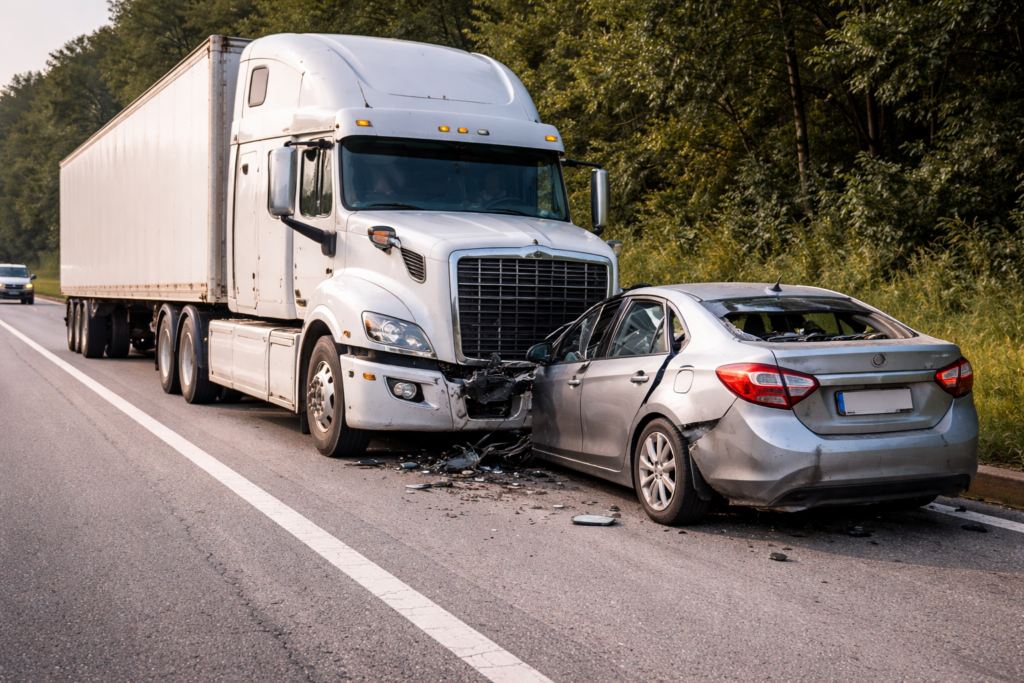
Commercial truck accidents are among the most devastating collisions on Georgia and South Carolina roadways. When a fully loaded tractor-trailer weighing up to 80,000 pounds strikes a passenger vehicle, the results are often catastrophic — traumatic brain injuries, spinal cord damage, severe burns, and wrongful death. Unlike a standard car accident, determining who is at fault in a commercial truck crash is significantly more complex because multiple parties — not just the driver — may share liability. Understanding who is responsible is the first step toward securing full compensation for your injuries. For more information, see the Federal Motor Carrier Safety Regulations (49 CFR Part 390) governing commercial vehicle operations.
Multiple Parties Can Be Liable in a Truck Accident
One of the biggest differences between a truck accident and a car accident is the number of potentially liable parties. In a car crash, liability typically falls on one or both drivers. In a commercial truck accident, fault can extend to:
- The truck driver — for distracted driving, fatigue, speeding, impairment, or other negligent behavior
- The trucking company — for negligent hiring, inadequate training, pressure to violate hours-of-service rules, or failure to maintain vehicles
- The cargo loading company — for improperly loaded or overweight cargo that causes a rollover or loss of control
- The maintenance company — for failing to inspect, repair, or maintain brakes, tires, or other critical components
- The truck or parts manufacturer — for defective brakes, tires, steering systems, or coupling devices
- Government entities — for dangerous road conditions, missing signage, or poorly designed intersections
Identifying every liable party is critical because it expands the pool of insurance coverage available to compensate you. A single trucking company policy may not cover the full extent of catastrophic injuries — but when multiple parties share fault, multiple policies apply.
Truck Driver Negligence
The truck driver is often the most obvious target in a fault analysis, and driver error remains the leading cause of commercial truck crashes according to the Federal Motor Carrier Safety Administration (FMCSA). Common forms of truck driver negligence include:
- Fatigued driving: Despite federal hours-of-service regulations, many drivers push past their legal limits. A fatigued trucker has reaction times comparable to a drunk driver. Under 49 CFR § 395, property-carrying drivers may not drive more than 11 hours after 10 consecutive hours off duty.
- Distracted driving: Texting, using GPS devices, eating, or adjusting the radio while operating an 80,000-pound vehicle. Federal regulations (49 CFR § 392.82) specifically prohibit commercial drivers from texting while driving.
- Speeding and reckless driving: Exceeding posted limits or driving too fast for weather or road conditions.
- Impaired driving: Driving under the influence of alcohol or drugs. Commercial drivers face a lower BAC limit of 0.04% under federal law (49 CFR § 392.5), compared to 0.08% for non-commercial drivers.
- Failure to inspect: Federal regulations require drivers to conduct pre-trip and post-trip inspections of their vehicles. Skipping these inspections can allow mechanical defects to go unnoticed.
Trucking Company Liability
Trucking companies frequently bear significant liability for accidents caused by their drivers and operations. Under the legal doctrine of respondeat superior (vicarious liability), an employer is responsible for the negligent acts of employees performed within the scope of employment. This means the trucking company can be held liable even if it did nothing wrong itself — as long as the driver was acting in the course of employment at the time of the crash.
Beyond vicarious liability, trucking companies may also be directly negligent through:
- Negligent hiring: Failing to screen drivers for prior accidents, DUI convictions, or license suspensions. Under 49 CFR § 391, carriers must verify a driver’s qualifications, driving history, and medical fitness before allowing them to operate a commercial vehicle.
- Inadequate training: Not providing proper training on cargo securement, defensive driving, or hazardous materials handling.
- Pressuring drivers to violate regulations: Setting unrealistic delivery schedules that force drivers to exceed hours-of-service limits or skip mandatory rest breaks.
- Failure to maintain vehicles: Ignoring or delaying required maintenance and inspections to cut costs.
- Failure to monitor: Not reviewing electronic logging device (ELD) data or failing to discipline drivers with safety violations.
In Georgia, trucking companies operating on highways like I-16 and I-95 through Savannah carry heavy freight traffic daily. In South Carolina, the Port of Charleston generates significant commercial truck traffic on I-26 and US-17, making carrier accountability especially important in this region.
Cargo Loaders, Mechanics, and Maintenance Companies
Truck accidents are not always caused by driver error. Improperly loaded or overweight cargo can shift during transit, causing the truck to roll over, jackknife, or lose control — particularly on curves and highway on-ramps. Federal cargo securement standards (49 CFR § 393) set specific requirements for how cargo must be restrained based on its type and weight.
Similarly, brake failures caused by negligent maintenance are a leading mechanical cause of truck accidents. When a third-party maintenance company is responsible for inspecting and repairing a truck, that company can be held liable if its failure to identify or fix a defect leads to an accident. Key evidence includes maintenance logs, inspection records, and repair invoices.
Truck and Parts Manufacturers
When a truck accident is caused by a defective component — faulty brakes, a defective tire, a malfunctioning steering system, or a defective coupling device — the manufacturer of the truck or the specific part may be liable under product liability law. Both Georgia (O.C.G.A. § 51-1-11) and South Carolina (S.C. Code § 15-73-10) recognize strict liability claims against manufacturers of defective products, meaning you do not need to prove the manufacturer was negligent — only that the product was defective and caused your injuries.
Common defective truck components include:
- Brake systems and air brake components
- Tires and retreads
- Steering and suspension systems
- Trailer coupling devices (fifth wheels, kingpins)
- Lighting and reflective tape
Federal Trucking Regulations That Establish Fault
The Federal Motor Carrier Safety Administration (FMCSA) regulates the commercial trucking industry through a comprehensive set of rules codified in Title 49 of the Code of Federal Regulations. When a trucking company or driver violates these regulations, that violation is strong evidence of negligence. Key regulations include:
- Hours of Service (49 CFR § 395): Limits driving to 11 hours after 10 hours off duty, with a 14-hour on-duty window. Drivers must take a 30-minute break after 8 cumulative hours of driving.
- Electronic Logging Devices (49 CFR § 395.8): Most commercial vehicles must use ELDs to automatically record driving time, making it harder for drivers and companies to falsify logs.
- Drug and Alcohol Testing (49 CFR § 382): Carriers must conduct pre-employment, random, post-accident, and reasonable-suspicion drug and alcohol testing of drivers.
- Vehicle Maintenance and Inspection (49 CFR § 396): Carriers must systematically inspect, repair, and maintain all commercial vehicles under their control.
- Driver Qualifications (49 CFR § 391): Drivers must hold a valid commercial driver’s license (CDL), pass medical examinations, and meet minimum age and experience requirements.
- Cargo Securement (49 CFR § 393): Specific standards for securing different types of cargo to prevent shifting, falling, or spilling during transport.
An experienced truck accident attorney knows how to obtain and analyze ELD data, driver qualification files, maintenance records, and drug testing results to identify regulatory violations that prove fault.
Trucking Insurance Requirements Under Federal Law
Federal law requires commercial trucking companies to carry significantly more insurance than passenger vehicle drivers. The minimum insurance requirements under 49 CFR § 387 depend on the type of cargo:
| Type of Carrier | Minimum Insurance Required |
|---|---|
| General freight (non-hazmat, over 10,001 lbs) | $750,000 |
| Household goods carriers | $750,000 |
| Oil transport (hazardous substances) | $1,000,000 |
| Other hazardous materials | $5,000,000 |
These higher insurance minimums reflect the severity of injuries caused by commercial truck crashes. However, many carriers purchase coverage well above the federal minimums — $1 million to $5 million or more — because the catastrophic nature of truck accident injuries routinely generates claims that exceed minimum policy limits. When a hazardous materials truck is involved, the insurance requirements are even higher, and the potential damages — including environmental cleanup — can be substantial.
How Comparative Fault Works in Georgia and South Carolina
In both Georgia and South Carolina, the injured person’s own degree of fault can affect their recovery. Both states follow a modified comparative fault system, but with a critical difference:
Georgia’s Modified Comparative Fault Rule
Under O.C.G.A. § 51-12-33, you can recover damages as long as you are less than 50% at fault for the accident. Your compensation is reduced by your percentage of fault. If you are found 50% or more responsible, you recover nothing. For example, if you are awarded $500,000 but found 20% at fault, your recovery is reduced to $400,000.
South Carolina’s Modified Comparative Fault Rule
South Carolina follows a slightly more favorable rule: you can recover damages as long as you are not more than 51% at fault. Like Georgia, your recovery is reduced by your percentage of fault — but the threshold for being barred from recovery is one percentage point higher.
Insurance companies and trucking companies aggressively try to shift blame to injured victims. They may argue you were speeding, following too closely, or failed to avoid the collision. A skilled truck accident lawyer knows how to counter these tactics with evidence — black box data, dashcam footage, witness testimony, and accident reconstruction analysis — to minimize or eliminate any fault attributed to you. Learn more about how comparative fault applies in Georgia and South Carolina.
How to Prove Fault in a Truck Accident
Proving fault in a truck accident requires gathering and preserving evidence that may be in the exclusive control of the trucking company. Critical evidence includes:
- Electronic logging device (ELD) data: Shows the driver’s hours on the road, rest breaks, and whether hours-of-service violations occurred.
- Event data recorder (EDR / “black box”) data: Records speed, braking, steering inputs, and other vehicle data in the seconds before and during the crash. Learn why requesting black box data quickly is essential.
- Driver qualification file: Contains the driver’s employment history, license status, medical certifications, drug test results, and training records.
- Maintenance and inspection records: Show whether the truck was properly maintained and whether known defects were repaired.
- Dispatch and communication records: Reveal whether the company pressured the driver to meet unrealistic deadlines.
- Dashcam and surveillance footage: Captures the moments before, during, and after the collision.
- Accident reconstruction expert analysis: Uses physical evidence, vehicle damage patterns, and physics calculations to determine how the accident occurred.
Trucking companies and their insurers often begin their own investigation within hours of a crash — and evidence like ELD data, dashcam footage, and dispatch records can be overwritten or destroyed if not preserved quickly. Georgia and South Carolina courts allow victims to send spoliation letters demanding that all relevant evidence be preserved, and failure to comply can result in sanctions.
Why You Need a Truck Accident Attorney
Truck accident claims are fundamentally different from car accident claims. The stakes are higher, the evidence is more complex, the regulations are more technical, and the defendants have more resources. Trucking companies and their insurers deploy teams of adjusters, attorneys, and accident reconstruction experts immediately after a crash — and their goal is to minimize what they pay, not to ensure you receive fair compensation.
An experienced truck accident attorney from Roden Law can:
- Send immediate evidence preservation demands to the trucking company
- Obtain and analyze ELD data, black box data, and driver qualification files
- Identify all potentially liable parties — driver, carrier, cargo company, manufacturer, and maintenance provider
- Retain accident reconstruction and medical experts to build a persuasive case
- Navigate complex FMCSA regulations and use violations to prove negligence
- Negotiate from a position of strength backed by trial experience
- File suit within the applicable statute of limitations — 2 years in Georgia (O.C.G.A. § 9-3-33) or 3 years in South Carolina (S.C. Code § 15-3-530)
Roden Law has recovered over $250 million for injured clients across Georgia and South Carolina. We handle all truck accident cases on a contingency fee basis — you pay nothing unless we win. If you or a loved one has been injured in a commercial truck accident, contact our Savannah, Charleston, Columbia, or Myrtle Beach office for a free consultation. Call 1-844-RESULTS today.
Frequently Asked Questions
Multiple parties can be held liable in a commercial truck accident, including the truck driver (for negligence like fatigue, distraction, or impairment), the trucking company (for negligent hiring, inadequate training, or pressuring drivers to violate hours-of-service rules), the cargo loading company (for improperly loaded or overweight cargo), maintenance companies (for failing to inspect or repair critical components like brakes), and the truck or parts manufacturer (for defective components). An experienced truck accident attorney can identify all responsible parties to maximize the insurance coverage available for your claim.
The Federal Motor Carrier Safety Administration (FMCSA) regulates the trucking industry through Title 49 of the Code of Federal Regulations. Key regulations include Hours of Service rules (49 CFR § 395) limiting driving to 11 hours after 10 hours off duty, Electronic Logging Device requirements (49 CFR § 395.8), drug and alcohol testing mandates (49 CFR § 382), vehicle maintenance and inspection standards (49 CFR § 396), driver qualification requirements (49 CFR § 391), and cargo securement standards (49 CFR § 393). Violations of these regulations are strong evidence of negligence in a truck accident lawsuit.
Federal law (49 CFR § 387) requires commercial trucking companies to carry significantly more insurance than passenger vehicle drivers. General freight carriers (non-hazmat, over 10,001 lbs) must carry at least $750,000 in liability coverage. Oil transport carriers must carry at least $1,000,000, and carriers transporting other hazardous materials must carry $5,000,000. Many carriers purchase coverage well above these minimums because catastrophic truck accident injuries routinely generate claims that exceed minimum policy limits.
Both Georgia and South Carolina follow modified comparative fault rules, but with a key difference. In Georgia, under O.C.G.A. § 51-12-33, you can recover damages as long as you are less than 50% at fault — if you are 50% or more responsible, you recover nothing. In South Carolina, the threshold is slightly more favorable: you can recover as long as you are not more than 51% at fault. In both states, your compensation is reduced by your percentage of fault. Trucking companies aggressively try to shift blame to injured victims, making experienced legal representation essential.
Critical evidence in a truck accident case includes electronic logging device (ELD) data showing hours-of-service compliance, event data recorder (black box) data capturing speed and braking in the seconds before the crash, the driver's qualification file with employment history and drug test results, vehicle maintenance and inspection records, dispatch and communication records, dashcam and surveillance footage, and accident reconstruction expert analysis. Much of this evidence is in the trucking company's exclusive control and can be overwritten or destroyed quickly, which is why retaining an attorney immediately after a truck accident is essential.
In Georgia, the statute of limitations for personal injury claims is 2 years from the date of the accident under O.C.G.A. § 9-3-33. In South Carolina, you have 3 years from the date of the accident under S.C. Code § 15-3-530. Missing these deadlines typically means losing your right to file a lawsuit and seek compensation entirely. Because truck accident cases require extensive investigation and evidence preservation, it is important to contact an attorney as soon as possible after the accident — not just before the deadline.
About the Author