
Key Takeaways
Lane-change crashes number in the hundreds of thousands nationally each year (NHTSA), and blind spot crashes hit motorcyclists, bicyclists, and pedestrians hardest. Proper mirror adjustment, shoulder checks, and defensive driving significantly reduce risk. Georgia requires safe, signaled lane changes under O.C.G.A. §§ 40-6-48 and 40-6-123, with a 2-year filing deadline (O.C.G.A. § 9-3-33). South Carolina imposes similar duties under S.C. Code §§ 56-5-1900 and 56-5-2150, including a signal for at least the last 100 feet, with a 3-year deadline (S.C. Code § 15-3-530). Both states apply modified comparative fault rules.
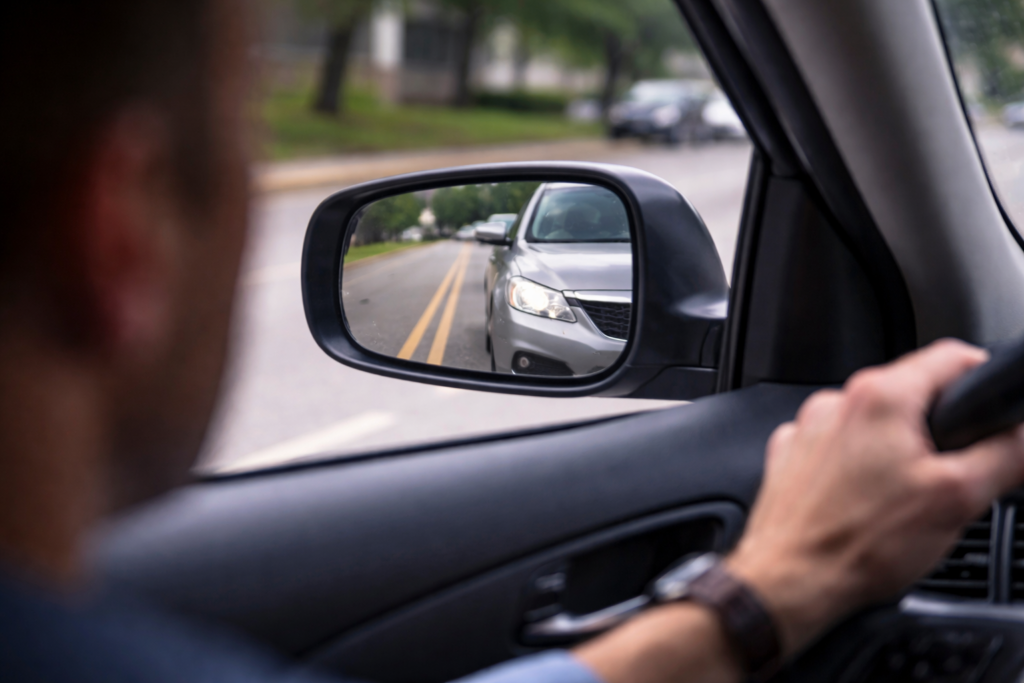
Blind spot accidents are among the most preventable yet frequently occurring crashes on roads throughout Georgia and South Carolina. When a driver fails to check a blind spot before changing lanes, merging, or turning, the results can be devastating — from sideswipe collisions on the interstate to fatal crashes involving motorcyclists and pedestrians. According to the most detailed lane-change study by the National Highway Traffic Safety Administration (NHTSA), two-vehicle lane-change crashes numbered about 539,000 in 1999 — roughly 9 percent of all police-reported crashes that year.
If you or a loved one was injured in a blind spot accident in Georgia or South Carolina, understanding your legal rights is the first step toward holding the negligent driver accountable. The car accident lawyers at Roden Law help victims across both states pursue full and fair compensation for their injuries.
What Are Blind Spots?
A blind spot is an area around a vehicle that the driver cannot see through side mirrors, rearview mirrors, or direct line of sight. Every vehicle has blind spots, though their size and location vary depending on the type of vehicle. For a standard passenger car, blind spots typically exist on both sides of the vehicle just behind the driver’s peripheral vision. SUVs and pickups have larger rear and side blind zones than cars, and around commercial trucks, blind spots can extend several car lengths on all four sides.
Blind spots are especially dangerous because they create a false sense of security. A driver who relies solely on mirrors may believe the adjacent lane is clear when another vehicle, motorcyclist, or bicyclist is actually traveling right next to them. This gap in visibility is a leading cause of lane-change accidents, sideswipe collisions, and merge-related crashes throughout Georgia and South Carolina.
Common Blind Spot Locations by Vehicle Type
| Vehicle Type | Primary Blind Spot Areas | Approximate Blind Zone Size |
|---|---|---|
| Passenger car | Left and right rear quarters | Varies with mirror setting |
| SUV / Pickup truck | Rear quarters, directly behind | Larger than a car’s |
| Semi-truck / 18-wheeler | All four sides (“No-Zones”) | About 20 feet in front, 30 feet behind, one lane on the left side and two lanes on the right |
| Motorcycle | Minimal blind spots, but nearly invisible to other drivers | N/A — the motorcyclist IS the blind spot risk |
Common Types of Blind Spot Accidents
Blind spot collisions take many forms depending on where and how they occur. The most frequent types include:
Lane-Change Sideswipes
The most common blind spot accident occurs when a driver changes lanes without seeing a vehicle in the adjacent lane. The result is typically a sideswipe collision that can push either vehicle into a guardrail, median, or other traffic. On interstates like I-95 and I-16 in Georgia and I-26 in South Carolina, high-speed sideswipes can lead to multi-vehicle pileups.
Merge Collisions
When a driver merges onto a highway or merges into a new lane at an intersection, failing to check the blind spot can cause a direct collision with vehicles already in that lane. Merge-related blind spot crashes are common at interchange ramps and construction zones.
Truck No-Zone Accidents
Commercial trucks have massive blind spots known as “No-Zones” — areas where passenger vehicles effectively disappear from the truck driver’s view. A truck accident caused by a blind spot failure can result in catastrophic injuries due to the extreme size and weight differential between a tractor-trailer and a passenger vehicle.
Right-Turn Squeeze Accidents
When a large vehicle makes a right turn, the blind spot on the passenger side can hide a bicyclist, pedestrian, or motorcyclist traveling alongside. These “right-hook” crashes are particularly dangerous in urban areas like downtown Savannah, Charleston, and Columbia.
Who Is Most at Risk?
While any motorist can be involved in a blind spot accident, certain road users face disproportionately high risks:
- Motorcyclists: Their smaller profile makes them easily concealed in a car or truck’s blind spot. Motorcycle accidents involving blind spots often cause severe injuries because riders have minimal protection.
- Bicyclists: Cyclists traveling in bike lanes or alongside traffic are frequently struck by drivers making turns or lane changes without checking blind spots.
- Pedestrians: At intersections and crosswalks, pedestrians can be in a vehicle’s blind spot — especially when large trucks or SUVs are making turns.
- Drivers of small cars: Compact vehicles are more likely to be hidden in a larger vehicle’s blind spot, particularly next to semi-trucks and delivery vans.
- Teen and elderly drivers: Inexperienced drivers may not develop reliable mirror-checking habits, while older drivers may have reduced neck mobility that limits blind spot checks.
How to Prevent Blind Spot Accidents
While you cannot control other drivers’ behavior, you can significantly reduce your risk of a blind spot collision by adopting these defensive driving practices:
Adjust Your Mirrors Properly
Most drivers position their side mirrors so they can see the rear fender of their own vehicle. Instead, lean your head against the driver’s window and set the left mirror so you can just see the side of your car, then lean to the center of the car and do the same with the right mirror; from your normal seat, your car should disappear from both side mirrors. This Blindzone and Glare Elimination (BGE) setting, described in a 1995 Society of Automotive Engineers paper, dramatically reduces blind spots by creating a seamless field of view from your rearview mirror to your side mirrors to your peripheral vision.
Perform Shoulder Checks Before Every Lane Change
Even with properly adjusted mirrors, a quick glance over your shoulder before changing lanes confirms the space is truly clear. Make this a non-negotiable habit — a one-second shoulder check can prevent a catastrophic collision.
Use Turn Signals Early
Signaling your intention to change lanes gives other drivers time to react, flash their lights, or honk to alert you of their presence. In both Georgia and South Carolina, failing to use turn signals before a lane change is a traffic violation whenever another driver could be affected.
Avoid Lingering in Other Vehicles’ Blind Spots
If you find yourself riding alongside another vehicle — especially a truck — for an extended period, either accelerate past or slow down to fall behind. The less time you spend in a blind spot, the lower your risk of being hit.
Use Technology Wisely
Modern vehicles often include blind spot monitoring systems, lane departure warnings, and backup cameras. These tools are valuable supplements but should never replace mirror checks and shoulder glances.
Blind Spot Accident Laws in Georgia and South Carolina
Both Georgia and South Carolina impose legal duties on drivers that directly relate to blind spot awareness and safe lane changes. Understanding these laws is essential for establishing fault after a blind spot collision.
Georgia Laws
Under O.C.G.A. § 40-6-48(1), a Georgia driver may not leave a lane until he or she has first ascertained that the move can be made safely, and O.C.G.A. § 40-6-123 requires an appropriate and timely signal. A driver who causes a collision by changing lanes without checking their blind spot has violated these statutes and can be found negligent. Georgia follows a modified comparative fault rule — you can recover damages as long as you are less than 50% at fault for the accident (O.C.G.A. § 51-12-33). The statute of limitations for personal injury claims in Georgia is 2 years from the date of the accident (O.C.G.A. § 9-3-33).
South Carolina Laws
South Carolina law similarly requires drivers to ensure lane changes can be made safely under S.C. Code § 56-5-2150, which also requires a signal for at least the last 100 feet. Drivers must not move from their lane until they have determined that it is safe to do so (S.C. Code § 56-5-1900(a)). South Carolina also follows a modified comparative fault system — you can recover damages if you are less than 51% at fault. The statute of limitations for personal injury claims in South Carolina is 3 years from the date of the accident (S.C. Code § 15-3-530).
Proving Fault in a Blind Spot Accident
Establishing that the other driver caused the accident by failing to check their blind spot requires gathering strong evidence. Key evidence in blind spot accident cases includes:
- Police report: The responding officer’s report often notes whether a driver was cited for an unsafe lane change or failure to yield. A citation alone does not prove fault — South Carolina bars evidence of a traffic conviction in a civil case (S.C. Code § 56-5-6160) — but in either state a guilty plea to the ticket can be used as an admission.
- Witness testimony: Other drivers or passengers who saw the lane change can confirm that the at-fault driver did not check their blind spot or signal.
- Dashcam and traffic camera footage: Video evidence showing the lane change in real time is among the most compelling evidence in these cases.
- Vehicle damage patterns: The location and angle of damage on both vehicles can help accident reconstructionists determine how the collision occurred and who was at fault.
- Electronic data recorders (EDR): Most modern vehicles have an event data recorder that captures speed, accelerator and brake use — and in many vehicles steering input — in the seconds before a crash (49 C.F.R. § 563.7), data that can reveal whether the at-fault driver took any evasive action before the crash.
In cases involving commercial trucks, additional evidence may include the truck’s mirror equipment and inspection reports, any camera or blind-spot warning system data, and the driver’s qualification file and hours-of-service records.
Damages You Can Recover
Victims of blind spot accidents in Georgia and South Carolina can pursue compensation for a wide range of losses, including:
- Medical expenses: Emergency treatment, surgeries, hospitalization, rehabilitation, physical therapy, and future medical needs
- Lost wages: Income lost during recovery and diminished future earning capacity if your injuries prevent you from returning to work at full capacity
- Pain and suffering: Physical pain and emotional distress caused by the accident and your injuries
- Property damage: Vehicle repair or replacement costs and damaged personal belongings
- Loss of enjoyment of life: Compensation for hobbies, activities, and quality of life diminished by your injuries
When a driver’s conduct shows willful misconduct or the conscious indifference to consequences Georgia requires — proven by clear and convincing evidence — punitive damages are available under O.C.G.A. § 51-12-5.1; negligence, even gross negligence, is not enough (Colonial Pipeline Co. v. Brown). Georgia generally caps them at $250,000 unless the driver intended harm or was impaired by alcohol or drugs. South Carolina also permits punitive damages for willful, wanton, or reckless conduct proven by clear and convincing evidence, capped at the greater of three times compensatory damages or $500,000 (indexed to $739,245 for 2026), with no cap for intentional harm, a related felony conviction, or impairment (S.C. Code § 15-32-530).
If a blind spot accident results in a fatality, the victim’s family may pursue a wrongful death claim — in Georgia for the full value of the deceased person’s life, with funeral and medical expenses recovered through a separate estate claim (O.C.G.A. § 51-4-5(b)); in South Carolina for the family’s financial and emotional losses, including loss of companionship.
How a Personal Injury Lawyer Can Help
Blind spot accident cases can be more complex than they initially appear. Insurance companies frequently argue that the injured party was also at fault — for example, by claiming you were speeding, riding in the other driver’s blind spot too long, or failing to take evasive action. An experienced car accident attorney at Roden Law can:
- Investigate the accident scene, gather evidence, and work with accident reconstruction experts to establish fault
- Handle all communication with insurance companies to prevent you from making statements that could reduce your claim
- Calculate the full value of your damages — including future medical costs and lost earning capacity that many victims underestimate
- Negotiate aggressively for a fair settlement or take your case to trial if the insurer refuses to offer adequate compensation
At Roden Law, we represent blind spot accident victims across Georgia and South Carolina on a contingency fee basis — you pay nothing unless we recover compensation for you. With offices in Savannah, Darien, Charleston, North Charleston, Columbia, and Myrtle Beach, we are ready to fight for the compensation you deserve.
Call Roden Law today at 1-844-RESULTS or contact us online for a free consultation.
Frequently Asked Questions
About the Author