Last reviewed: 2026-08-05
By Graeham C. Gillin — Partner, Roden Law · Charleston, South Carolina
If you were hurt on I-26 through Tenmile, the honest way to choose a Tenmile I-26 best car accident lawyer is to test what a firm already knows about this corridor before you sign anything. Ask where interstate traffic slows into the Tenmile surface grid, why a Rivers Avenue (US 52 / US 78) claim is valued differently than an interstate claim, and which policy pays when the driver who hit you carried minimum limits. A firm working from a city-wide North Charleston page answers in generalities. Under South Carolina law you have three years from the date of injury to file (S.C. Code Ann. § 15-3-530(5)) — but the corridor evidence that decides value disappears in days.
Key Takeaways
- The deadline. South Carolina gives you three years from the date of injury to file a personal-injury lawsuit (S.C. Code Ann. § 15-3-530(5)).
- A claim over roadway design or maintenance on publicly maintained I-26, Rivers Avenue, or Remount Road runs on two years (S.C. Code Ann. § 15-78-110).
- The fault rule. You recover only if your share of fault is 50% or less (Nelson v. Concrete Supply Co., 303 S.C. 243, 399 S.E.2d 783 (1991)).
- Uninsured motorist coverage is mandatory on every South Carolina auto policy (S.C. Code Ann. § 38-77-150) — frequently the policy that actually pays in this corridor.
- Tenmile produces two different case types — interstate-speed I-26 impacts and lower-speed Rivers Avenue and Remount Road collisions — valued very differently.
- Your case is heard in Charleston County Court of Common Pleas, Ninth Judicial Circuit; ask any firm you interview to confirm it.
- Roden Law's North Charleston office is at 2703 Spruill Ave, and we work on contingency — no fees unless we win. Call 844-RESULTS.
What Corridor Knowledge Sounds Like on This Stretch of I-26
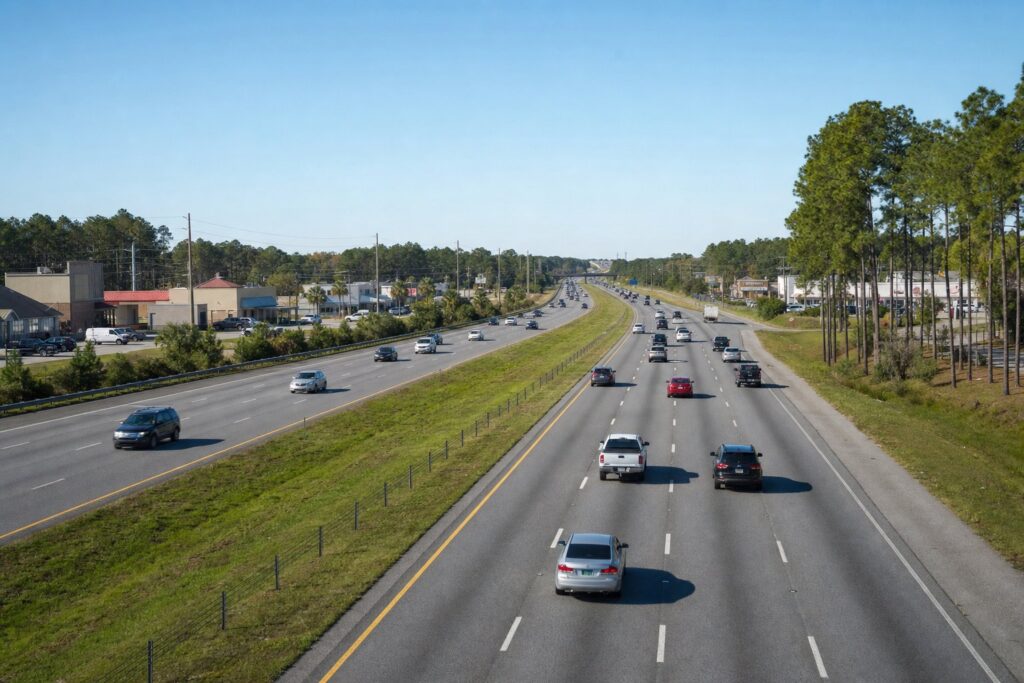
The test. A lawyer who genuinely works this corridor can describe it before you do: the Tenmile segment of I-26 is mapped as motorway, and the surface-street network sits within a few tenths of a mile of it, so interstate-speed traffic decelerates directly into local movements. That one fact explains why this neighborhood generates both catastrophic highway claims and modest arterial claims, which require different proof.
According to the National Highway Traffic Safety Administration, higher travel speeds increase both the likelihood of a crash and the severity of the injuries that follow. On this segment that means rear-end and chain-reaction impacts in slowed commuter traffic, where injuries are often worse than the vehicle damage suggests — the pattern an adjuster uses to argue you were not badly hurt.
The surface network adds its own pressure: Gas Lite Square (about 0.12 miles out) and Doscher's Shopping Center (0.23 miles) push turning and lot-exit movements against through traffic, while Bethune School, Charlestone Academy, and Matilda F Dunston Elementary School — all within 0.6 miles — layer twice-daily pedestrian and stop-and-go surges on top. Our I-26 car accident lawyers page covers the interstate side in depth.
Why a Rivers Avenue Claim Is Valued Differently Than an Interstate Claim
The difference is mechanism and coverage, not sympathy. Where your collision started changes the injury profile, the fault argument, and the size of the policy behind it. A firm that treats every North Charleston crash as one product will misjudge yours.
| Where the crash started | Typical mechanism | What usually drives value |
|---|---|---|
| I-26 motorway segment through Tenmile | Rear-end and chain-reaction impacts in slowed or stopped traffic | Injury severity out of proportion to vehicle damage; commercial policies when a carrier is involved |
| Rivers Avenue (US 52 / US 78), three lanes | Left-turn and driveway-entry collisions against through traffic | Disputed right-of-way and comparative fault; minimum-limits policies |
| Remount Road connector | Merging and weaving as neighborhood traffic feeds the arterial | Witness availability and the sequence of lane changes |
| Gas Lite Square and Doscher's Shopping Center lots | Low-speed backing and lot-exit conflicts | Often no police report; smaller property-damage cases |
Interstate cases turn on a different question: who the defendant is. According to the Federal Motor Carrier Safety Administration, interstate carriers hauling general freight must maintain at least $750,000 in financial responsibility, many times what a private South Carolina auto policy carries. If a tractor-trailer was involved, see our I-26 truck accident lawyers page; if your crash was on the arterial, start with our Rivers Avenue car accident lawyers page.
The South Carolina Rules a Firm Should Explain at the First Meeting
Start with the calendar. You have three years from the date of injury to file a South Carolina personal-injury lawsuit (S.C. Code Ann. § 15-3-530(5)), and a wrongful-death action runs three years from the date of death (S.C. Code Ann. § 15-51-10). One exception matters on this corridor, because I-26, Rivers Avenue, and Remount Road are all publicly maintained.
| Claim type | South Carolina deadline | Authority |
|---|---|---|
| Personal injury | 3 years from the date of injury | S.C. Code Ann. § 15-3-530(5) |
| Wrongful death | 3 years from the date of death | S.C. Code Ann. § 15-51-10 |
| Against a government entity (roadway design, signage, maintenance) | 2 years from the loss; 3 years only if a verified claim was filed within 1 year | S.C. Code Ann. § 15-78-110 |
Fault is the second rule, and the lever every insurer pulls here. Under Nelson v. Concrete Supply Co., 303 S.C. 243, 399 S.E.2d 783 (1991), you may recover only if your own share of fault is 50% or less, with any award reduced proportionally; at 51% you recover nothing. Expect the carrier to argue you left a shopping-center driveway without clearing traffic, followed too closely in slowed I-26 traffic, or merged unsafely off Remount Road. One argument they cannot make: South Carolina bars evidence that you were not wearing a seat belt as proof of negligence or to reduce damages (S.C. Code Ann. § 56-5-6540). See our Charleston, SC personal injury lawyers page.
The Coverage Question That Separates a Real Evaluation From a Sales Pitch
Ask which policy pays before you ask what the case is worth. In a corridor defined by low-coverage and no-coverage drivers, the answer is often your own policy: uninsured motorist coverage is mandatory on every South Carolina auto policy (S.C. Code Ann. § 38-77-150), and underinsured motorist coverage must be offered to you (S.C. Code Ann. § 38-77-160). A firm that cannot walk that sequence in the first conversation is guessing at your case value.
According to the South Carolina Department of Motor Vehicles, an owner may register a vehicle without carrying liability insurance by paying the state's uninsured-motorist fee — a payment that buys the at-fault driver nothing and pays you nothing. Graeham C. Gillin, a partner in Roden Law's Charleston office, tells Tenmile clients that the most common mistake he sees is treating the at-fault driver's minimum-limits policy as the ceiling, when a household's own stacked coverage is often the larger and faster recovery. See how uninsured and underinsured motorist coverage works in South Carolina.
Two variations come up constantly here. If the driver fled — and I-26 gives a fleeing driver an immediate high-speed exit from the Tenmile streets — South Carolina permits a "John Doe" action against the unknown motorist under S.C. Code Ann. § 38-77-170, subject to that statute's corroboration conditions, which is why witness names and camera footage matter in the first hours; see our hit and run accident lawyers page. If the driver was impaired, the criminal case under S.C. Code Ann. § 56-5-2930 proceeds separately from your civil claim, and punitive damages remain available for reckless conduct subject to the caps in S.C. Code Ann. § 15-32-530 — see our drunk driver accident lawyers page.
Six Questions That Expose a Firm With Only a City-Wide Page
Ask these on the free consultation, and listen for specifics rather than reassurance. A firm that has actually handled claims from this corridor answers without hedging:
- Is mine an interstate case or an arterial case — and where does I-26 traffic slow into the Tenmile streets?
- Which policy do you expect to pay — the at-fault driver's, or mine?
- What percentage of fault will the insurer try to put on me, and how do you rebut it?
- Which court would my case be filed in, and have you tried cases there?
- Who handles my file day to day, and how quickly do calls get returned?
- What do you charge, and what costs come out of a settlement?
You are not being difficult by asking — you are asking what the firm should have volunteered.
Where a Tenmile Case Is Actually Filed
Charleston County Court of Common Pleas, Ninth Judicial Circuit, hears personal-injury and wrongful-death actions arising in Tenmile and North Charleston. According to the South Carolina Judicial Branch, the Court of Common Pleas is the state's trial court of general jurisdiction for civil matters, which is where a serious Tenmile claim belongs.
Two other forums come up: Charleston County Magistrate Court, which handles civil claims up to $7,500 and is where minor property-damage-only collisions on Rivers Avenue or Remount Road land, and the United States District Court for the District of South Carolina, Charleston Division, when the defendant is an out-of-state trucking or rideshare company. Ask which of the three a firm expects, and why.
What to Do in the First Week After a Tenmile Crash
Get evaluated the same day, even if you feel functional. According to the Centers for Disease Control and Prevention, symptoms of a concussion or mild traumatic brain injury may not appear until hours or days after an impact, and a treatment gap is the first thing an adjuster uses to discount a claim. Go to the nearest emergency department or urgent care, describe every symptom, and keep the records.
Then protect the corridor evidence while it exists. Photograph vehicle positions, debris, and roadway conditions before the lane clears, collect witness names yourself, and ask about camera coverage along the Gas Lite Square and Doscher's Shopping Center frontage within days, because retail systems overwrite quickly. According to the South Carolina Department of Public Safety, law enforcement documents reportable collisions on a uniform traffic collision report — the record your own carrier asks for first. Decline a recorded statement until you know your policy limits.
Roden Law has recovered more than $300 million for injured clients and holds a 4.9-star average across 500+ reviews. Depending on what this crash cost you, start with our North Charleston brain injury lawyers, Rivers Avenue pedestrian accident lawyers, or North Charleston wrongful death lawyers pages.
Frequently Asked Questions
Q: How do I pick the best lawyer for a crash on I-26 in Tenmile?
A: Judge firms on corridor-specific answers, not advertising. A Tenmile I-26 best car accident lawyer should be able to explain how interstate traffic decelerating into the Tenmile surface grid affects your injury argument, whether your claim is an interstate or arterial case, which policy pays, and which Charleston County court hears it — before quoting any value.
Q: What does hiring a Tenmile I-26 best car accident lawyer cost?
A: Nothing upfront. Roden Law handles North Charleston crash claims on a contingency fee basis — you pay no upfront fees and no legal fees unless we win your case, and the review is free. One conversation is usually enough to tell you whether your own coverage, the at-fault driver's limits, and the collision report support a claim worth pursuing.
Q: How long do I have to file after a North Charleston crash?
A: Three years from the date of injury for most South Carolina personal-injury lawsuits (S.C. Code Ann. § 15-3-530(5)), and three years from the date of death for a wrongful-death action (S.C. Code Ann. § 15-51-10). If your claim involves a government entity — including roadway conditions on I-26, Rivers Avenue, or Remount Road — the period is two years (S.C. Code Ann. § 15-78-110).
Q: What if the driver who hit me had no insurance, or never stopped?
A: Your own uninsured motorist coverage becomes the source of recovery, and South Carolina requires it on every auto policy issued in the state (S.C. Code Ann. § 38-77-150). If the driver was never identified, you may pursue a "John Doe" claim against the unknown motorist under S.C. Code Ann. § 38-77-170, subject to that statute's reporting and corroboration conditions.
Q: The insurer says I was partly at fault. Can I still recover?
A: Yes, as long as your share of fault is 50% or less. Under Nelson v. Concrete Supply Co., 303 S.C. 243, 399 S.E.2d 783 (1991), South Carolina reduces your award in proportion to your fault and bars recovery entirely at 51%. Insurers routinely overstate a claimant's share, which is why the collision report, witnesses, and footage matter so much.
Q: Which court would hear my Tenmile case?
A: Charleston County Court of Common Pleas, Ninth Judicial Circuit, is the trial court for personal-injury and wrongful-death actions arising in Tenmile and North Charleston. Smaller property-damage matters may land in Charleston County Magistrate Court, which handles civil claims up to $7,500, and cases against out-of-state trucking or rideshare companies may proceed in federal court in Charleston.
About the Author
Graeham C. Gillin is a partner at Roden Law and is admitted to practice law in South Carolina, handling motor-vehicle, catastrophic-injury, and wrongful-death claims out of the firm's Charleston office, including collisions on I-26, Rivers Avenue (US 52 / US 78), and Remount Road in North Charleston. Start with our car accident lawyers in North Charleston, SC page or our statewide car accident lawyers hub.
Free Case Review — No Fees Unless We Win. 📞 Call 844-RESULTS, or reach our North Charleston office at 2703 Spruill Ave, (843) 612-6561.
About the Author