
Last reviewed: 2026-06-05
If you were hurt in an Uber or Lyft crash near the airport, an experienced International Boulevard airport rideshare accident lawyer North Charleston can help you sort out the layered insurance, the South Carolina deadlines, and who actually pays for your medical bills, lost income, and pain. International Boulevard is the 35 mph corridor feeding the Charleston International Airport (CHS) and the Tanger Outlets hotel-and-retail district, where Uber and Lyft pickups, rental cars, and out-of-town drivers all converge — and that mix produces a very specific kind of wreck. This guide walks you through what to do, what South Carolina law says, and how Roden Law's North Charleston office approaches these claims. We work on a contingency fee basis — you pay nothing upfront and no legal fees unless we win your case.
Key Takeaways
- In South Carolina, you generally have 3 years from the date of injury to file a rideshare crash lawsuit under S.C. Code Ann. § 15-3-530 — but Tort Claims Act notice deadlines can be far shorter.
- The driver's app status at the moment of the crash decides whether Uber/Lyft's commercial coverage layer applies or only the driver's personal policy.
- South Carolina uses modified comparative negligence with a 51% bar (Nelson v. Concrete Supply Co.) — you can still recover if you are not more than 50% at fault.
- International Boulevard's airport-and-outlet traffic mixes unfamiliar out-of-town drivers with local commuters, raising rear-end, turning, and hit-and-run risk.
- Uninsured/underinsured motorist (UM/UIM) coverage under S.C. Code Ann. §§ 38-77-150 and 38-77-160 is often the key recovery source in hit-and-run and minimal-coverage crashes.
- Charleston County injury suits are filed in the Court of Common Pleas (Ninth Judicial Circuit); smaller claims may go to Magistrate Court.
- Roden Law's North Charleston office charges no upfront fees — call 844-RESULTS for a free case review.
Why International Boulevard Crashes Near CHS Are Different
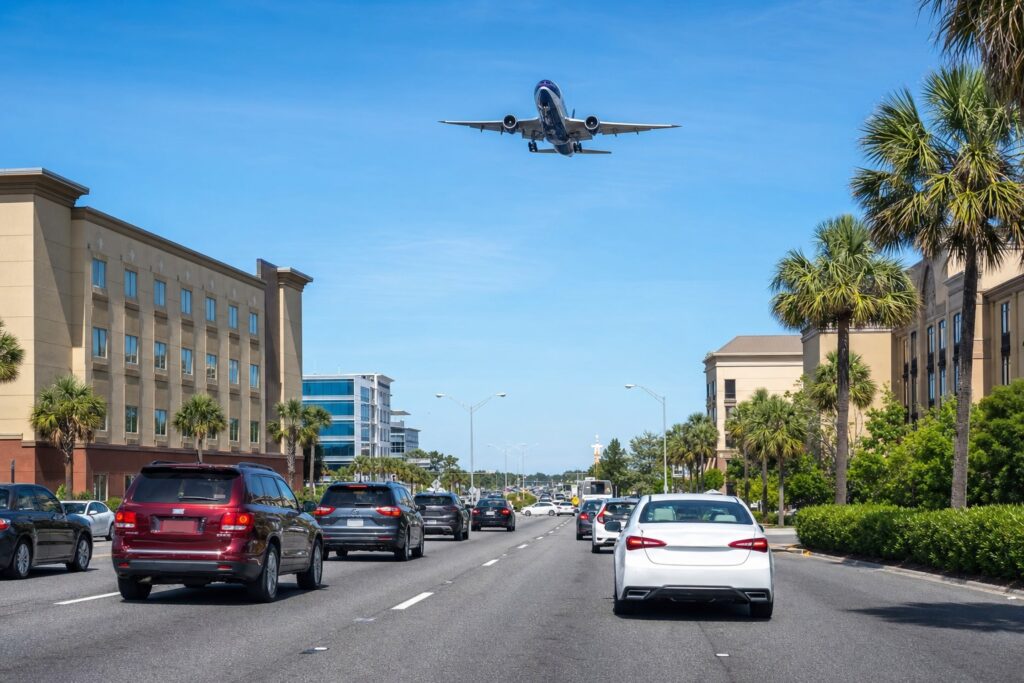
A crash in an Uber or Lyft on International Boulevard is rarely a simple two-car fender bender. This corridor is built for transition: travelers being dropped off and picked up, rental cars heading to and from the airport, and outlet shoppers turning across two lanes of traffic into hotel and commercial driveways. According to the South Carolina Department of Public Safety, rear-end and turning collisions are among the most common crash types statewide — exactly the patterns this stop-and-go, driveway-heavy corridor produces.
The research brief for this corridor identifies several distinguishing hazards: International Boulevard is a 35 mph two-lane secondary road feeding the airport and Tanger Outlets district; Michaux Parkway is a secondary connector through the 29418 retail/industrial pocket near Collins Park with frequent turning movements; and Dorchester Road (SC 642) is a primary arterial carrying heavy commuter and commercial volume. The common thread is a high concentration of unfamiliar drivers — airport rideshare, rental cars, tourists, and outlet shoppers — who do not know the street grid.
Eric Roden, Roden Law's founding partner, points out that airport-corridor rideshare wrecks are some of the hardest claims to untangle precisely because so many of the drivers involved are from out of state, driving rental or rideshare vehicles, which complicates insurance identification and even service of process. That is exactly why getting a local lawyer involved early matters on a road like this one.
If your wreck happened on a connecting route, our I-526 car accident lawyers and I-26 car accident lawyers pages cover the interstate corridors that feed this same airport district, and you can read more about car wrecks on Aviation Avenue near the Charleston airport for a closely related corridor.
The First Thing That Decides Your Claim: App Status
In a rideshare crash, the single most important question is what the Uber or Lyft app was doing at the moment of impact. Rideshare collisions implicate the driver's app status, which determines whether the commercial coverage layer applies versus the driver's personal policy. Here is how that generally breaks down.
| Driver's app status at the time of the crash | Coverage that typically applies |
|---|---|
| App off (driver using car personally) | The driver's personal auto policy only |
| App on, waiting for a ride request | Limited contingent liability coverage from the rideshare company |
| En route to pick up or actively carrying a passenger | The rideshare company's larger commercial liability policy, plus UM/UIM coverage |
If you were a passenger in the Uber or Lyft, you were almost certainly in the period of highest coverage — the trip was active. If you were in another vehicle, a pedestrian, or a cyclist struck by a rideshare driver, the analysis turns on whether that driver was logged in and what they were doing. Getting this wrong, or accepting the first insurer's framing of it, can cost you significant compensation. Our rideshare and Uber accident lawyers and Uber & Lyft accident lawyers handle the app-status investigation and the document requests needed to pin it down.
South Carolina Law That Controls Your Case
South Carolina law — not Georgia law — governs a crash in Charleston County, and a few rules drive nearly every rideshare claim on this corridor.
The deadline to sue. South Carolina generally allows three years from the date of injury to file a personal injury or wrongful death lawsuit under S.C. Code Ann. § 15-3-530. That is longer than some neighboring states, but it is not a reason to wait — evidence on a busy corridor like International Boulevard disappears fast. And if a government entity is involved, claims under the South Carolina Tort Claims Act can carry shorter notice and filing deadlines, so you should confirm the specific deadline that applies to your crash.
How fault is shared. South Carolina follows modified comparative negligence with a 51% bar, established in Nelson v. Concrete Supply Co. You can still recover as long as you are not more than 50% at fault, with your damages reduced by your share of fault. When several drivers are involved — common on a multi-driveway corridor — fault among multiple defendants is apportioned under S.C. Code Ann. § 15-38-15.
When the at-fault driver has no insurance. Hit-and-run and minimal-coverage crashes are common in busy retail and hotel traffic, where transient drivers come and go. In those cases, uninsured and underinsured motorist coverage under S.C. Code Ann. §§ 38-77-150 and 38-77-160 is frequently the key recovery source. According to the Insurance Information Institute, a meaningful share of drivers nationwide carry no insurance at all — making UM/UIM coverage one of the most overlooked tools in a rideshare claim.
Where Your Charleston County Case Is Filed
A personal injury lawsuit arising from a North Charleston crash is filed in Charleston County. According to the South Carolina Judicial Branch, the county's civil trial court is the Charleston County Court of Common Pleas (Ninth Judicial Circuit), where most injury suits are litigated. Smaller disputes — claims under $7,500 — fall within the Charleston County Magistrate Court. Knowing the right forum, and the procedural rules that go with it, is part of why local representation matters on a corridor like this.
What To Do After an International Boulevard Rideshare Crash
If you are physically able, the steps you take in the first hours can protect both your health and your claim:
- Get medical care. Even if you feel okay, airport-corridor speeds and sudden stops cause injuries that surface later. Get evaluated.
- Report the crash and get the police report. A North Charleston officer's report documents the scene, the vehicles, and the drivers — critical when out-of-town drivers are involved.
- Screenshot the rideshare trip. Your Uber or Lyft app records the trip, the driver, and the time. Save it before anything changes.
- Document everything. Photos of the vehicles, the driveway or intersection, and your injuries. Note nearby landmarks like Collins Park or the outlet entrances.
- Do not give a recorded statement to the other insurer before talking to a lawyer.
- Call a local lawyer. Roden Law's North Charleston office can begin the app-status and insurance investigation immediately.
The corridor also sees pedestrian conflicts, hit-and-run crashes, and impaired-driving wrecks tied to airport-area hotel and nightlife traffic. If your situation involves those facts, our North Charleston pedestrian accident lawyers, our hit-and-run accident lawyers, and our drunk driver accident lawyers cover those scenarios in depth. For a broader overview, see our personal injury lawyers pillar, and for related local reading, our coverage of rideshare crashes on I-26 through Tenmile and Dorchester Road and 29418 school-zone pedestrian crashes.
Why Roden Law
Roden Law has recovered more than $250 million for injured clients, handled over 5,000 cases, and earned a 4.9-star average across 500+ client reviews, backed by 62 years of combined experience. Our North Charleston office serves the entire Charleston metro's northern corridor — and we never charge upfront fees. No fees unless we win your case.
If a crash on this corridor took the life of a loved one, our North Charleston wrongful death lawyers and our car accident lawyers in North Charleston, SC can explain how a wrongful death claim works under South Carolina law.
📞 Call 844-RESULTS — Free Case Review, No Fees Unless We Win.
Frequently Asked Questions
Q: How long do I have to file a rideshare accident lawsuit in North Charleston?
A: In South Carolina, you generally have three years from the date of injury to file a personal injury or wrongful death lawsuit under S.C. Code Ann. § 15-3-530. However, if a government entity is involved, the South Carolina Tort Claims Act can impose shorter notice and filing deadlines, so confirm the specific deadline that applies to your International Boulevard crash as soon as possible.
Q: Whose insurance pays after an Uber or Lyft crash near the airport?
A: It depends on the driver's app status at the moment of the crash. If the driver was carrying a passenger or en route to a pickup, Uber or Lyft's commercial liability and UM/UIM coverage typically applies. If the app was off, only the driver's personal policy applies. Pinning down app status is the first step in any rideshare claim.
Q: Can I still recover if I was partly at fault for the International Boulevard crash?
A: Yes, in most cases. South Carolina follows modified comparative negligence with a 51% bar under Nelson v. Concrete Supply Co. You can recover as long as you were not more than 50% at fault, though your damages are reduced by your share of fault. Fault among multiple drivers is apportioned under S.C. Code Ann. § 15-38-15.
Q: What if the driver who hit me fled or had no insurance?
A: Hit-and-run and uninsured-driver crashes are common in busy airport and outlet traffic. In those situations, your own uninsured/underinsured motorist coverage under S.C. Code Ann. §§ 38-77-150 and 38-77-160 is often the key recovery source. A local lawyer can identify every available policy, including the rideshare company's UM/UIM layer if the app was active.
Q: Where would my Charleston County rideshare case be filed?
A: A North Charleston personal injury suit is filed in Charleston County. Most injury cases are litigated in the Charleston County Court of Common Pleas (Ninth Judicial Circuit). Claims under $7,500 generally fall within the Charleston County Magistrate Court. The right forum depends on the size and nature of your claim.
Q: How much does it cost to hire an International Boulevard airport rideshare accident lawyer North Charleston?
A: Nothing upfront. Roden Law's North Charleston office works on a contingency fee basis — you pay no upfront fees and no legal fees unless we win your case. Your initial case review is free. Call 844-RESULTS to speak with our team about your airport-corridor rideshare crash.
About the Author
Eric Roden is the founding partner of Roden Law and is admitted to practice in both Georgia and South Carolina. He leads the firm's personal injury practice, including rideshare and airport-corridor crash claims handled out of Roden Law's North Charleston office in Charleston County, South Carolina. This article is for general information and is not legal advice.
About the Author