
Key Takeaways
Multi-vehicle crashes in Georgia and South Carolina involve complex fault allocation under modified comparative fault rules—Georgia bars recovery at 50% fault (O.C.G.A. § 51-12-33) and South Carolina at 51%. Fault is determined through accident reconstruction, black box data, witness testimony, and physical evidence, with statutes of limitations of 2 years in Georgia (O.C.G.A. § 9-3-33) and 3 years in South Carolina (S.C. Code § 15-3-530).
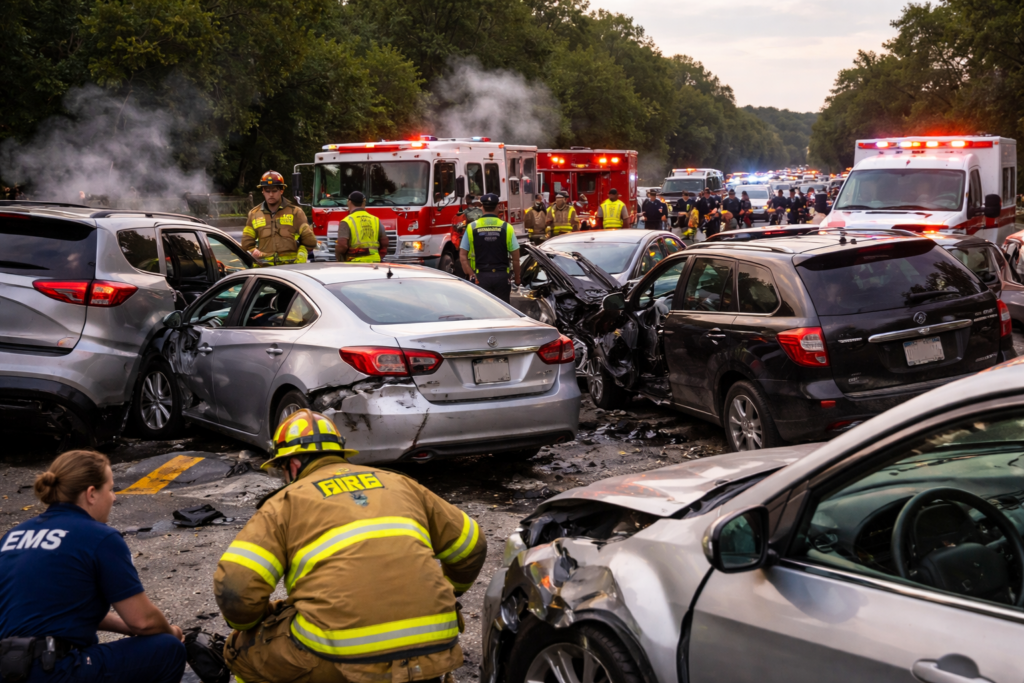
Multi-vehicle accidents—commonly called chain-reaction crashes or pileups—are among the most legally complex personal injury cases in Georgia and South Carolina. When three or more vehicles are involved in a collision, determining who caused the accident and how much fault each driver bears becomes significantly more difficult than in a standard two-car crash. Every driver involved may point the finger at someone else, insurance companies may dispute liability, and the stakes rise with every additional vehicle. For a deeper look at how negligence applies in traffic collisions, visit the Cornell Law Institute’s overview of negligence law.
Why Multi-Vehicle Crashes Are Complex
In a typical two-car accident, liability usually comes down to one driver’s actions versus the other’s. Multi-vehicle crashes shatter this simplicity. Consider a five-car pileup on I-95 or I-16: one driver may have been speeding, another following too closely, a third may have braked suddenly, and a fourth may have been texting. Each driver’s actions contributed to the overall collision in different ways, and untangling who caused what requires a detailed reconstruction of the entire chain of events.
The complexity increases because each vehicle in the pileup may have been struck multiple times. A car that was rear-ended first may then be pushed into the vehicle ahead, making it both a victim of one collision and a contributing factor in another. Insurance adjusters and attorneys must analyze each individual impact within the larger accident to properly assign fault—a process that often requires accident reconstruction experts and extensive evidence gathering.
Common Types of Multi-Vehicle Accidents
Chain-Reaction Rear-End Collisions
The most common multi-vehicle accident occurs when one vehicle rear-ends another, pushing it into the car ahead and triggering a chain reaction. These crashes frequently happen on highways during heavy traffic, at red lights, and in construction zones. While the driver who initiated the chain reaction often bears the most fault, other drivers who were following too closely may also share liability.
Intersection Pileups
Running a red light or stop sign at a busy intersection can trigger collisions involving multiple vehicles from different directions. T-bone impacts at intersections are particularly dangerous and can result in severe traumatic brain injuries and spinal cord injuries. Determining fault requires analyzing traffic signal timing, witness testimony, and surveillance footage.
Highway Pileups
High-speed multi-vehicle crashes on interstates and highways often involve commercial trucks, multiple passenger vehicles, and sometimes dozens of cars. Poor visibility from fog, rain, or smoke can trigger these catastrophic pileups. Georgia’s I-16 and I-95 corridors and South Carolina’s I-26 and I-85 are frequent locations for these dangerous collisions.
Head-On Chain Reactions
When a vehicle crosses the center line and strikes an oncoming car, the initial collision can push vehicles into other lanes of traffic, creating secondary impacts. Head-on collisions generate tremendous force and often cause fatal injuries, especially at highway speeds.
Merge and Lane-Change Accidents
A driver who makes an unsafe lane change can clip one vehicle and trigger a multi-car collision as other drivers swerve to avoid the initial impact. These accidents frequently involve motorcyclists and bicyclists, who are especially vulnerable in chain-reaction scenarios.
How Fault Is Determined in Multi-Vehicle Crashes
Establishing fault in a multi-vehicle accident requires a thorough investigation that examines multiple types of evidence and considers each driver’s actions leading up to and during the collision:
Accident Reconstruction
Professional accident reconstructionists use physics, engineering, and computer modeling to recreate the sequence of events. They analyze vehicle damage patterns, skid marks, debris fields, and final resting positions to determine the speed, direction, and point of impact for each vehicle involved.
Police Reports
The responding officer’s crash report documents the scene, records driver and witness statements, notes traffic violations, and may include the officer’s preliminary opinion about fault. While police reports are not conclusive on liability, they carry significant weight in insurance negotiations and court proceedings.
Witness Testimony
Eyewitness accounts from other drivers, passengers, pedestrians, and nearby business employees can help establish the sequence of the chain reaction. Independent witnesses—those who were not involved in the crash—typically carry the most credibility.
Electronic Evidence
Modern vehicles contain event data recorders (EDRs or “black boxes”) that capture speed, braking, steering input, and seatbelt use in the seconds before a crash. Commercial trucks are required to have electronic logging devices (ELDs) that record hours of service. Cell phone records can prove distracted driving, and dashcam footage may capture the entire incident.
Physical Evidence
Tire marks, gouge marks in the pavement, paint transfer between vehicles, and the pattern of vehicle damage all tell a story about how the collision unfolded. Preserving this evidence quickly is critical, as road conditions change and vehicles are towed from the scene.
Comparative Fault Rules in Georgia and South Carolina
Both Georgia and South Carolina follow modified comparative fault systems, which are especially relevant in multi-vehicle crashes where more than one driver may bear responsibility:
Multi-vehicle cases are where the difference between the two systems bites hardest, because apportionment among several defendants follows different rules in each state. Our guide to comparative negligence in Georgia versus South Carolina sets that out in detail.
| Factor | Georgia | South Carolina |
|---|---|---|
| Fault Standard | Modified comparative fault (O.C.G.A. § 51-12-33) | Modified comparative fault |
| Recovery Threshold | You can recover if less than 50% at fault | You can recover if less than 51% at fault |
| Damage Reduction | Award reduced by your percentage of fault | Award reduced by your percentage of fault |
| Multiple Defendants | Each defendant liable for their proportional share (O.C.G.A. § 51-12-33(b)) | Joint and several liability may apply in certain cases |
| Statute of Limitations | 2 years from the date of accident (O.C.G.A. § 9-3-33) | 3 years from the date of accident (S.C. Code § 15-3-530) |
In a multi-vehicle crash, comparative fault percentages are assigned to each driver involved. For example, if you are found 20% at fault in a Georgia pileup and your total damages are $200,000, your recovery would be reduced by 20% to $160,000. But if you are found 50% or more at fault in Georgia—or 51% or more in South Carolina—you cannot recover any compensation at all.
This threshold makes multi-vehicle cases particularly high-stakes. Insurance companies in these cases often try to shift blame onto every driver except their own insured, and each percentage point of fault can be worth thousands of dollars.
Critical Evidence in Multi-Vehicle Accident Cases
Preserving and collecting evidence quickly is essential after a multi-vehicle crash. Key evidence includes:
- Photos and video: Photograph all vehicles, damage patterns, road conditions, traffic signs, skid marks, and the overall scene from multiple angles
- Dashcam and surveillance footage: Request footage from your own dashcam, other drivers’ cameras, nearby traffic cameras, and business security cameras
- Black box data: Send a spoliation letter to all involved parties to preserve electronic data recorder information before vehicles are repaired or scrapped
- 911 calls and dispatch records: These recordings capture real-time accounts of the accident from callers at the scene
- Medical records: Seek medical attention immediately and document all injuries, as delayed treatment gives insurers ammunition to argue your injuries were not caused by the crash
- Cell phone records: Subpoenaing phone records can prove distracted driving by other involved drivers
- Weather and road condition reports: Official weather data and road maintenance records can establish whether environmental factors contributed to the crash
When Multiple Parties Share Liability
Multi-vehicle crashes often involve claims against multiple at-fault parties, which creates both opportunities and complications for injured victims:
Multiple insurance policies: When several drivers share fault, you may be able to recover from multiple insurance policies, increasing the total compensation available. This is particularly important in severe injury cases where one driver’s policy limits may not cover your full damages.
Commercial vehicle involvement: If a tractor-trailer or commercial vehicle was involved, additional parties may be liable, including the trucking company, the vehicle owner, the cargo loader, and the maintenance provider. Commercial vehicles typically carry much higher insurance limits—often $1 million or more.
Government liability: If a road defect, missing signage, or malfunctioning traffic signal contributed to the pileup, the government entity responsible for road maintenance may share liability. These claims have shorter filing deadlines and special procedural requirements under state tort claims acts.
Vehicle defects: If a vehicle defect—such as brake failure, tire blowout, or accelerator malfunction—triggered the chain reaction, the vehicle manufacturer or parts supplier may be liable under product liability theories.
Insurance Challenges in Multi-Vehicle Claims
Multi-vehicle accident claims present unique insurance challenges that rarely arise in two-car crashes:
Finger-pointing between insurers: Each insurance company tries to minimize its insured’s fault percentage and shift blame to other drivers. This often leads to prolonged disputes and delayed settlements.
Stacking coverage: When multiple at-fault drivers are involved, your attorney may need to pursue claims against several insurance policies simultaneously and coordinate settlements to maximize your recovery.
Underinsured motorist coverage: If the at-fault drivers lack sufficient insurance to cover your injuries, your own underinsured motorist (UIM) coverage may fill the gap. Both Georgia and South Carolina require insurers to offer UIM coverage, and carrying adequate UIM limits is one of the most important financial decisions drivers can make.
Subrogation disputes: If your health insurer or workers’ compensation carrier paid for your medical treatment, they may assert subrogation rights against your personal injury recovery, further complicating the settlement process.
How a Car Accident Lawyer Can Help
Multi-vehicle crashes require an attorney who can manage the complexity of multiple parties, multiple insurance companies, and disputed liability. An experienced car accident lawyer brings critical advantages:
- Conducting a thorough investigation with accident reconstructionists, engineers, and expert witnesses
- Identifying all at-fault parties and all available insurance coverage
- Preserving critical evidence before it is lost, destroyed, or altered
- Negotiating simultaneously with multiple insurance companies
- Countering attempts by insurers to inflate your percentage of fault
- Calculating the full value of your claim including medical expenses, lost wages, pain and suffering, and future damages
- Taking your case to trial if insurance companies refuse to offer fair settlements
At Roden Law, we represent injured drivers across Georgia and South Carolina in complex multi-vehicle accident cases. We work on a contingency fee basis—you owe us nothing unless we win your case. If you were injured in a chain-reaction crash or highway pileup, contact us today for a free case review. Call 1-844-RESULTS to speak with an attorney who understands how to fight for maximum compensation when fault is shared among multiple drivers.
Frequently Asked Questions
About the Author