
Key Takeaways
Traffic tickets carry weight with insurance adjusters but are not conclusive, and the ticket itself is generally not admissible at trial in Georgia or South Carolina. The doctrine of negligence per se may apply when a traffic violation directly causes an accident. Both Georgia (O.C.G.A. § 51-12-33) and South Carolina use modified comparative fault, allowing recovery even with shared fault. Pleading guilty to a traffic ticket can be used against you in a civil case. Georgia has a 2-year statute of limitations (O.C.G.A. § 9-3-33); South Carolina has 3 years (S.C. Code § 15-3-530).
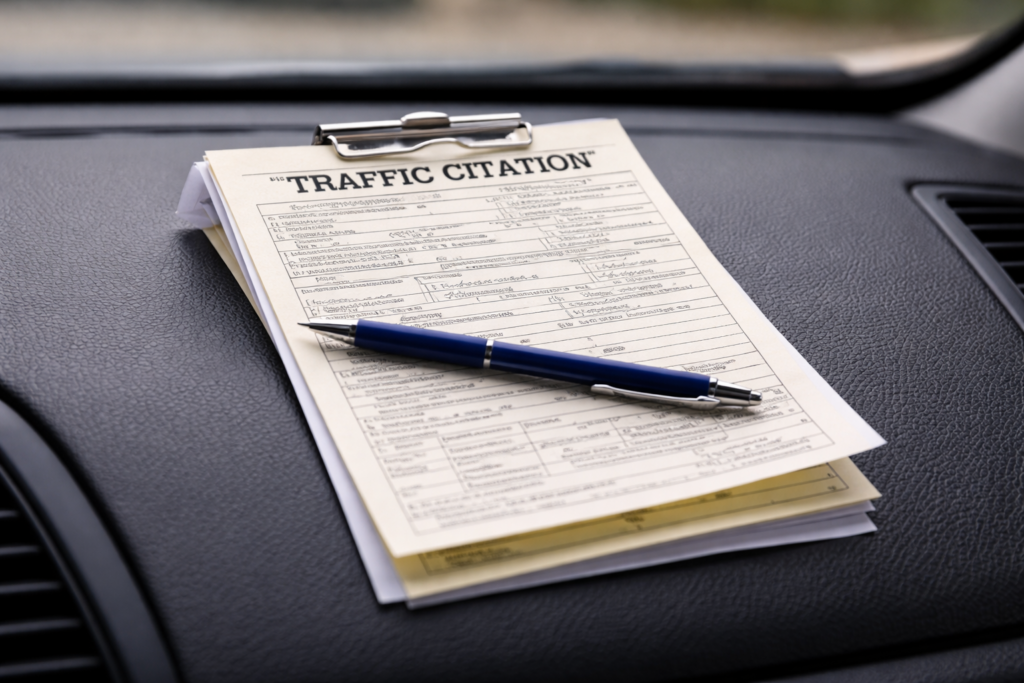
After a car accident, one of the first questions people ask is: “Who got the ticket?” Traffic citations issued at an accident scene can play an important role in your injury claim — but they do not automatically determine fault. Understanding how traffic tickets interact with personal injury claims in Georgia and South Carolina is crucial for protecting your right to compensation. For a comprehensive overview of car accident claims, visit our car accident lawyers page.
According to the Legal Information Institute at Cornell Law School, violating a traffic statute can serve as evidence of negligence in a civil lawsuit, though the relationship between traffic citations and civil liability is more nuanced than most people realize.
Do Traffic Tickets Determine Fault in a Car Accident?
A traffic ticket carries real weight with insurance adjusters, but it is not the final word. In both Georgia and South Carolina, fault in a car accident is determined by the civil legal system — not by the police officer who issued the citation. A traffic ticket reflects the officer’s assessment of who violated traffic laws, but in both states the ticket itself is generally not even admissible at trial; the jury decides fault from the evidence of what each driver did.
Here is why traffic tickets are not conclusive on the question of fault:
- The officer may not have witnessed the accident — they are reconstructing events from evidence and witness statements
- Traffic court and civil court have different standards of proof
- A driver can receive a ticket but still not be primarily at fault for the collision
- Both drivers can receive citations, creating shared fault scenarios
- A ticket can be dismissed in traffic court and the underlying conduct can still be proven in the civil case with witnesses and physical evidence
That said, a traffic citation — especially for a serious violation like running a red light or DUI — carries significant weight in settlement negotiations, and a guilty plea to it can be used against the driver at trial. Insurance adjusters treat citations as meaningful indicators of fault.
Traffic Violations and Negligence Per Se
When a driver violates a traffic law and that violation causes an accident, the legal doctrine of negligence per se may apply. Under this doctrine, violating a statute designed to protect public safety establishes the driver’s duty and breach as a matter of law — the injured party does not need to prove that the driver failed to act reasonably because the law has already defined what reasonable conduct requires. In Georgia that showing is prima facie, so the driver may try to rebut it.
Negligence per se applies only if the injured person is someone the statute was meant to protect and the harm is the kind it was meant to prevent (nearly always true when one motorist’s violation injures another). Then two conditions must be met:
- The driver violated a traffic statute
- The violation was the proximate cause of the accident and injuries
For example, if a driver was cited for running a red light and that caused a T-bone collision, negligence per se likely applies — the driver violated a safety statute and that violation directly caused the crash. However, if a driver was cited for having a broken taillight but the accident was a head-on collision caused by the other driver crossing the centerline, the broken taillight violation has no causal connection to the crash.
Georgia Rules on Traffic Tickets and Accident Claims
Georgia follows a modified comparative fault system under O.C.G.A. § 51-12-33, allowing injured parties to recover damages as long as they are less than 50% at fault.
Admissibility of Traffic Tickets in Georgia Civil Cases
In Georgia, the traffic citation itself is generally not admissible in a civil lawsuit: courts have consistently held that a traffic-court charge or its disposition is inadmissible unless the driver pleaded guilty (Eubanks v. Waldron). A guilty plea, or posting a cash bond and not appearing, which O.C.G.A. § 40-13-58 treats as an admission of guilt, makes a prima facie showing of negligence the driver must then rebut (Coleman v. Fortner). Merely paying a fine is not by itself an admission, a conviction after a contested traffic trial is not admissible, and a plea of nolo contendere can never be used (O.C.G.A. § 17-7-95(c)).
Georgia Comparative Fault and Traffic Violations
Even if you also received a traffic citation, you may still recover compensation under Georgia’s comparative fault rules. For instance, if you were cited for minor speeding but the other driver ran a stop sign causing the collision, the other driver likely bears the majority of fault. Your compensation would be reduced by your percentage of fault — say 15% — but you would still recover 85% of your damages.
Georgia Statute of Limitations
Under O.C.G.A. § 9-3-33, you have 2 years from the date of the accident to file a personal injury lawsuit in Georgia.
South Carolina Rules on Traffic Tickets and Accident Claims
South Carolina also follows a modified comparative fault system that allows recovery as long as you are less than 51% at fault. South Carolina also keeps traffic convictions out of civil trials. For more, visit our car accident lawyers page or read about car accident claims in South Carolina.
Traffic Citations as Evidence in South Carolina
By statute, no evidence of a traffic conviction is admissible in any civil action (S.C. Code § 56-5-6160), and the investigating officer may testify to observations, not to an opinion on who caused the crash, unless qualified as an expert (Gulledge v. McLaughlin). What can come in is a guilty plea, which courts treat as an admission the driver may explain or rebut; a bond forfeiture or a plea of nolo contendere cannot be used as an admission (Samuel v. Mouzon), even though S.C. Code § 56-5-6220 gives both the effect of a conviction for traffic-law purposes. Proving the violation itself — DUI (S.C. Code § 56-5-2930), reckless driving (S.C. Code § 56-5-2920), or failure to yield — is what supports a negligence per se claim. And the absence of a citation does not mean the absence of fault.
South Carolina Comparative Fault and Traffic Violations
Under South Carolina’s comparative fault system, traffic violations by both drivers are weighed against each other. If both drivers were cited, the jury still decides each party’s percentage of fault from the evidence of what each driver did and how much it contributed to the crash, not from the citations, which it will not see.
South Carolina Statute of Limitations
Under S.C. Code § 15-3-530, you have 3 years from the date of the accident to file a personal injury lawsuit in South Carolina.
Common Traffic Citations in Car Accident Cases
Certain traffic violations are more common — and more impactful — in accident claims than others:
| Traffic Violation | Impact on Fault Determination | Negligence Per Se Likely? |
|---|---|---|
| Running a red light / stop sign | Very high — strong indicator of fault | Yes |
| DUI / DWI | Extremely high — may also support punitive damages | Yes |
| Speeding (significant) | High — shows disregard for safety | Yes, if speed caused the crash |
| Failure to yield right of way | High — directly relevant to intersection collisions | Yes |
| Following too closely (tailgating) | High — common in rear-end collisions | Yes |
| Improper lane change | Moderate to high | Yes, if it caused the collision |
| Texting while driving | Very high — shows distracted driving | Yes |
| Minor speeding (5-10 mph over) | Low to moderate | Depends on circumstances |
| Broken taillight / equipment violation | Low — usually not causally connected | Unlikely |
| Expired registration / inspection | Minimal — administrative issue | No |
Violations involving drunk driving or distracted driving carry the most weight because they demonstrate a clear disregard for the safety of others.
What If You Received the Traffic Ticket?
Receiving a traffic citation after an accident does not mean you are automatically at fault — and it certainly does not mean you cannot pursue a personal injury claim. There are several important considerations:
The Ticket May Be Wrong
Police officers arrive after the accident and must piece together what happened from physical evidence, witness statements, and driver accounts. They can make mistakes. The officer may not have had all the facts, witnesses may have provided inaccurate information, or the physical evidence may have been misinterpreted.
Your Violation May Not Have Caused the Accident
Even if the ticket is valid, your violation may not have caused the collision. For example, if you were cited for minor speeding (going 40 in a 35 zone) but the other driver made an illegal left turn directly into your path, the other driver’s violation — not yours — was the proximate cause of the crash.
Shared Fault Does Not Bar Recovery
Under comparative fault rules in both Georgia and South Carolina, you can recover damages even if you share some fault. If you were 20% at fault due to a traffic violation, you can still recover 80% of your damages. Only reaching the state’s threshold (50% in Georgia, 51% in South Carolina) bars recovery entirely.
How Traffic Tickets Are Used as Evidence
Traffic tickets enter the civil claim process in several ways:
- Police report — the accident report documents which citations were issued and typically includes the officer’s narrative of how the accident occurred; adjusters lean on it, but in South Carolina it may not be used as evidence of either party’s negligence at trial (S.C. Code § 56-5-1290)
- Settlement negotiations — insurance adjusters review traffic citations when evaluating fault and determining settlement offers
- Depositions — attorneys may question the cited driver about the violation and whether they contested it
- Trial evidence — the officer’s testimony about what he or she observed, and any guilty plea, can be presented to a jury; the citation itself and a traffic-court conviction generally cannot
- Guilty pleas — if the cited driver pleaded guilty to the traffic violation, that admission is powerful evidence of fault in a civil case
This is why the decision to plead guilty to a traffic ticket after an accident should never be taken lightly. In Georgia, a driver who posts a cash bond and skips traffic court is treated as having admitted guilt (O.C.G.A. § 40-13-58); South Carolina will not admit a forfeited bond, but it will admit a guilty plea. In both states a plea of nolo contendere, where the court allows it, is not an admission.
Should You Fight the Traffic Ticket?
If you plan to file a personal injury claim (or expect the other driver to file one against you), fighting the traffic ticket is often worth considering. Here is why:
- A guilty plea is an admission — pleading guilty to the traffic violation can be used as evidence of fault in your civil case
- A dismissal closes the door on a plea — if the ticket is dismissed, there is no guilty plea for the other side to use
- Timing matters — the traffic case and the civil case operate on different timelines, so consult your attorney about strategy before making any decisions in traffic court
Your personal injury lawyer can advise you on whether fighting the ticket makes strategic sense for your specific situation.
What Happens When No Ticket Is Issued?
Sometimes police respond to an accident and do not issue any citations. This can happen when fault is unclear, when the officer did not witness the accident, or when both drivers appear to share responsibility. The absence of a traffic ticket does not mean no one was at fault — it simply means the officer chose not to cite anyone at the scene.
In these cases, your personal injury claim relies on other evidence to establish fault:
- Witness statements from passengers, bystanders, or other drivers
- Surveillance camera footage from nearby businesses or traffic cameras
- Physical evidence including skid marks, vehicle damage patterns, and debris fields
- Accident reconstruction expert analysis
- Cell phone records showing distracted driving
- Vehicle data from electronic control modules (black boxes)
An experienced attorney can build a strong fault case even without a traffic citation. Our firm handles cases across Georgia and South Carolina, including Savannah, Myrtle Beach, and surrounding communities; our car accident lawyers page covers car accident claims in both states.
How a Car Accident Attorney Can Help
Whether the other driver received a ticket, you received a ticket, or no tickets were issued, an experienced car accident attorney can protect your interests by:
- Obtaining and analyzing the full police report and any traffic citations
- Investigating the accident scene and gathering additional evidence beyond the police report
- Advising you on whether to contest a traffic citation you received
- Using the other driver’s traffic violation to strengthen your negligence per se argument
- Countering insurance company attempts to inflate your fault percentage based on a minor citation
- Calculating the full value of your claim including medical bills, lost wages, and pain and suffering
- Negotiating with insurance companies or presenting your case at trial
At Roden Law, we handle all types of car accident claims including truck accidents, motorcycle accidents, pedestrian accidents, and bicycle accidents across Georgia and South Carolina. We have recovered over $300 million for injury victims and work on a contingency fee basis — you pay nothing unless we win your case.
If you have questions about how a traffic ticket might affect your accident claim, contact us today for a free consultation or call 1-844-RESULTS.
Frequently Asked Questions
About the Author