
Millions of visitors are drawn to Charleston each year, captivated by its historic architecture and coastal charm. This constant influx of tourism, however, brings a unique set of challenges to our local roads. From the winding, tree-canopied Ashley River Road to the busy streets leading to Folly Beach, our roadways are often shared with drivers unfamiliar with their layout. A driver distracted by a GPS in the historic district or mesmerized by the marsh views can create a hazardous situation in seconds. If you’ve been in a tourist car accident Charleston, understanding how to prove the other driver was at fault is the first step toward protecting your rights and securing fair compensation.
Charleston’s Scenic Routes and Tourist Driving Risks
The very things that make Charleston beautiful can also make its roads dangerous. Tourists navigating the narrow, one-way streets south of Broad are often more focused on finding a landmark than on watching for cyclists or pedestrians. The scenic pull-offs on the way to the beaches become spots for sudden, unexpected stops, creating a high risk for rear-end collisions. This isn’t about blaming visitors, but about recognizing a real pattern of behavior. An out-of-state driver may be hesitant at roundabouts in Mount Pleasant or confused by the lane shifts on the Crosstown. These moments of distraction or uncertainty are often the root cause of accidents. This guide is designed to help Charleston residents understand how to demonstrate fault and manage the claims process when the at-fault driver is from out of town.
Understanding South Carolina’s At-Fault Insurance System
Before you can build a claim, you need to understand the legal ground rules. South Carolina is an “at-fault” state. This means the person responsible for causing the accident is also responsible for paying for the resulting damages. It’s a straightforward concept, but it places the burden of proof squarely on the injured party. Unlike in “no-fault” states where each driver’s own insurance covers their initial costs, here you must demonstrate the other driver’s negligence.
For a successful claim, proving negligence car accident SC requires establishing four key elements:
- Duty: Every driver has a legal obligation to operate their vehicle safely and follow traffic laws.
- Breach: The tourist failed to meet this obligation through a specific action, like running a red light or texting while driving.
- Causation: This failure directly caused the accident and your injuries.
- Damages: You suffered measurable harm, such as medical bills, lost income, or vehicle repair costs.
A skilled Charleston personal injury lawyer can help you accurately calculate all these damages to ensure your claim reflects the full extent of your losses.
Common Negligent Actions by Tourist Drivers
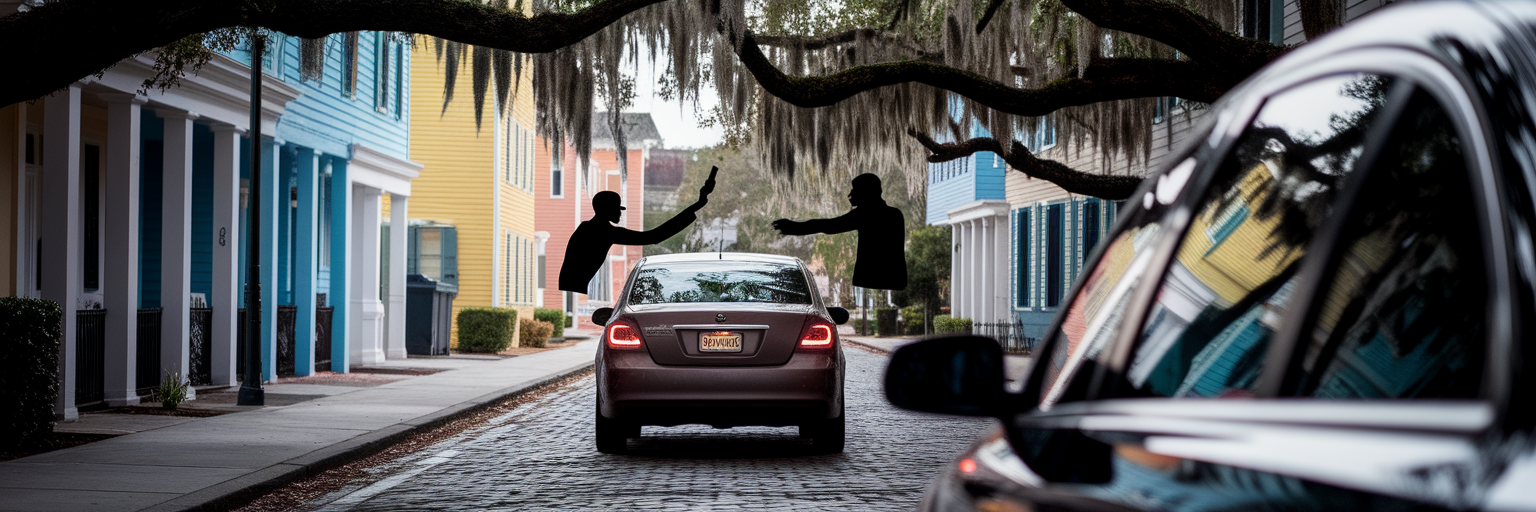
Negligence isn’t just an abstract legal term. It’s a set of observable behaviors that we see on Charleston’s roads every day. We’ve all been behind a car that brakes abruptly on The Battery for a quick photo, a classic example of a driver failing to maintain the safe flow of traffic. This is more than just an annoyance; it’s a breach of their duty to drive safely. Similarly, a driver fixated on their GPS while trying to decipher the one-way streets downtown is not paying adequate attention to their surroundings, putting others at risk.
Unfamiliarity with local traffic patterns is another common source of negligence. Tourists may hesitate at the complex intersections on Coleman Boulevard or make illegal U-turns on Johnnie Dodds Boulevard out of confusion. Some might even speed across the Arthur Ravenel Jr. Bridge to get a better view of the harbor, drastically reducing their reaction time. These are not just simple mistakes; they are negligent actions with serious consequences. Recognizing these behaviors is the first step in connecting the tourist’s actions to your accident.
| Negligent Action | Common Charleston Location | Why It’s a Breach of Duty |
|---|---|---|
| Sudden, unexpected braking | Rainbow Row, The Battery | Failing to maintain traffic flow and creating a rear-end collision risk. |
| GPS fixation / distracted driving | Historic District one-way streets | Not paying attention to pedestrians, cyclists, or other vehicles. |
| Illegal U-turns | Coleman Blvd, Johnnie Dodds Blvd | Violating traffic laws and causing intersection accidents. |
| Speeding for a better view | Arthur Ravenel Jr. Bridge | Exceeding the speed limit and reducing reaction time. |
| Failure to yield at roundabouts | Mount Pleasant, West Ashley | Unfamiliarity with roundabout rules, leading to right-of-way collisions. |
Note: These examples illustrate common behaviors that can be used to establish a breach of the duty to drive safely, a key component in proving negligence.
Steps for Gathering Evidence at the Accident Scene
In the moments after a collision, your priority is safety, but the evidence you collect can determine the outcome of your claim. In a stressful situation, a simple checklist can make all the difference.
- Prioritize Safety and Call 911. Move to a safe location if possible and immediately report the accident. A police report is an official record that provides a neutral account of the incident and is vital for your claim.
- Document Everything with Your Phone. Take photos and videos from multiple angles. Capture the positions of the vehicles, all property damage, skid marks on the road, and any relevant traffic signs or signals.
- Get the Other Driver’s Information. Don’t just write it down. Take a clear photograph of the tourist’s out-of-state driver’s license and their insurance card. This prevents transcription errors and captures all necessary details.
- Speak to Witnesses. An independent witness who saw the tourist make a sudden U-turn or run a stop sign can be incredibly persuasive. Get their name and contact information. Their testimony can corroborate your account of what happened.
The type of evidence needed can sometimes depend on the vehicles involved. For example, if the accident involved a commercial delivery truck, there are additional factors to consider, which our experienced Charleston truck accident lawyers are equipped to handle.
Building a Strong Claim After Leaving the Scene

The work of proving negligence continues long after the tow trucks have left. Building a strong case requires a strategic approach to gathering and organizing information.
- Obtain the Official Police Report. Once it’s available, get a copy and review it carefully. Pay close attention to the officer’s narrative description of the accident and note if any citations were issued to the other driver.
- Seek Immediate Medical Attention. Even if you feel fine, see a doctor right away. Some injuries, like whiplash, have delayed symptoms. A medical evaluation creates a documented link between the accident and your injuries, which is essential for your claim.
- Look for Additional Evidence. Think about the accident location. Were there security cameras at a nearby business on King Street or in the City Market that might have captured the collision? A formal request can sometimes secure this powerful footage.
- Consider Cell Phone Records. If you strongly suspect the tourist was texting or on a call, a lawyer can take steps to subpoena their cell phone records. This can provide definitive proof of distracted driving and solidify your out of state driver accident claim.
As you can see, these steps can become complex. The support of our dedicated Charleston car accident lawyers can be invaluable in ensuring no detail is overlooked.
Managing Claims Involving Out-of-State Insurance
Dealing with an insurance company from another state can feel intimidating, but one fact provides clarity: because the accident happened here, South Carolina at fault laws apply. You will file what is known as a “third-party claim” directly with the tourist’s insurance provider. Many people worry if the tourist is from a “no-fault” state, but that doesn’t matter. The liability coverage on their policy is what pays for the damages they cause, regardless of their home state’s rules.
However, you should be prepared for potential challenges. Out-of-state adjusters may be less familiar with our local laws or may try to delay the process. As Joye Law Firm highlights, navigating these claims can be complex due to differing state regulations and insurance practices. Having a local advocate on your side ensures the adjuster takes your claim seriously.
How South Carolina’s Comparative Negligence Rule Affects Your Claim
South Carolina uses a “modified comparative negligence” rule to determine compensation when more than one party might be partially at fault. The rule is straightforward: you can recover damages only if you are found to be 50% or less at fault for the accident. If you are assigned 51% or more of the blame, you recover nothing.
Your compensation is also reduced by your percentage of fault. For example, if you have $100,000 in damages but are found 20% at fault for the accident, your potential recovery is reduced by 20% to $80,000. This rule makes it absolutely critical to build a strong case that minimizes any fault attributed to you. As noted by the Brewer Law Firm, this 51% bar makes it essential to clearly establish the other party’s negligence. Every piece of evidence proving the tourist’s fault helps protect your right to full compensation for your comparative negligence South Carolina claim.
The Role of a Local Attorney in Tourist Accident Cases
After an accident with a tourist, you are left facing unique hurdles. You have to gather evidence against someone who may have already left the state, communicate with an unfamiliar out-of-state insurer, and defend your claim against South Carolina’s 51% fault rule. A Charleston car accident lawyer is the advocate you need to manage these challenges effectively.
An experienced attorney handles all communications, preserves critical evidence, and builds a compelling case to maximize your settlement for medical bills, lost wages, and pain and suffering. Instead of bearing this burden alone, let a professional strengthen your claim. If you need help, please contact us for guidance.