
Key Takeaways
Pedestrian accidents in Georgia and South Carolina carry high fatality rates due to lack of pedestrian protection. Drivers must yield at crosswalks under O.C.G.A. § 40-6-91 and S.C. Code § 56-5-3130. Georgia allows recovery if less than 50% at fault (O.C.G.A. § 51-12-33); South Carolina if less than 51% at fault. Filing deadlines are 2 years in GA and 3 years in SC. Visibility, distraction, and speed are leading causes.
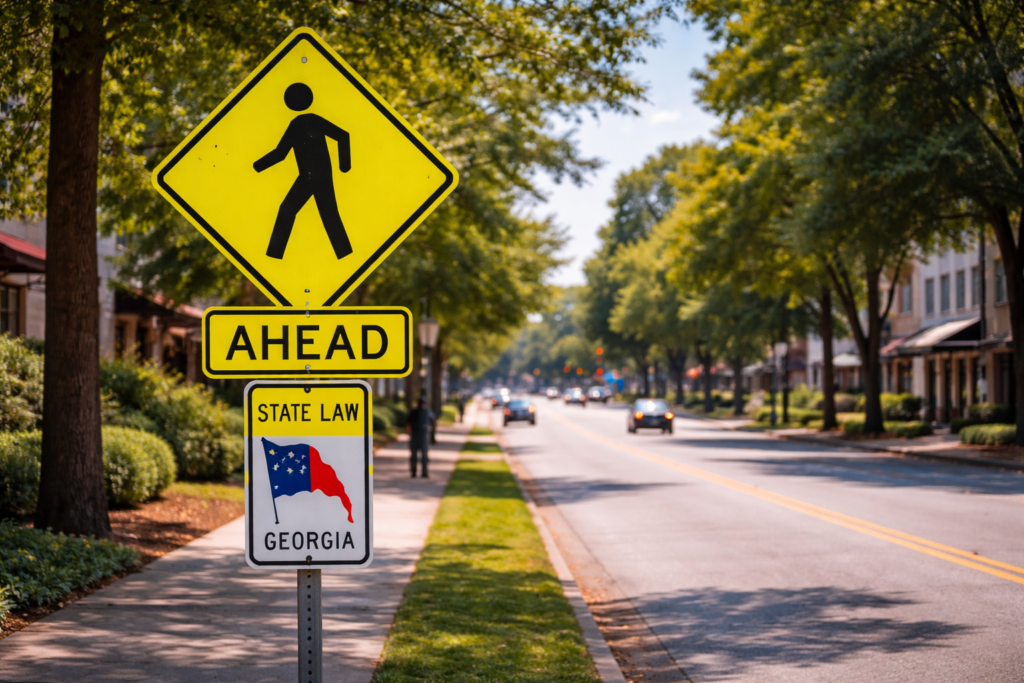
Pedestrian accidents remain one of the most devastating types of traffic collisions in both Georgia and South Carolina. Unlike vehicle occupants who are shielded by steel frames and airbags, pedestrians have virtually no protection against a multi-ton vehicle. Understanding pedestrian safety laws, common risks, and your legal rights can mean the difference between a preventable tragedy and a safe journey home. For a comprehensive overview of pedestrian accident claims, visit the Cornell Law Institute’s guide on negligence, which forms the legal foundation for most pedestrian injury cases.
Pedestrian Accident Statistics in Georgia and South Carolina
Both Georgia and South Carolina consistently rank among the most dangerous states for pedestrians in the United States. The Governors Highway Safety Association (GHSA) has repeatedly flagged the Southeast as a hotspot for pedestrian fatalities, with Georgia and South Carolina appearing in the top 15 most dangerous states nearly every year.
In Georgia, the Department of Transportation reports hundreds of pedestrian fatalities annually, with urban corridors in Savannah, Atlanta, and Augusta representing the highest concentration of incidents. South Carolina faces similar challenges, with Charleston, Columbia, and Myrtle Beach recording significant pedestrian crash rates.
Key contributing factors include high speed limits on arterial roads, inadequate crosswalk infrastructure, poor street lighting, and distracted driving. These statistics underscore the need for both pedestrians and drivers to understand their responsibilities under state law.
Common Causes of Pedestrian Accidents
Understanding the root causes of pedestrian accidents helps both walkers and drivers take preventive action. The most common causes include:
Distracted Driving: Texting, adjusting GPS, or scrolling through a phone while driving is one of the leading causes of pedestrian accidents. A driver traveling at 35 mph covers more than 50 feet in the time it takes to read a single text message — more than enough distance to miss a pedestrian in a crosswalk.
Failure to Yield at Crosswalks: Georgia law under O.C.G.A. § 40-6-91 requires drivers to stop and remain stopped for pedestrians in crosswalks. South Carolina has similar provisions under S.C. Code § 56-5-3130. Despite these laws, drivers routinely fail to yield, especially at uncontrolled intersections.
Speeding: Higher vehicle speeds dramatically increase both the likelihood and severity of pedestrian collisions. A pedestrian struck at 20 mph has roughly a 90% survival rate, but at 40 mph, the fatality risk jumps to approximately 50%.
Impaired Driving: Alcohol and drug impairment remains a significant factor in pedestrian accidents throughout both states. Impaired drivers have slower reaction times, reduced peripheral vision, and impaired judgment — all of which make it harder to detect and avoid pedestrians. If an impaired driver caused your injuries, you may also have a wrongful death claim if a loved one did not survive.
Poor Visibility: A large percentage of pedestrian accidents occur during nighttime hours or in low-light conditions such as dawn and dusk. Inadequate street lighting, dark clothing, and obstructed sightlines all contribute to reduced visibility.
Left-Turn Collisions: Drivers making left turns at intersections frequently focus on oncoming traffic and fail to check for pedestrians in the crosswalk they are turning into. This type of collision accounts for a disproportionate share of urban pedestrian accidents.
Pedestrian Traffic Laws in Georgia and South Carolina
Georgia Pedestrian Laws
Georgia’s pedestrian laws are codified primarily in O.C.G.A. § 40-6-90 through § 40-6-97. Key provisions include:
- Crosswalk right of way (O.C.G.A. § 40-6-91): Drivers must stop and remain stopped for pedestrians within the driver’s half of the roadway or within one lane of the driver’s half at marked crosswalks.
- Pedestrian obligations (O.C.G.A. § 40-6-92): Pedestrians must obey traffic signals and may not suddenly leave a curb and walk into the path of a vehicle so close that the driver cannot yield.
- Crossing outside crosswalks (O.C.G.A. § 40-6-92): Where traffic control signals are in operation, pedestrians must use crosswalks. Pedestrians crossing at any point other than a marked crosswalk must yield to vehicles.
- Sidewalk use (O.C.G.A. § 40-6-96): Where sidewalks are provided, pedestrians must use them. Where no sidewalks exist, pedestrians must walk on the left side of the road facing oncoming traffic.
South Carolina Pedestrian Laws
South Carolina’s pedestrian statutes are found in S.C. Code § 56-5-3110 through § 56-5-3230. Key rules include:
- Crosswalk right of way (S.C. Code § 56-5-3130): Drivers must yield the right of way to pedestrians within any marked crosswalk or within any unmarked crosswalk at an intersection.
- Pedestrian responsibilities (S.C. Code § 56-5-3150): Pedestrians must not suddenly walk into the path of a vehicle that is so close as to constitute an immediate hazard.
- Crossing at signalized intersections (S.C. Code § 56-5-3110): Pedestrians must obey walk and don’t-walk signals at signalized intersections.
- Walking on highways (S.C. Code § 56-5-3190): Pedestrians walking along roads must use sidewalks when available, or walk on the left side facing traffic when no sidewalk is present.
High-Risk Areas for Pedestrian Accidents
Certain environments consistently produce more pedestrian accidents than others. Understanding where risks are highest helps pedestrians exercise extra caution:
Multi-lane arterial roads: Wide, high-speed roads with multiple lanes in each direction are the most dangerous for pedestrians. These roads often lack adequate crosswalks, medians, or pedestrian refuges, forcing walkers to cross four or more lanes of fast-moving traffic.
Parking lots and shopping centers: The mix of vehicles backing out of spaces, drivers searching for spots, and pedestrians carrying bags creates a dangerous combination. Premises liability claims may apply when a property owner fails to maintain safe pedestrian pathways.
School zones: Despite reduced speed limits, school zones remain high-risk areas, particularly during morning drop-off and afternoon pickup when children may dart into traffic unexpectedly.
Tourist districts: Popular areas in Charleston’s historic district, Savannah’s downtown squares, and Myrtle Beach’s oceanfront see elevated pedestrian accident rates due to unfamiliar visitors, heavy foot traffic, and distracted walking.
Construction zones: Detoured sidewalks, obstructed pathways, and heavy equipment create additional hazards for pedestrians near construction sites.
Safety Tips for Pedestrians
While pedestrians have the legal right of way in many situations, exercising caution can prevent life-changing injuries:
- Use crosswalks and obey signals: Always cross at marked crosswalks and wait for walk signals at controlled intersections. Jaywalking not only increases your risk but can also reduce your compensation in an injury claim under comparative fault rules.
- Make eye contact with drivers: Before stepping into a crosswalk, try to make eye contact with approaching drivers to confirm they see you and intend to stop.
- Wear visible clothing: At night, wear light-colored or reflective clothing. Consider carrying a flashlight or using reflective accessories, especially in areas without streetlights.
- Stay alert — avoid distractions: Remove headphones and put away your phone when crossing streets. Distracted walking is a growing contributor to pedestrian accidents.
- Walk facing traffic: When no sidewalk is available, walk on the left side of the road facing oncoming traffic so you can see approaching vehicles.
- Be extra cautious at night: Most fatal pedestrian accidents occur between 6:00 PM and midnight. Use extra caution during these hours and choose well-lit routes when possible.
- Watch for turning vehicles: Even when you have a walk signal, watch for vehicles making right or left turns through your crosswalk.
Safety Tips for Drivers Sharing the Road
Drivers bear the greater legal responsibility to avoid pedestrian collisions. Follow these guidelines to protect pedestrians:
- Slow down in pedestrian areas: Reduce speed in school zones, residential neighborhoods, downtown areas, and anywhere pedestrians are likely to be present.
- Yield at crosswalks — always: Under both Georgia and South Carolina law, you must yield to pedestrians in crosswalks. Come to a complete stop, not a rolling yield.
- Eliminate distractions: Put your phone away. A moment of inattention can result in a life-altering collision.
- Check blind spots before turning: Before making left or right turns, scan crosswalks thoroughly. Check mirrors and blind spots for pedestrians.
- Use extra caution at night: Slow down after dark and remain alert for pedestrians who may be difficult to see, especially in areas with poor lighting.
- Never pass a stopped vehicle at a crosswalk: If a vehicle ahead of you is stopped at a crosswalk, they may be yielding to a pedestrian you cannot see. Georgia law under O.C.G.A. § 40-6-91(d) prohibits a driver approaching from the rear from overtaking and passing a vehicle stopped at a crosswalk for a pedestrian.
Liability and Fault in Pedestrian Accident Cases
Determining liability in a pedestrian accident depends on who violated their duty of care. Both Georgia and South Carolina use modified comparative fault systems, meaning a pedestrian’s compensation can be reduced by their percentage of fault — and potentially barred entirely if fault exceeds a threshold.
Georgia’s Comparative Fault Rule
Under O.C.G.A. § 51-12-33, Georgia follows a modified comparative fault rule where an injured pedestrian can recover damages only if they are less than 50% at fault for the accident. If the pedestrian is 50% or more at fault, they are barred from recovery entirely. If the pedestrian is found to be 20% at fault, for example, their total compensation would be reduced by 20%.
South Carolina’s Comparative Fault Rule
South Carolina also applies modified comparative fault, but with a slightly more favorable threshold. A pedestrian can recover as long as they are not more than 50% at fault (effectively less than 51%). This means a pedestrian who is exactly 50% at fault can still recover in South Carolina but would be barred in Georgia.
| Factor | Georgia | South Carolina |
|---|---|---|
| Comparative Fault Standard | Modified — less than 50% | Modified — less than 51% |
| Crosswalk Yield Law | O.C.G.A. § 40-6-91 | S.C. Code § 56-5-3130 |
| Statute of Limitations | 2 years (O.C.G.A. § 9-3-33) | 3 years (S.C. Code § 15-3-530) |
| Pedestrian Must Use Sidewalk | Yes, when available | Yes, when available |
Common Pedestrian Accident Injuries and Damages
Pedestrian accidents produce some of the most severe injuries seen in personal injury law because of the complete lack of protection for the pedestrian. Common injuries include:
- Traumatic brain injuries (TBI) — from impact with the vehicle or the ground
- Spinal cord injuries — potentially resulting in partial or complete paralysis
- Broken bones and fractures — particularly legs, pelvis, ribs, and arms
- Internal organ damage — from blunt force trauma to the abdomen or chest
- Road rash and abrasion injuries — from sliding along pavement
- Soft tissue injuries — including torn ligaments, tendons, and muscles
Damages in a pedestrian accident case may include medical expenses (past and future), lost wages and earning capacity, pain and suffering, emotional distress, loss of enjoyment of life, and in cases involving fatalities, wrongful death damages for surviving family members.
What to Do After a Pedestrian Accident
If you or a loved one is struck by a vehicle, taking the right steps immediately afterward protects both your health and your legal rights:
- Call 911 immediately: Request emergency medical services and police response. A police report is critical evidence in any pedestrian accident claim.
- Seek medical attention: Even if you feel okay, adrenaline can mask serious injuries. Get a thorough medical evaluation as soon as possible. Some injuries like traumatic brain injuries may not show symptoms for hours or days.
- Document the scene: If physically able, photograph the accident scene, vehicle damage, your injuries, crosswalk conditions, traffic signals, and any skid marks or debris.
- Get witness information: Collect names and phone numbers from anyone who saw the accident. Witness testimony can be decisive in establishing fault.
- Do not admit fault: Avoid saying things like “I shouldn’t have been crossing there” or “I didn’t see the car.” These statements can be used against you later.
- Report the accident to your insurance: Notify your insurance company about the accident, but avoid giving recorded statements to the at-fault driver’s insurer without consulting an attorney first.
- Contact a pedestrian accident lawyer: An experienced attorney can protect your rights, handle insurance negotiations, and ensure you meet filing deadlines.
Remember the filing deadlines: Georgia’s statute of limitations for personal injury is 2 years from the date of the accident (O.C.G.A. § 9-3-33), while South Carolina allows 3 years (S.C. Code § 15-3-530). Missing these deadlines typically means losing your right to compensation entirely.
How a Pedestrian Accident Lawyer Can Help
Pedestrian accident cases often involve complex liability disputes, particularly when the driver’s insurance company argues the pedestrian was partially at fault. An experienced pedestrian accident attorney from Roden Law can:
- Investigate the accident scene, obtain surveillance footage, and secure witness testimony
- Work with accident reconstruction experts to establish the driver’s negligence
- Calculate the full value of your damages, including future medical needs and lost earning capacity
- Counter comparative fault arguments raised by insurance companies
- Negotiate aggressively with insurers or take your case to trial if a fair settlement cannot be reached
At Roden Law, we represent injured pedestrians on a contingency fee basis — you pay nothing unless we recover compensation for you. With offices in Savannah, Charleston, Columbia, and Myrtle Beach, our attorneys understand the local roads, intersections, and courtrooms where these cases are decided.
Contact Roden Law today for a free consultation. Call 1-844-RESULTS or reach out online to discuss your pedestrian accident case with an experienced attorney.
Frequently Asked Questions
About the Author