
Key Takeaways
Rain does not eliminate driver liability — motorists must adjust speed, use headlights, and maintain safe tires in wet conditions. Georgia requires headlights when wipers are active (O.C.G.A. § 40-8-20), while South Carolina mandates headlights in low visibility (S.C. Code § 56-5-4450). Both states apply comparative fault: Georgia bars recovery at 50% fault (O.C.G.A. § 51-12-33), South Carolina at 51%. Government entities may share liability for poor road design or drainage.
Who Is Liable for a Car Accident Caused by Heavy Rain in Georgia or South Carolina?
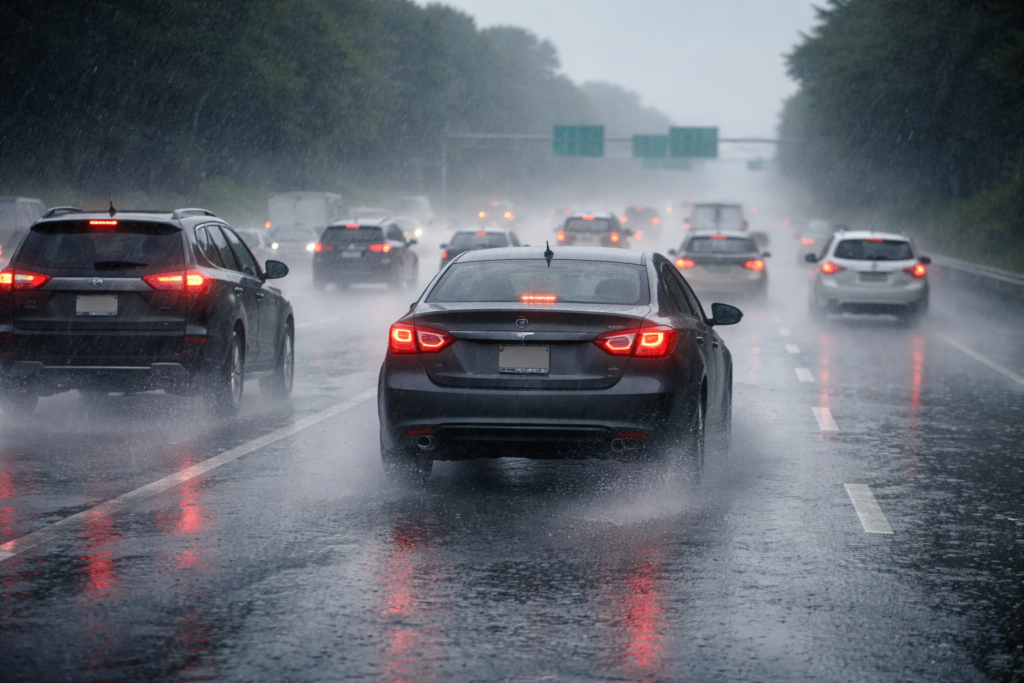
Heavy rain causes thousands of traffic accidents across Georgia and South Carolina every year. The Southeast sees some of the highest annual rainfall totals in the country, and roads in Savannah, Charleston, Columbia, and Myrtle Beach regularly flood during summer storms and hurricane season. When a crash happens in the rain, insurance companies almost always try to blame the weather rather than the driver. But rain does not cause accidents—drivers who fail to adjust their behavior cause accidents.
According to the Federal Highway Administration, wet pavement and rainfall contribute to roughly 21% of all vehicle crashes nationwide. That figure represents nearly 1.2 million crashes per year. Yet in the vast majority of these cases, another driver’s negligence—speeding, following too closely, failing to use headlights—is the real cause. If you were hit by a negligent driver during a rainstorm, you likely have a valid claim for compensation under Georgia or South Carolina law.
Duty of Care in Bad Weather
Every driver in Georgia and South Carolina has a legal duty to operate their vehicle with reasonable care under the circumstances. This duty does not disappear when the weather turns bad. In fact, courts in both states have consistently held that the duty of care actually increases during hazardous conditions. A driver who would be considered reasonable at 55 mph on a dry highway may be grossly negligent at the same speed during a downpour.
The legal standard is straightforward: a reasonably prudent driver adjusts their speed, increases their following distance, turns on headlights, and avoids unnecessary lane changes when rain reduces visibility or makes roads slick. A driver who fails to make these adjustments and causes a car accident can be held liable for the resulting injuries and property damage—regardless of the weather.
Insurance adjusters often argue that rain-related crashes are “no-fault” weather events. This is a negotiation tactic, not the law. Georgia and South Carolina courts evaluate whether a driver behaved reasonably given the conditions at the time of the crash, not whether the conditions were ideal.
Common Causes of Rain-Related Accidents
Hydroplaning
Hydroplaning happens when a layer of water builds up between a vehicle’s tires and the road surface, causing the tires to lose contact with the pavement. At that point, the driver has almost no steering or braking control. Hydroplaning is most dangerous in the first 10 to 15 minutes of rainfall, when oil and debris mix with water on the road surface.
Drivers who speed through standing water, fail to replace worn tires, or ignore pooling water on the highway are responsible when their vehicle hydroplanes into another car. Commercial trucks are especially prone to hydroplaning due to their weight and the spray they generate, which can blind following vehicles for several seconds at a time.
Reduced Visibility
Heavy rain can cut visibility to a few hundred feet or less. Drivers who refuse to slow down, fail to turn on headlights, or neglect to use windshield wipers are creating hazards for every vehicle around them. Rear-end collisions spike during rain because drivers cannot see brake lights until it is too late to stop. Motorcyclists and bicyclists are particularly vulnerable because they are harder to see even in good conditions.
Flooded Roads and Standing Water
Georgia and South Carolina both experience flash flooding, especially in low-lying coastal areas around Savannah, Charleston, and the Grand Strand. Drivers who attempt to cross flooded roadways put themselves and others at serious risk. Flooding also creates slip and fall hazards at intersections and parking lots where water hides curbs, potholes, and uneven surfaces. Just six inches of moving water can knock a person off their feet, and two feet can float most vehicles. Pedestrians caught near flooded intersections face life-threatening danger from vehicles pushing through high water.
When a driver ignores road closure signs, drives around barriers, or plows through standing water that pushes their vehicle into oncoming traffic, they bear full responsibility for the resulting crash.
How Georgia Determines Liability in Weather-Related Crashes
Georgia has specific statutes that apply directly to driving in rain and other adverse weather conditions.
Georgia’s Basic Speed Law
Under O.C.G.A. § 40-6-180, Georgia law requires drivers to operate at a speed that is “reasonable and prudent under the conditions and having regard to the actual and potential hazards then existing.” This means the posted speed limit is not automatically a safe speed during heavy rain. A driver going 65 mph in a 65-mph zone during a severe storm may still be violating Georgia law if that speed is unreasonable given the road conditions.
This statute gives accident victims strong grounds to argue negligence. If the at-fault driver was traveling at or near the speed limit during a rainstorm and lost control, their speed was likely unreasonable under the circumstances.
Georgia’s Headlight Law
O.C.G.A. § 40-8-20 requires all vehicles to use headlights from one-half hour after sunset to one-half hour before sunrise, and “at any other time when visibility is reduced to 500 feet or less.” During heavy rainfall, visibility almost always drops below that threshold. A driver who causes an accident without headlights on during a rainstorm has violated this statute, which is strong evidence of negligence per se—meaning the violation itself can establish fault.
Georgia’s Statute of Limitations
Under O.C.G.A. § 9-3-33, you have two years from the date of the accident to file a personal injury lawsuit in Georgia. Missing this deadline almost always means losing your right to seek compensation entirely.
How South Carolina Determines Liability
South Carolina has parallel statutes that address the same driving behaviors.
South Carolina’s Speed Law
S.C. Code § 56-5-1520 states that no person shall drive a vehicle at a speed greater than is “reasonable and prudent under the conditions and having regard to the actual and potential hazards then existing.” The language mirrors Georgia’s law almost exactly. South Carolina courts apply the same analysis: a driver must reduce speed below the posted limit when rain, fog, or other conditions make normal speeds unsafe.
South Carolina’s Headlight Law
S.C. Code § 56-5-4450 requires headlights whenever windshield wipers are in use due to weather conditions. This is actually a broader requirement than Georgia’s law—if your wipers are on, your headlights must be on. Drivers who use wipers but not headlights during rain are in violation of South Carolina law, and that violation can be used as evidence of negligence in a crash.
South Carolina’s Statute of Limitations
Under S.C. Code § 15-3-530, you have three years from the date of the accident to file a personal injury lawsuit in South Carolina. While this is a year longer than Georgia’s deadline, waiting too long to pursue a claim still weakens your case because evidence deteriorates and witnesses forget details.
Georgia vs. South Carolina Comparison Table
| Legal Issue | Georgia | South Carolina |
|---|---|---|
| Speed Law | O.C.G.A. § 40-6-180 — reasonable and prudent under conditions | S.C. Code § 56-5-1520 — reasonable and prudent under conditions |
| Headlight Requirement | O.C.G.A. § 40-8-20 — required when visibility under 500 feet | S.C. Code § 56-5-4450 — required whenever wipers are in use |
| Comparative Fault Rule | Modified — recover if less than 50% at fault (O.C.G.A. § 51-12-33) | Modified — recover if less than 51% at fault |
| Statute of Limitations | 2 years (O.C.G.A. § 9-3-33) | 3 years (S.C. Code § 15-3-530) |
| Government Immunity | Sovereign immunity with exceptions under Ga. Tort Claims Act (O.C.G.A. § 50-21-20 et seq.) | SC Tort Claims Act (S.C. Code § 15-78-10 et seq.) — $600,000 cap per occurrence |
| Negligence Per Se | Violation of traffic statute is evidence of negligence | Violation of traffic statute is evidence of negligence |
Government Liability for Dangerous Road Conditions
Sometimes a government agency shares the blame alongside the driver who hit you. State and local governments have a duty to maintain roads in reasonably safe condition. When poor road design, clogged drainage systems, missing signage, or deteriorated pavement contributes to a rain-related crash, the government entity responsible for that road may share liability.
Georgia’s Sovereign Immunity Rules
Georgia generally protects state and local governments through sovereign immunity, but the Georgia Tort Claims Act (O.C.G.A. § 50-21-20 et seq.) creates limited exceptions. You can sue a state entity for negligent maintenance of roads and highways, though damages are capped. Claims against counties and municipalities follow separate rules. A claim against a municipality requires written ante litem notice within six months under O.C.G.A. § 36-33-5; a claim against a county must be presented within 12 months under O.C.G.A. § 36-11-1.
South Carolina’s Tort Claims Act
The South Carolina Tort Claims Act (S.C. Code § 15-78-10 et seq.) waives sovereign immunity for negligent acts of government employees acting within the scope of their duties. However, damages are capped at $300,000 per claimant and $600,000 per occurrence. You must bring the action within two years of the date the loss was or should have been discovered (S.C. Code § 15-78-110). Filing a verified claim with the entity within one year (S.C. Code § 15-78-80) is optional and extends the deadline to three years.
Common Government Negligence in Rain Accidents
Situations where government liability may apply include:
- Drainage systems that fail to prevent water from pooling on the roadway
- Missing or damaged guardrails on curves that become dangerous when wet
- Failure to post flood warning signs in areas with known flooding problems
- Road surfaces that were never treated for proper water runoff
- Construction zones left without adequate drainage during rain events
If defective road conditions played a role in your accident, a premises liability analysis may apply alongside your vehicle accident claim. Government negligence claims require strict procedural compliance, so early legal counsel is critical.
What to Do After a Rain-Related Accident
The steps you take immediately after a rain-related crash can make or break your claim. Insurance companies will look for any excuse to minimize your payout, and missing evidence is their favorite tool.
1. Call 911 and Get a Police Report
Always call law enforcement, even if injuries seem minor. The police report will document weather conditions, road conditions, and the officer’s observations about each driver’s behavior. This report becomes a key piece of evidence when the insurance company tries to blame the rain instead of their insured driver.
2. Document the Scene
If you can safely do so, photograph and video the accident scene. Capture standing water, road conditions, visibility, traffic signals, skid marks, and vehicle damage. Take wide shots that show the overall scene and close-ups of specific hazards. Note whether the other driver’s headlights were on or off.
3. Get Medical Attention
Rain-related crashes often involve high-speed impacts that cause serious injuries including traumatic brain injuries and spinal damage. Adrenaline can mask pain for hours or even days after a crash. See a doctor within 24 to 48 hours of the accident, even if you feel fine. A gap in medical treatment gives the insurance company ammunition to argue your injuries are unrelated to the crash.
4. Preserve Evidence of Weather Conditions
Download weather data from the National Weather Service for the exact time and location of your accident. Save screenshots of radar images showing rainfall intensity. This evidence can directly counter an insurance company’s argument that conditions were “light rain” when they were actually a severe downpour.
5. Do Not Give a Recorded Statement
The other driver’s insurance company will call and ask for your version of events. They will ask leading questions designed to get you to admit partial fault: “Wasn’t it raining pretty hard? Were you having trouble seeing too?” Politely decline to give a recorded statement until you have spoken with an attorney.
How Comparative Fault Applies
Rain-related accident claims almost always involve some argument about shared fault. The at-fault driver’s insurance company will argue that you should have pulled over, driven slower, or stayed home. Georgia and South Carolina both use modified comparative fault systems, but the rules differ slightly.
Georgia’s Comparative Fault Rule
Under O.C.G.A. § 51-12-33, Georgia follows a modified comparative fault system where you can recover damages as long as you are less than 50% at fault for the accident. If you are found 50% or more responsible, you recover nothing. If you are found 20% at fault, your total damages are reduced by 20%. For example, if your damages total $100,000 and you are assigned 20% fault, you would receive $80,000.
South Carolina’s Comparative Fault Rule
South Carolina also uses modified comparative fault, but the threshold is slightly more favorable to plaintiffs. You can recover damages as long as you are less than 51% at fault. This means that even a driver found to be exactly 50% responsible can still recover in South Carolina, while the same driver in Georgia would be completely barred.
Why Comparative Fault Matters in Rain Cases
Insurance adjusters will point to anything they can to shift blame. Were your tires worn? Were you exceeding the speed limit, even by a few miles per hour? Did you brake suddenly? Were your headlights off? Each of these factors can increase your assigned fault percentage and reduce your recovery.
An experienced attorney can push back on inflated fault assignments by presenting evidence that the other driver’s negligence was the primary cause of the crash. This is especially true in cases involving commercial trucks that were speeding or following too closely in the rain, or in wrongful death cases where the stakes are highest and insurance companies fight hardest.
Contact Roden Law
Rain-related car accidents raise unique legal questions about duty of care, weather conditions, road maintenance, and shared fault. Insurance companies bank on the fact that most people will accept the “it was just the weather” argument without pushing back. You deserve better than that.
At Roden Law, we handle car accident claims across Georgia and South Carolina from offices in Savannah, Charleston, Columbia, Myrtle Beach, and Darien. We investigate weather-related crashes thoroughly—pulling weather data, analyzing road conditions, and identifying every source of liability so you receive the full compensation you are owed.
We work on a contingency fee basis, which means you pay nothing unless we win your case. If a negligent driver caused your crash during heavy rain, call us today at 1-844-RESULTS or contact us online for a free consultation.
Frequently Asked Questions
About the Author